Health Design Inc., Tokyo, Japan.
Department of Epidemiology and Prevention, National Center for Global Health and Medicine, Tokyo, Japan.
J Diabetes Investig. 2020 May;11(3):719-725. doi: 10.1111/jdi.13159. Epub 2019 Nov 3.
AIMS/INTRODUCTION: We examined the association between hemoglobin A1c (HbA1c) and anemia, which was categorized into three groups according to mean corpuscular volume (MCV), as well as the association between hemoglobin in the non-anemic range and HbA1c.
We used the 2016 health checkup data from 36,422 workers without diabetes. Anemic people were divided into three groups based on MCV: <80, 80-90 and >90 fL. Non-anemic people were divided into four groups based on their hemoglobin levels. We carried out multiple linear regression models to estimate the means and 95% confidence intervals (CIs) of HbA1c.
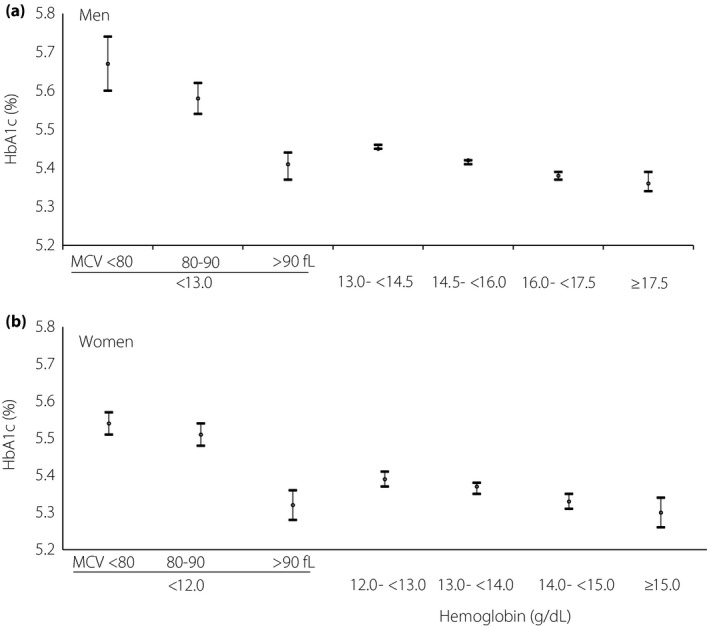
For men, 0.2% had anemia with MCV <80 fL, 0.5% had anemia with MCV 80-90 fL, 0.9% had anemia with MCV >90 fL and 98.4% had no anemia. For women, the corresponding values were 6.1, 6.4, 2.8 and 84.7%, respectively. The adjusted mean HbA1c (%) values for men with anemia with MCV <80, 80-90 and >90 fL were 5.67 (95% CI 5.60-5.74), 5.58 (95% CI 5.54-5.62) and 5.41 (95% CI 5.37-5.44), respectively. Among men without anemia, HbA1c (%) increased from 5.36 (95% CI 5.34-5.39) in those with hemoglobin ≥17.5 mg/dL to 5.45 (95% CI 5.45-5.46) in those with hemoglobin 13.0 to <14.5 mg/dL (P for trend <0.001). The HbA1c values were higher in men with anemia with MCV <80 fL or MCV 80-90 fL, but lower in men with MCV >90 fL, compared with non-anemic men with hemoglobin 13.0 to <14.5 mg/dL (All P < 0.001). Similar findings were observed in women.
We observed elevated HbA1c among anemic people with MCV <80 fL or MCV 80-90 fL, and decreased HbA1c among anemic people with MCV >90 fL, suggesting that different types of anemia might influence HbA1c differently. In addition, non-anemic people with lower hemoglobin levels had higher HbA1c levels, suggesting that hemoglobin levels are in need of consideration when interpreting HbA1c values among non-anemic people.
目的/引言:我们研究了血红蛋白 A1c(HbA1c)与贫血之间的关系,贫血根据平均红细胞体积(MCV)分为三组,同时还研究了非贫血人群中血红蛋白在 HbA1c 范围内的关系。
我们使用了 2016 年来自 36422 名无糖尿病工人的健康检查数据。根据 MCV 将贫血患者分为三组:<80、80-90 和 >90 fL。非贫血患者根据其血红蛋白水平分为四组。我们进行了多元线性回归模型,以估计 HbA1c 的平均值和 95%置信区间(CI)。
男性中,0.2%的人有 MCV<80 fL 的贫血,0.5%的人有 MCV 80-90 fL 的贫血,0.9%的人有 MCV>90 fL 的贫血,98.4%的人没有贫血。女性的相应值分别为 6.1%、6.4%、2.8%和 84.7%。MCV<80、80-90 和 >90 fL 的贫血男性的调整后平均 HbA1c(%)值分别为 5.67(95%CI 5.60-5.74)、5.58(95%CI 5.54-5.62)和 5.41(95%CI 5.37-5.44)。在非贫血男性中,HbA1c(%)从血红蛋白≥17.5mg/dL 的 5.36(95%CI 5.34-5.39)增加到血红蛋白 13.0 至<14.5mg/dL 的 5.45(95%CI 5.45-5.46)(P<0.001)。与血红蛋白 13.0 至<14.5mg/dL 的非贫血男性相比,MCV<80 fL 或 MCV 80-90 fL 的贫血男性的 HbA1c 值更高,而 MCV>90 fL 的贫血男性的 HbA1c 值更低(所有 P<0.001)。在女性中也观察到了类似的发现。
我们观察到 MCV<80 fL 或 MCV 80-90 fL 的贫血患者的 HbA1c 升高,MCV>90 fL 的贫血患者的 HbA1c 降低,这表明不同类型的贫血可能会对 HbA1c 产生不同的影响。此外,血红蛋白水平较低的非贫血患者的 HbA1c 水平较高,这表明在解释非贫血人群的 HbA1c 值时,需要考虑血红蛋白水平。