Institute of Molecular, Cell and Systems Biology, College of Medical, Veterinary and Life Sciences, University of Glasgow, Glasgow G12 8QQ, UK.
Huntington's Disease Centre, Department of Neurodegenerative Disease, Institute of Neurology, University College London, London, UK.
EBioMedicine. 2019 Oct;48:568-580. doi: 10.1016/j.ebiom.2019.09.020. Epub 2019 Oct 10.
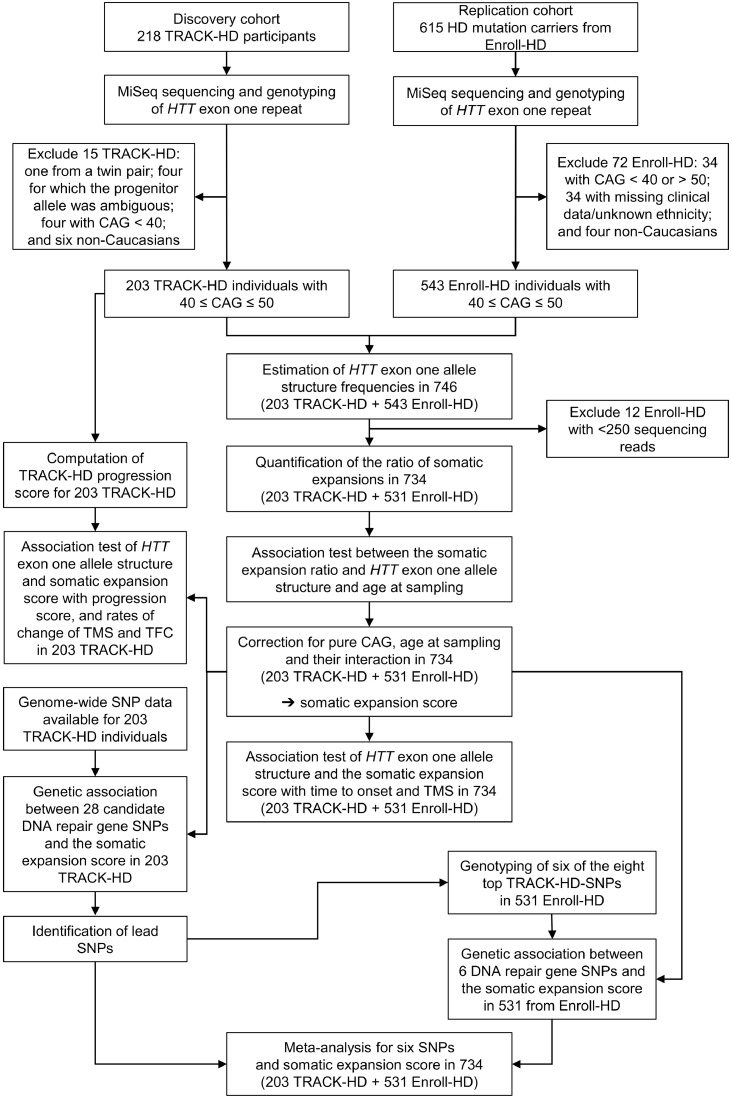
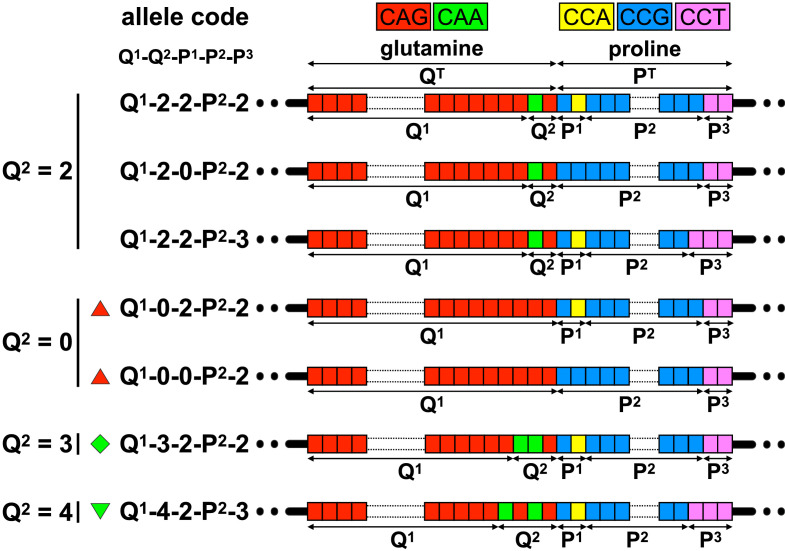
Huntington disease (HD) is caused by an unstable CAG/CAA repeat expansion encoding a toxic polyglutamine tract. Here, we tested the hypotheses that HD outcomes are impacted by somatic expansion of, and polymorphisms within, the HTT CAG/CAA glutamine-encoding repeat, and DNA repair genes.
The sequence of the glutamine-encoding repeat and the proportion of somatic CAG expansions in blood DNA from participants inheriting 40 to 50 CAG repeats within the TRACK-HD and Enroll-HD cohorts were determined using high-throughput ultra-deep-sequencing. Candidate gene polymorphisms were genotyped using kompetitive allele-specific PCR (KASP). Genotypic associations were assessed using time-to-event and regression analyses.
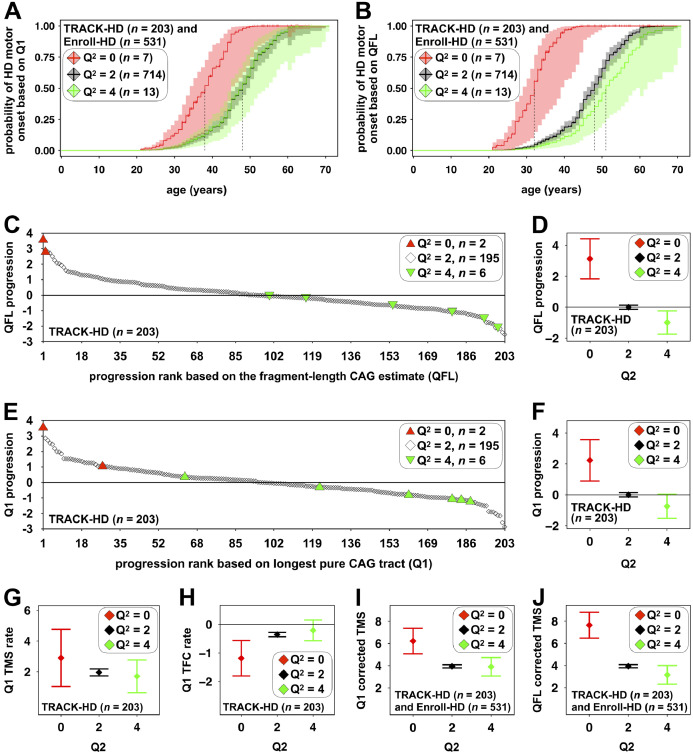
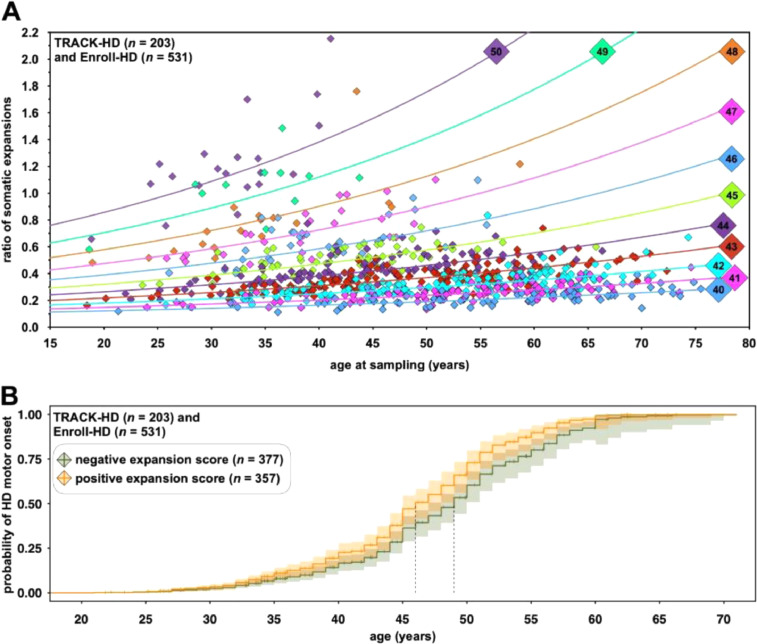
Using data from 203 TRACK-HD and 531 Enroll-HD participants, we show that individuals with higher blood DNA somatic CAG repeat expansion scores have worse HD outcomes: a one-unit increase in somatic expansion score was associated with a Cox hazard ratio for motor onset of 3·05 (95% CI = 1·94 to 4·80, p = 1·3 × 10). We also show that individual-specific somatic expansion scores are associated with variants in FAN1 (pFDR = 4·8 × 10), MLH3 (pFDR = 8·0 × 10), MLH1 (pFDR = 0·004) and MSH3 (pFDR = 0·009). We also show that HD outcomes are best predicted by the number of pure CAGs rather than total encoded-glutamines.
These data establish pure CAG length, rather than encoded-glutamine, as the key inherited determinant of downstream pathophysiology. These findings have implications for HD diagnostics, and support somatic expansion as a mechanistic link for genetic modifiers of clinical outcomes, a driver of disease, and potential therapeutic target in HD and related repeat expansion disorders.
CHDI Foundation.
亨廷顿病(HD)是由不稳定的 CAG/CAA 重复扩展引起的,该重复扩展编码有毒的多谷氨酰胺片段。在这里,我们检验了以下假设,即 HD 结果受到 HTT CAG/CAA 谷氨酰胺编码重复和 DNA 修复基因的体细胞扩展和多态性的影响。
使用高通量超深度测序确定来自 TRACK-HD 和 Enroll-HD 队列中遗传 40 至 50 个 CAG 重复的参与者血液 DNA 中谷氨酰胺编码重复的序列和体细胞 CAG 扩展的比例。使用竞争性等位基因特异性 PCR (KASP) 对候选基因多态性进行基因分型。使用时间事件和回归分析评估基因型相关性。
使用来自 203 名 TRACK-HD 和 531 名 Enroll-HD 参与者的数据,我们表明,血液 DNA 体细胞 CAG 重复扩展评分较高的个体 HD 结果较差:体细胞扩展评分增加一个单位与运动发病的 Cox 风险比为 3.05(95%CI=1.94 至 4.80,p=1.3×10)。我们还表明,个体特异性体细胞扩展评分与 FAN1(pFDR=4.8×10)、MLH3(pFDR=8.0×10)、MLH1(pFDR=0.004)和 MSH3(pFDR=0.009)的变体相关。我们还表明,HD 结果最好由纯 CAG 数而不是编码谷氨酰胺来预测。
这些数据确定了纯 CAG 长度而不是编码谷氨酰胺,作为下游病理生理学的关键遗传决定因素。这些发现对 HD 诊断具有影响,并支持体细胞扩展作为遗传修饰物对临床结果的机制联系,是疾病的驱动因素,也是 HD 和相关重复扩展障碍的潜在治疗靶点。
CHDI 基金会。