Department of Biomedical Engineering, Nancy E. and Peter C. Meinig School of Biomedical Engineering, Cornell University, Ithaca, New York.
Department of Chemical and Biomolecular Engineering, Robert Frederick Smith School of Chemical and Biomolecular Engineering, Cornell University, Ithaca, New York.
Biotechnol Bioeng. 2020 Feb;117(2):486-497. doi: 10.1002/bit.27188. Epub 2019 Nov 25.
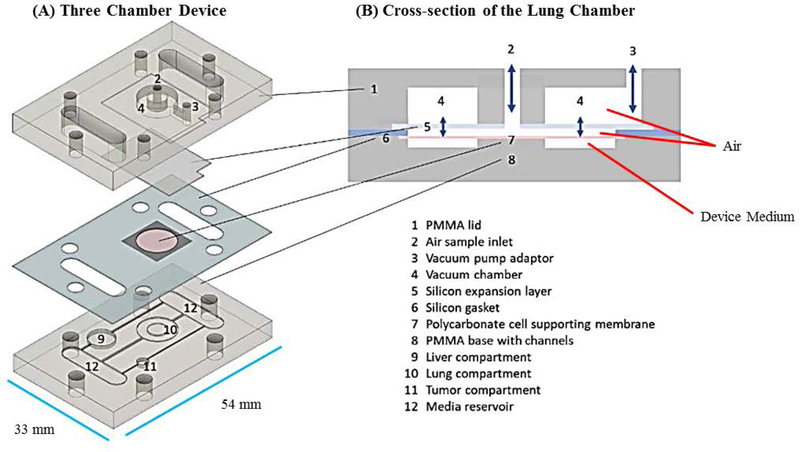
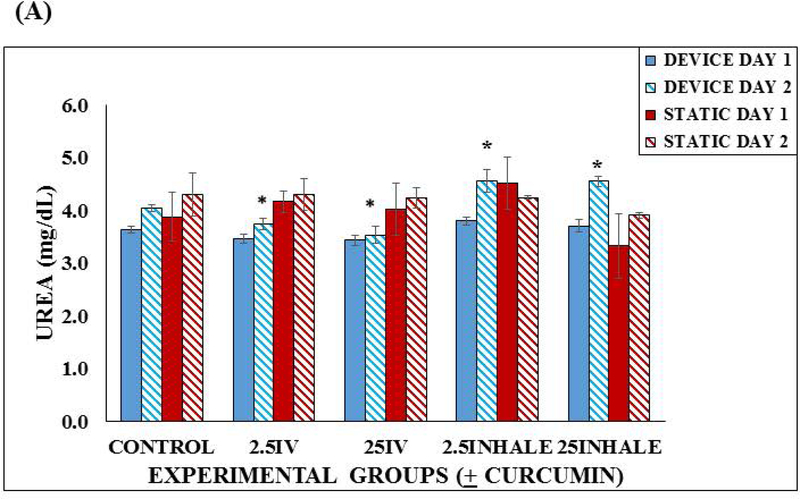
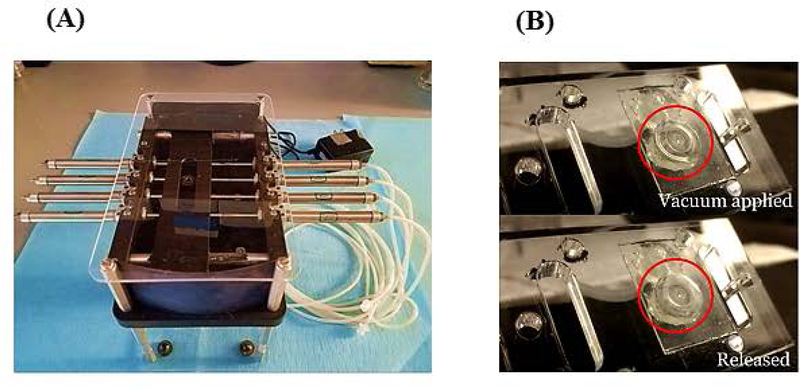
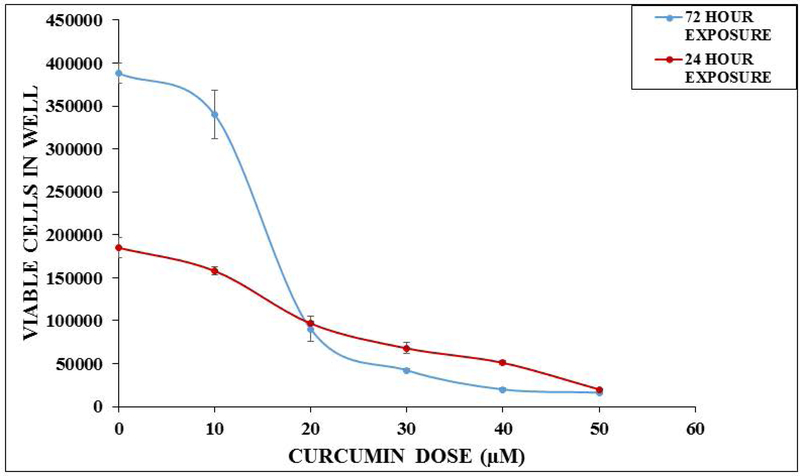
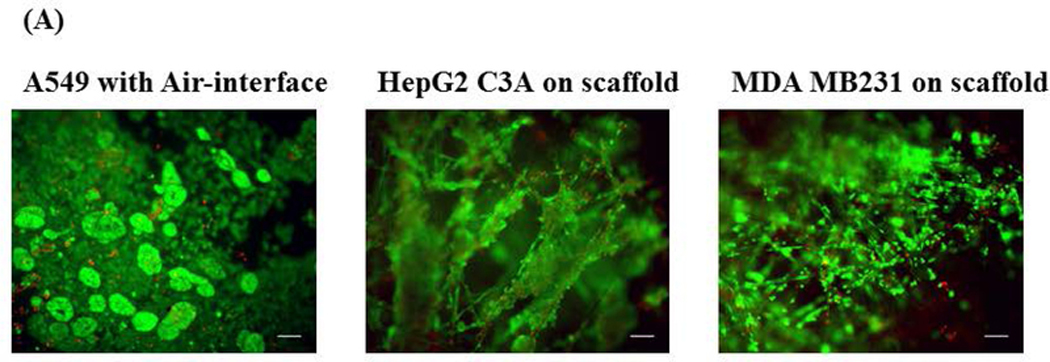
Efficient and economical delivery of pharmaceuticals to patients is critical for effective therapy. Here we describe a multiorgan (lung, liver, and breast cancer) microphysiological system ("Body-on-a-Chip") designed to mimic both inhalation therapy and/or intravenous therapy using curcumin as a model drug. This system is "pumpless" and self-contained using a rocker platform for fluid (blood surrogate) bidirectional recirculation. Our lung chamber is constructed to maintain an air-liquid interface and contained a "breathable" component that was designed to mimic breathing by simulating gas exchange, contraction and expansion of the "lung" using a reciprocating pump. Three cell lines were used: A549 for the lung, HepG2 C3A for the liver, and MDA MB231 for breast cancer. All cell lines were maintained with high viability (>85%) in the device for at least 48 hr. Curcumin is used to treat breast cancer and this allowed us to compare inhalation delivery versus intravenous delivery of the drug in terms of effectiveness and potentially toxicity. Inhalation therapy could be potentially applied at home by the patient while intravenous therapy would need to be applied in a clinical setting. Inhalation therapy would be more economical and allow more frequent dosing with a potentially lower level of drug. For 24 hr exposure to 2.5 and 25 µM curcumin in the flow device the effect on lung and liver viability was small to insignificant, while there was a significant decrease in viability of the breast cancer (to 69% at 2.5 µM and 51% at 25 µM). Intravenous delivery also selectively decreased breast cancer viability (to 88% at 2.5 µM and 79% at 25 µM) but was less effective than inhalation therapy. The response in the static device controls was significantly reduced from that with recirculation demonstrating the effect of flow. These results demonstrate for the first time the feasibility of constructing a multiorgan microphysiological system with recirculating flow that incorporates a "breathable" lung module that maintains an air-liquid interface.
有效且经济地将药物递送给患者对于有效的治疗至关重要。在这里,我们描述了一种多器官(肺、肝和乳腺癌)微生理系统(“芯片上的器官”),旨在使用姜黄素作为模型药物模拟吸入治疗和/或静脉治疗。该系统是“无泵”的,使用摇床平台实现流体(血液替代物)双向再循环,自成一体。我们的肺室构造为维持气液界面,并包含一个“透气”组件,该组件旨在通过模拟气体交换、使用往复泵模拟“肺”的收缩和扩张来模拟呼吸。使用了三种细胞系:A549 用于肺,HepG2 C3A 用于肝,MDA MB231 用于乳腺癌。所有细胞系在装置中至少 48 小时保持高活力(>85%)。姜黄素用于治疗乳腺癌,这使我们能够比较药物的吸入治疗与静脉治疗在有效性和潜在毒性方面的差异。吸入治疗可能由患者在家中进行,而静脉治疗则需要在临床环境中进行。吸入治疗将更加经济实惠,并允许更频繁地给药,药物水平可能更低。在流动装置中暴露于 2.5 和 25 μM 姜黄素 24 小时,对肺和肝活力的影响很小或无意义,而乳腺癌活力显著下降(2.5 μM 时为 69%,25 μM 时为 51%)。静脉输送也选择性地降低了乳腺癌活力(2.5 μM 时为 88%,25 μM 时为 79%),但不如吸入治疗有效。与再循环相比,静态装置对照的反应明显降低,证明了流动的效果。这些结果首次证明了构建具有再循环流动的多器官微生理系统的可行性,该系统包含维持气液界面的“透气”肺模块。