Cardiology Department, First Affiliated Hospital of Sun Yat-sen University, Guangzhou, China.
NHC Key Laboratory of Assisted Circulation, Sun Yat-sen University, Guangzhou, China.
Clin Cardiol. 2019 Dec;42(12):1170-1180. doi: 10.1002/clc.23275. Epub 2019 Oct 14.
Dual antiplatelet therapy (DAPT) in the form of aspirin plus a P Y inhibitor, when indicated, is one of the key treatments in coronary artery disease (CAD). Many recommendations on DAPT in patients with CAD based on current guidelines are largely inconsistent. In our current study, we aimed at systematically reviewing DAPT-relevant clinical practice guidelines, and highlighting their commonalities and differences for better informed decision-making.
Contemporary guidelines in English were searched in MEDLINE, Embase and websites of guideline organizations and professional societies. Guidelines with recommendations on DAPT for CAD patients were included. Guideline quality was appraised with the 6-domain Appraisal of Guidelines for Research and Evaluation II (AGREE II) instrument. The reporting of conflicts of interest (COI) was assessed individually with supplementary items from the RIGHT (Reporting Item for Practice Guidelines in Healthcare) checklist. Meanwhile, extraction of recommendations was performed.
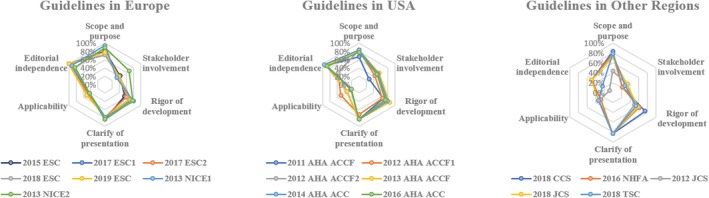
A total of 18 guidelines fulfilled our inclusion criteria. Most of them were graded with relatively good scores averaging from 42% to 74%. Domains for lower scores were in "stakeholder involvement" and "application." The reporting of COI was satisfactory. For the recommendations on DAPT, most guidelines with high AGREE II scores included consistent recommendations on the timing and P Y inhibitor selection. Nonetheless, conflicts still exist on the duration of DAPT.
Quality of guidelines for DAPT in CAD was relatively high, though defects existed in "Applicability" and "Stakeholder Involvement." As these guidelines developed, DAPT recommendations gradually converged on a consensus. Clinical decision should be made on an individual basis.
双联抗血小板治疗(DAPT)形式为阿司匹林加 P Y 抑制剂,在有指征时,是冠心病(CAD)的关键治疗之一。许多基于当前指南的 CAD 患者 DAPT 相关建议在很大程度上不一致。在我们目前的研究中,我们旨在系统地回顾 DAPT 相关的临床实践指南,并强调它们的共同点和差异,以便做出更明智的决策。
在 MEDLINE、Embase 和指南组织及专业协会的网站上搜索英文当代指南。纳入了针对 CAD 患者 DAPT 的推荐指南。使用 6 个领域评估指南研究与评价 II (AGREE II)工具评估指南质量。使用RIGHT(医疗保健实践指南报告项目)清单的补充项目单独评估利益冲突(COI)的报告情况。同时,提取推荐意见。
共有 18 项指南符合我们的纳入标准。它们中的大多数评分相对较高,平均得分为 42%至 74%。得分较低的领域是“利益相关者参与”和“应用”。COI 的报告令人满意。对于 DAPT 的推荐意见,大多数具有较高 AGREE II 评分的指南包括关于时机和 P Y 抑制剂选择的一致建议。然而,DAPT 的持续时间仍存在冲突。
CAD 中 DAPT 指南的质量相对较高,尽管在“适用性”和“利益相关者参与”方面存在缺陷。随着这些指南的发展,DAPT 建议逐渐达成共识。临床决策应根据个体情况做出。