Sadanandan Nadia, Di Santo Stefano, Widmer Hans Rudolf
Department of Neurosurgery and Brain Repair, College of Medicine, University of South Florida Morsani, Tampa, FL, USA.
Department of Neurosurgery, Neurocenter and Regenerative Neuroscience Cluster, Inselspital, Bern University Hospital, University of Bern, Bern, Switzerland.
Brain Circ. 2019 Sep 30;5(3):106-111. doi: 10.4103/bc.bc_41_19. eCollection 2019 Jul-Sep.
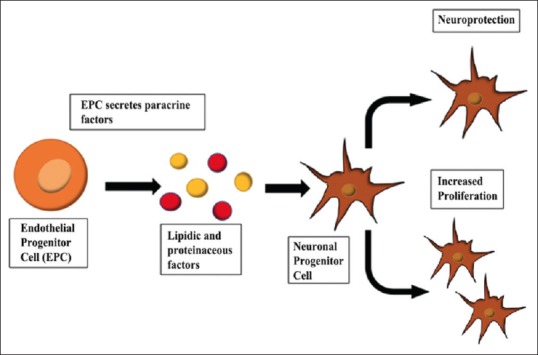
Progress in stem cell research demonstrates stem cells' potential for treating neurodegenerative diseases. Stem cells have proliferative/differentiative properties and produce a variety of paracrine factors that can potentially be used to regenerate nervous tissue. Previous studies have shown the positive regenerative effects of endothelial progenitor cells (EPCs), and thus, they may be used as a tool for regeneration. A study by Di Santo . explored whether EPC-derived conditioned medium (EPC-CM) promotes the survival of cultured striatal progenitor cells and attempted to find the paracrine factors and signaling pathways involved with EPC-CM's effects. The neuronal progenitor cells that were cultured with EPC-CM had much higher densities of GABA-immunoreactive (GABA-ir) neurons. It was shown that phosphatidylinositol-3-kinase/AKT and mitogen-activated protein kinase/ERK signaling pathways are involved in the proliferation of GABAergic neurons, as inhibition of these pathways decreased GABAergic densities. In addition, the results suggest that paracrine factors from EPC, both proteinaceous and lipidic, significantly elevated the viability and/or differentiation in the cultures. Importantly, it was found that EPC-CM provided neuroprotection against toxins from 3-nitropropionic acid. In sum, EPC-CM engendered proliferation and regeneration of the cultured striatal cells through paracrine factors and imparted neuroprotection. Furthermore, the effects of EPC-CM may generate a cell-free therapeutic strategy to address neurodegeneration.
干细胞研究的进展表明了干细胞在治疗神经退行性疾病方面的潜力。干细胞具有增殖/分化特性,并产生多种旁分泌因子,这些因子有可能用于神经组织的再生。先前的研究已经显示了内皮祖细胞(EPCs)的积极再生作用,因此,它们可用作再生工具。迪·桑托的一项研究探讨了EPC衍生的条件培养基(EPC-CM)是否能促进培养的纹状体祖细胞的存活,并试图找出与EPC-CM作用相关的旁分泌因子和信号通路。用EPC-CM培养的神经元祖细胞中,GABA免疫反应性(GABA-ir)神经元的密度要高得多。结果表明,磷脂酰肌醇-3-激酶/AKT和丝裂原活化蛋白激酶/ERK信号通路参与了GABA能神经元的增殖,因为抑制这些通路会降低GABA能密度。此外,结果表明,EPC的旁分泌因子,包括蛋白质类和脂质类,显著提高了培养物中的活力和/或分化。重要的是,发现EPC-CM对3-硝基丙酸毒素具有神经保护作用。总之,EPC-CM通过旁分泌因子促进了培养的纹状体细胞的增殖和再生,并赋予了神经保护作用。此外,EPC-CM的作用可能会产生一种无细胞治疗策略来解决神经退行性变问题。