Sun Hui, Wang Huishan, Xu Ningze, Li Junling, Shi Jufang, Zhou Naitong, Ni Ming, Hu Xianzhi, Chen Yingyao
Key Lab of Health Technology Assessment, National Health Commission, School of Public Health, Fudan University, Shanghai, People's Republic of China.
Department of Health Technology Assessment Research, Shanghai Health Development Research Center, Shanghai Medical Information Center, Shanghai, People's Republic of China.
Patient Prefer Adherence. 2019 Oct 8;13:1701-1709. doi: 10.2147/PPA.S224529. eCollection 2019.
The study aims to quantify patients' risk-benefit preferences for chemotherapy in the treatment of non-small cell lung cancer (NSCLC), and to elicit their willingness to pay (WTP) for treatment outcomes.
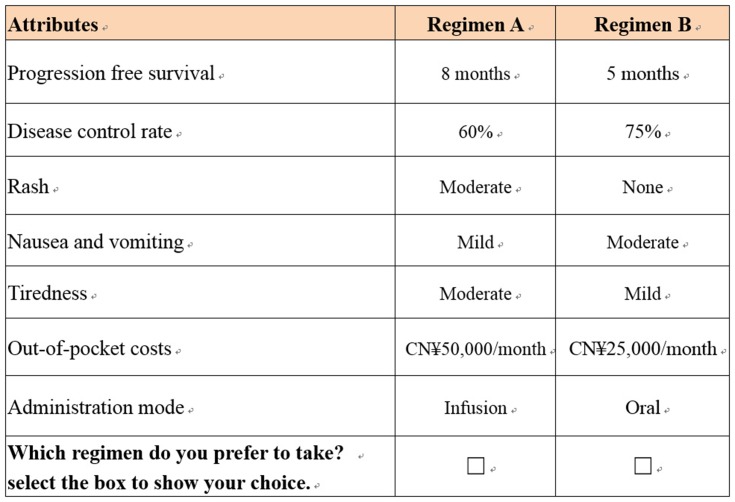
A face-to-face discrete choice experiment (DCE) was conducted on NSCLC patients in four tertiary hospitals each from Beijing, Shanghai, Guangzhou and Chengdu in China. Patients were invited to complete choice questions that constructed by seven attributes: progression-free survival (PFS), disease control rate (DCR), rash, nausea and vomiting, tiredness, mode of administration and out-of-pocket costs. A mixed logit model was used to evaluate the choice model. Estimates of relative preferences and marginal willingness to pay for each attribute were then explored.
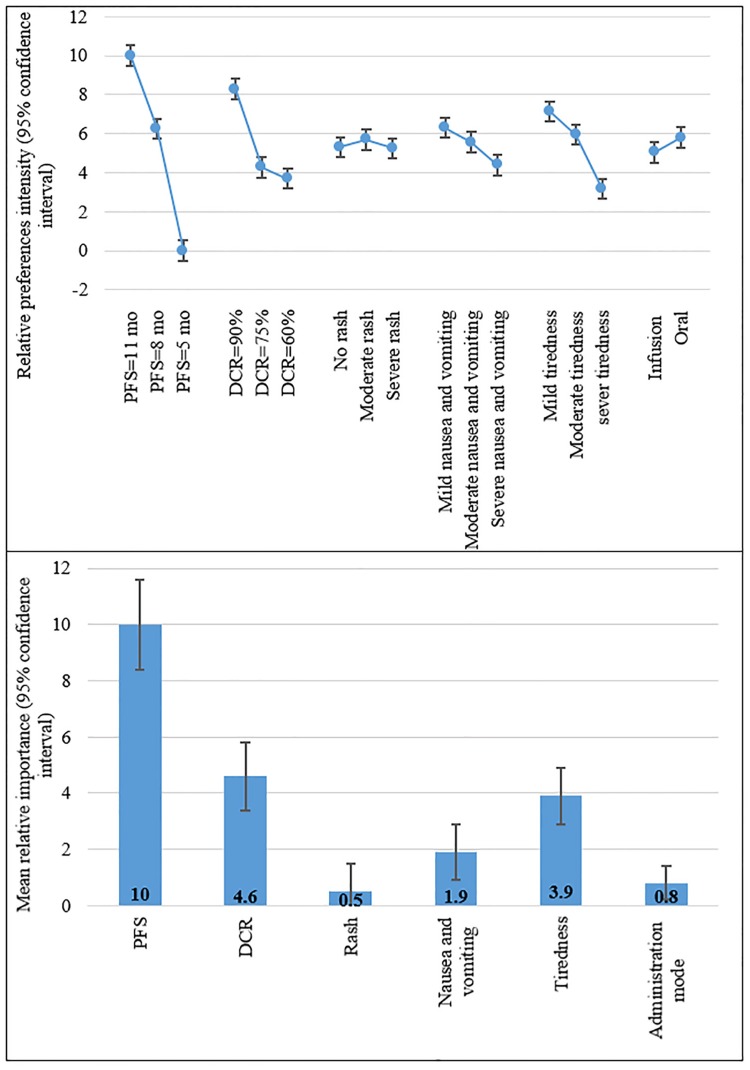
A total of 361 patients completed the survey. Improvements in PFS (10, 95% CI: 8.4-11.6) were the most important attribute for patients, followed by increase in DCR (4.6, 95% CI: 3.4-5.8). Tiredness (3.9, 95% CI: 2.9-5.1) was judged to be the most important risk. While remaining attributes were ranked in decreasing order of importance: nausea and vomiting (1.9, 95% CI: 0.9-3.0), mode of administration (0.8, 95% CI: 0.2-1.4) and rash (0.5, 95% CI: -0.6-1.5). There was little variation in preferences among patients with different sociodemographic characteristics. Patients were monthly willing to pay $2304 (95% CI, $1916-$2754) that guaranteed 11 months of PFS, followed by $1465 (95% CI, $1163-$1767) per month to improve their disease control rate by 90%.
The results suggested that efficacy was the most important attribute for patients. Side effects, mode of administration and treatment cost significantly influenced patient preferences. Patient engagement in prioritizing their treatment preferences should be emphasized during the clinical decision-making process and regimen implementation.
本研究旨在量化患者在非小细胞肺癌(NSCLC)治疗中对化疗的风险效益偏好,并了解他们对治疗结果的支付意愿(WTP)。
在中国北京、上海、广州和成都的四家三级医院对NSCLC患者进行了面对面的离散选择实验(DCE)。邀请患者完成由七个属性构成的选择问题:无进展生存期(PFS)、疾病控制率(DCR)、皮疹、恶心和呕吐、疲劳、给药方式和自付费用。使用混合逻辑模型评估选择模型。然后探讨每个属性的相对偏好估计值和边际支付意愿。
共有361名患者完成了调查。PFS的改善(10,95%CI:8.4-11.6)是患者最重要的属性,其次是DCR的提高(4.6,95%CI:3.4-5.8)。疲劳(3.9,95%CI:2.9-5.1)被认为是最重要的风险。其余属性按重要性从高到低排序为:恶心和呕吐(1.9,95%CI:0.9-3.0)、给药方式(0.8,95%CI:0.2-1.4)和皮疹(0.5,95%CI:-0.6-1.5)。不同社会人口统计学特征的患者之间偏好差异不大。患者每月愿意支付2304美元(95%CI,1916-2754美元)以保证11个月的PFS,其次是每月支付1465美元(95%CI,1163-1767美元)以将疾病控制率提高90%。
结果表明,疗效是患者最重要的属性。副作用、给药方式和治疗成本显著影响患者偏好。在临床决策过程和治疗方案实施过程中,应强调患者参与确定其治疗偏好的优先级。