Department of Radiation Oncology, Korea University Guro Hospital, Korea University College of Medicine, Seoul, South Korea.
Division of Pulmonary and Critical Care Medicine, Department of Medicine, Samsung Medical Center, Sungkyunkwan University School of Medicine, Seoul, South Korea.
Int J Chron Obstruct Pulmon Dis. 2019 Oct 4;14:2273-2281. doi: 10.2147/COPD.S210759. eCollection 2019.
Current guidelines recommend definitive radiotherapy for patients with medically inoperable early-stage non-small cell lung cancer (NSCLC). However, the impact of underlying pulmonary diseases on survival in those patients remains unclear.
We retrospectively reviewed the medical records of 234 patients with stage I-II NSCLC treated with definitive radiotherapy alone at Samsung Medical Center between January 2010 and October 2017. We compared survival outcomes according to the presence of underlying pulmonary diseases, including chronic obstructive pulmonary disease (COPD), combined pulmonary fibrosis and emphysema (CPFE), and idiopathic pulmonary fibrosis (IPF). The control group in this study was stage I-II NSCLC patients who were non-COPD, non-CPFE, and non-IPF.
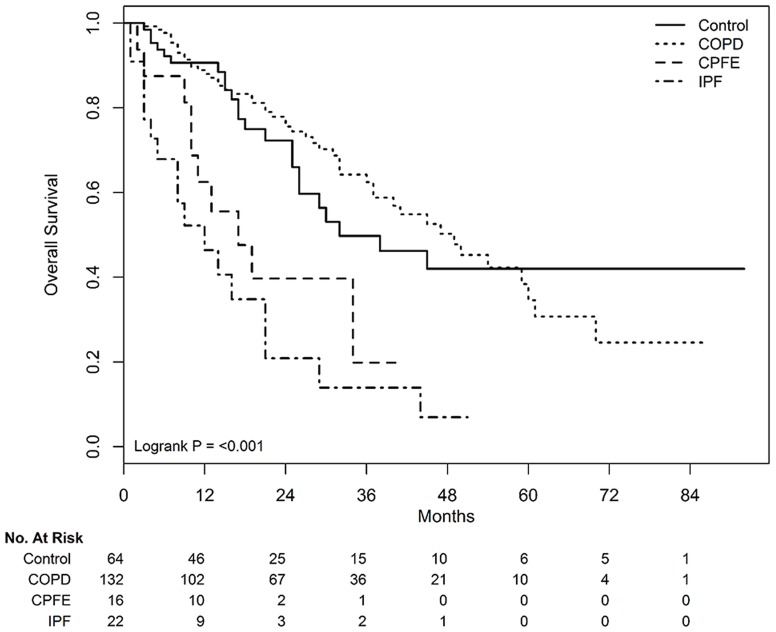
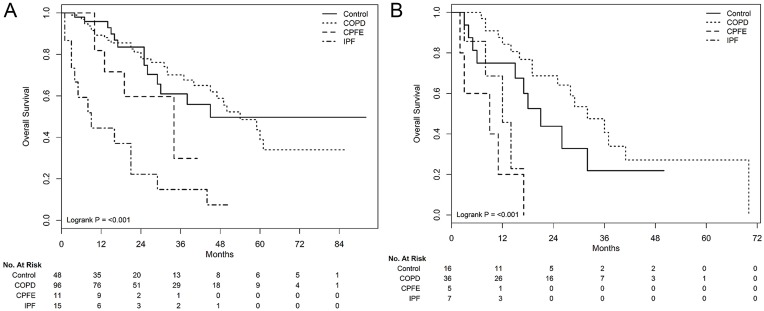
The median follow-up duration was 17 (range, 1-92) months. The median survival times of the control, COPD, CPFE, and IPF groups were 32, 49, 17, and 12 months, respectively (<0.001). In a Cox proportional hazards analysis for factors associated with overall survival, patients with COPD showed a similar risk of death (adjusted hazard ratio [HR], 1.306; 95% confidence interval [CI], 0.723-2.358; =0.376) compared to that of the control group, while patients with CPFE (adjusted HR, 3.382; 95% CI, 1.472-7.769; =0.004) and IPF (adjusted HR, 4.061; 95% CI, 1.963-8.403; <0.001) showed an increased risk of death.
Definitive radiotherapy may be a tolerable treatment for early-stage NSCLC with COPD. However, poor survival in early-stage NSCLC patients with IPF or CPFE requires further study to identify and develop patient selection criteria as well as an optimal radiotherapy modality.
目前的指南建议对不能手术的早期非小细胞肺癌(NSCLC)患者进行确定性放疗。然而,基础肺部疾病对这些患者生存的影响仍不清楚。
我们回顾性分析了 2010 年 1 月至 2017 年 10 月期间在三星医疗中心单独接受根治性放疗的 234 例 I 期-II 期 NSCLC 患者的病历。我们根据基础肺部疾病的存在情况比较了生存结果,包括慢性阻塞性肺疾病(COPD)、肺纤维化合并肺气肿(CPFE)和特发性肺纤维化(IPF)。本研究的对照组为非 COPD、非 CPFE 和非 IPF 的 I 期-II 期 NSCLC 患者。
中位随访时间为 17 个月(范围为 1-92 个月)。对照组、COPD 组、CPFE 组和 IPF 组的中位生存时间分别为 32、49、17 和 12 个月(<0.001)。在与总生存相关的因素的 Cox 比例风险分析中,COPD 患者的死亡风险相似(调整后的风险比[HR],1.306;95%置信区间[CI],0.723-2.358;=0.376),而 CPFE(调整后的 HR,3.382;95%CI,1.472-7.769;=0.004)和 IPF(调整后的 HR,4.061;95%CI,1.963-8.403;<0.001)患者的死亡风险增加。
对于 COPD 的早期 NSCLC,根治性放疗可能是一种可耐受的治疗方法。然而,IPF 或 CPFE 的早期 NSCLC 患者的生存状况较差,需要进一步研究以确定和制定患者选择标准以及最佳放疗方式。