
一种用于预测胶质母细胞瘤患者的新型转录因子预后特征
A Novel Prognostic Signature of Transcription Factors for the Prediction in Patients With GBM.
作者信息
Cheng Quan, Huang Chunhai, Cao Hui, Lin Jinhu, Gong Xuan, Li Jian, Chen Yuanbing, Tian Zhi, Fang Zhenyu, Huang Jun
机构信息
Department of Neurosurgery, Xiangya Hospital, Central South University, Changsha, China.
Department of Neurosurgery, First Affiliated Hospital of Jishou University, Jishou, China.
出版信息
Front Genet. 2019 Oct 1;10:906. doi: 10.3389/fgene.2019.00906. eCollection 2019.
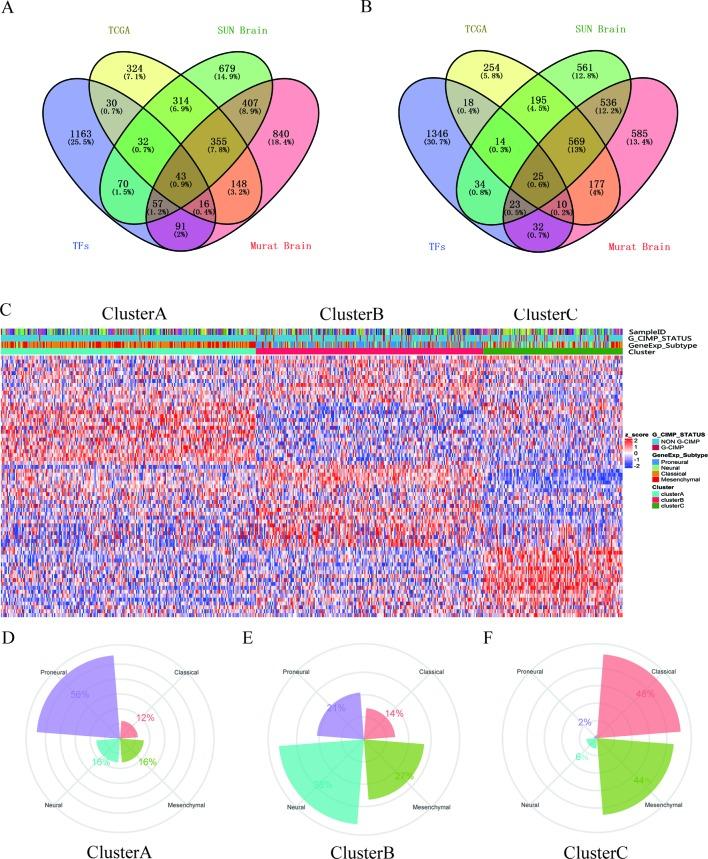
: Although the diagnosis and treatment of glioblastoma (GBM) is significantly improved with recent progresses, there is still a large heterogeneity in therapeutic effects and overall survival. The aim of this study is to analyze gene expressions of transcription factors (TFs) in GBM so as to discover new tumor markers. : Differentially expressed TFs are identified by data mining using public databases. The GBM transcriptome profile is downloaded from The Cancer Genome Atlas (TCGA). The nonnegative matrix factorization (NMF) method is used to cluster the differentially expressed genes to discover hub genes and signal pathways. The TFs affecting the prognosis of GBM are screened by univariate and multivariate COX regression analysis, and the receiver operating characteristic (ROC) curve is determined. The GBM hazard model and nomogram map are constructed by integrating the clinical data. Finally, the TFs involving potential signaling pathways in GBM are screened by Gene Set Enrichment Analysis (GSEA), Gene Ontology (GO), and Kyoto Encyclopedia of Genes and Genomes (KEGG) enrichment analysis. : There are 68 differentially expressed TFs in GBM, of which 43 genes are upregulated and 25 genes are downregulated. NMF clustering analysis suggested that GBM patients are divided into three groups: Clusters A, B, and C. LHX2, MEOX2, SNAI2, and ZNF22 are identified from the above differential genes by univariate/multivariate regression analysis. The risk score of those four genes are calculated based on the beta coefficient of each gene, and we found that the predictive ability of the risk score gradually increased with the prolonged predicted termination time by time-dependent ROC curve analysis. The nomogram results have showed that the integration of risk score, age, gender, chemotherapy, radiotherapy, and 1p/19q can further improve predictive ability towards the survival of GBM. The pathways in cancer, phosphoinositide 3-kinases (PI3K)-Akt signaling, Hippo signaling, and proteoglycans, are highly enriched in high-risk groups by GSEA. These genes are mainly involved in cell migration, cell adhesion, epithelial-mesenchymal transition (EMT), cell cycle, and other signaling pathways by GO and KEGG analysis. : The four-factor combined scoring model of LHX2, MEOX2, SNAI2, and ZNF22 can precisely predict the prognosis of patients with GBM.
尽管随着近期的进展,胶质母细胞瘤(GBM)的诊断和治疗有了显著改善,但治疗效果和总生存期仍存在很大的异质性。本研究的目的是分析GBM中转录因子(TFs)的基因表达,以发现新的肿瘤标志物。
通过使用公共数据库进行数据挖掘来识别差异表达的TFs。从癌症基因组图谱(TCGA)下载GBM转录组图谱。使用非负矩阵分解(NMF)方法对差异表达基因进行聚类,以发现核心基因和信号通路。通过单因素和多因素COX回归分析筛选影响GBM预后的TFs,并确定受试者工作特征(ROC)曲线。通过整合临床数据构建GBM风险模型和列线图。最后,通过基因集富集分析(GSEA)、基因本体(GO)和京都基因与基因组百科全书(KEGG)富集分析筛选GBM中涉及潜在信号通路的TFs。
GBM中有68个差异表达的TFs,其中43个基因上调,25个基因下调。NMF聚类分析表明GBM患者分为三组:A组、B组和C组。通过单因素/多因素回归分析从上述差异基因中鉴定出LHX2、MEOX2、SNAI2和ZNF22。根据每个基因的β系数计算这四个基因的风险评分,通过时间依赖性ROC曲线分析发现风险评分的预测能力随着预测终止时间的延长而逐渐增加。列线图结果表明,风险评分、年龄、性别、化疗、放疗和1p/19q的整合可以进一步提高对GBM生存的预测能力。通过GSEA分析,癌症、磷酸肌醇3激酶(PI3K)-Akt信号通路、Hippo信号通路和蛋白聚糖等通路在高危组中高度富集。通过GO和KEGG分析,这些基因主要参与细胞迁移、细胞黏附、上皮-间质转化(EMT)、细胞周期等信号通路。
LHX2、MEOX2、SNAI2和ZNF22的四因素联合评分模型可以精确预测GBM患者的预后。



 Zotero 插件