
肝脏蛋白激酶A的抑制作用会加速肝脏中的脂质积累。
Hepatic PKA inhibition accelerates the lipid accumulation in liver.
作者信息
Yang Jining, Zhang Xiaoying, Yi Long, Yang Ling, Wang Wei Eric, Zeng Chunyu, Mi Mantian, Chen Xiongwen
机构信息
1Research Center for Nutrition and Food Safety, Chongqing Key Laboratory of Nutrition and Food Safety, Institute of Military Preventive Medicine, Third Military Medical University, Chongqing, People's Republic of China.
2Department of Physiology & Cardiovascular Research Center, Temple University Lewis Katz School of Medicine, Philadelphia, PA USA.
出版信息
Nutr Metab (Lond). 2019 Oct 11;16:69. doi: 10.1186/s12986-019-0400-5. eCollection 2019.
BACKGROUND/AIMS: Liver lipid accumulation induced by high-fat diet (HFD) is an early onset process of non-alcoholic fatty liver diseases (NAFLD). Protein kinase A (PKA) is known to be involved in hepatic lipid metabolism. However, the role of PKA in NAFLD has not been well tested in vivo due to the lack of optimal PKA deficient mouse model.
METHODS
A novel PKA-specific inhibitor gene was conditionally overexpressed in mouse (PKAi mouse) liver using LoxP/Cre system. PKA activity in the liver extract was measured with a commercial assay kit. The PKAi and control mice of 8-week age, were subjected to HFD or chow diet (CD) for 2 months. Body weight, liver index, and triglyceride in the liver were measured. RNA sequencing was performed for the liver tissues and analyzed with Gene Ontology (GO) and pathway enrichment.
RESULTS
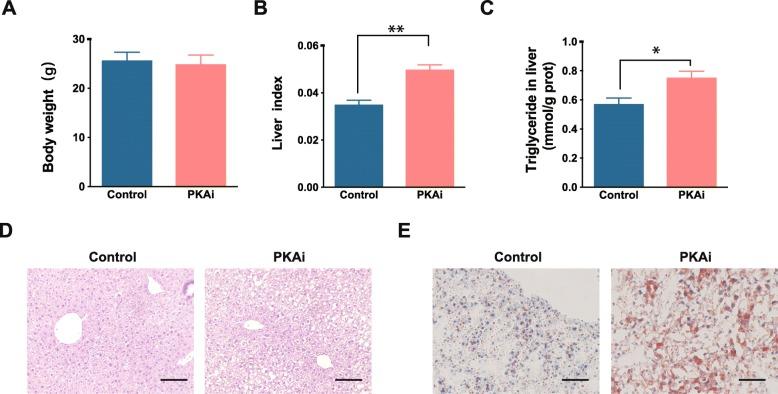
PKAi-GFP protein was overexpressed in the liver and the PKA activation was significantly inhibited in the liver of PKAi mouse. When fed with CD, RNA sequencing revealed 56 up-regulated and 51 down-regulated genes in PKAi mice compared with control mice, which were mainly involved in lipid metabolism though no significant differences in the body weight, liver index, triglyceride accumulation were observed between PKAi and control mice. However, when fed with HFD for 2 months, the liver was enlarged more, and the accumulation of triglyceride in the liver was more severe in PKAi mice. When comparing the transcriptomes of CD-fed and HFD-fed control mice, GO enrichment showed that the genes down-regulated by HFD were mainly enriched in immune-related GO terms, and up-regulated genes were enriched in metabolism. When comparing the transcriptomes of CD-fed and HFD-fed PKAi mice, GO analysis showed that the down-regulated genes were enriched in metabolism, while the up-regulated genes were clustered in ER stress-related pathways. When comparing HFD-fed PKAi and HFD-fed control mice, the genes with lower expression level in PKAi mice were enriched in the lipoprotein synthesis, which might explain that more TG is accumulated in PKAi liver after HFD feeding.
CONCLUSIONS
Reduced PKA activity could be a factor promoting the TG accumulation in the liver and the development of NAFLD.
背景/目的:高脂饮食(HFD)诱导的肝脏脂质蓄积是非酒精性脂肪性肝病(NAFLD)的早期发病过程。已知蛋白激酶A(PKA)参与肝脏脂质代谢。然而,由于缺乏理想的PKA缺陷小鼠模型,PKA在NAFLD中的作用尚未在体内得到充分验证。
方法
使用LoxP/Cre系统在小鼠(PKAi小鼠)肝脏中条件性过表达一种新型的PKA特异性抑制基因。用商业检测试剂盒测量肝脏提取物中的PKA活性。8周龄的PKAi小鼠和对照小鼠分别接受高脂饮食或普通饮食(CD)2个月。测量体重、肝脏指数和肝脏中的甘油三酯。对肝脏组织进行RNA测序,并通过基因本体论(GO)和通路富集分析。
结果
PKAi-GFP蛋白在肝脏中过表达,PKAi小鼠肝脏中的PKA激活受到显著抑制。喂食普通饮食时,RNA测序显示与对照小鼠相比,PKAi小鼠中有56个基因上调,51个基因下调,这些基因主要参与脂质代谢,尽管PKAi小鼠和对照小鼠在体重、肝脏指数、甘油三酯蓄积方面未观察到显著差异。然而,喂食高脂饮食2个月后,PKAi小鼠的肝脏肿大更明显,肝脏中甘油三酯的蓄积更严重。比较喂食普通饮食和高脂饮食的对照小鼠的转录组,GO富集分析表明,高脂饮食下调的基因主要富集在免疫相关的GO术语中,上调的基因富集在代谢中。比较喂食普通饮食和高脂饮食的PKAi小鼠的转录组,GO分析表明,下调的基因富集在代谢中,而上调的基因聚集在内质网应激相关通路中。比较喂食高脂饮食的PKAi小鼠和喂食高脂饮食的对照小鼠,PKAi小鼠中表达水平较低的基因富集在脂蛋白合成中,这可能解释了喂食高脂饮食后PKAi小鼠肝脏中积累了更多的甘油三酯。
结论
PKA活性降低可能是促进肝脏中甘油三酯蓄积和NAFLD发展的一个因素。



 Zotero 插件