Uelze Laura, Borowiak Maria, Deneke Carlus, Jacobs Cécile, Szabó István, Tausch Simon H, Malorny Burkhard
1Bundesinstitut für Risikobewertung (BfR), Max-Dohrn-Str. 8-10, 10589 Berlin, Germany.
Landeslabor Schleswig-Holstein, Max-Eyth-Straße 5, 24537 Neumünster, Germany.
Gut Pathog. 2019 Oct 14;11:48. doi: 10.1186/s13099-019-0330-9. eCollection 2019.
The subsp. serovar 61:k:1,5,(7) (SASd) has been found to be host-adapted to sheep, with a high prevalence in sheep herds worldwide. Infections are usually sub-clinical, however the serovar has the potential to cause diarrhea, abortions and chronic proliferative rhinitis. Although occurrence and significance of SASd infections in sheep have been extensively studied, the genetic mechanism underlying this unusual host-adaptation have remained unknown, due to a lack of (a) available high-quality genome sequence(s).
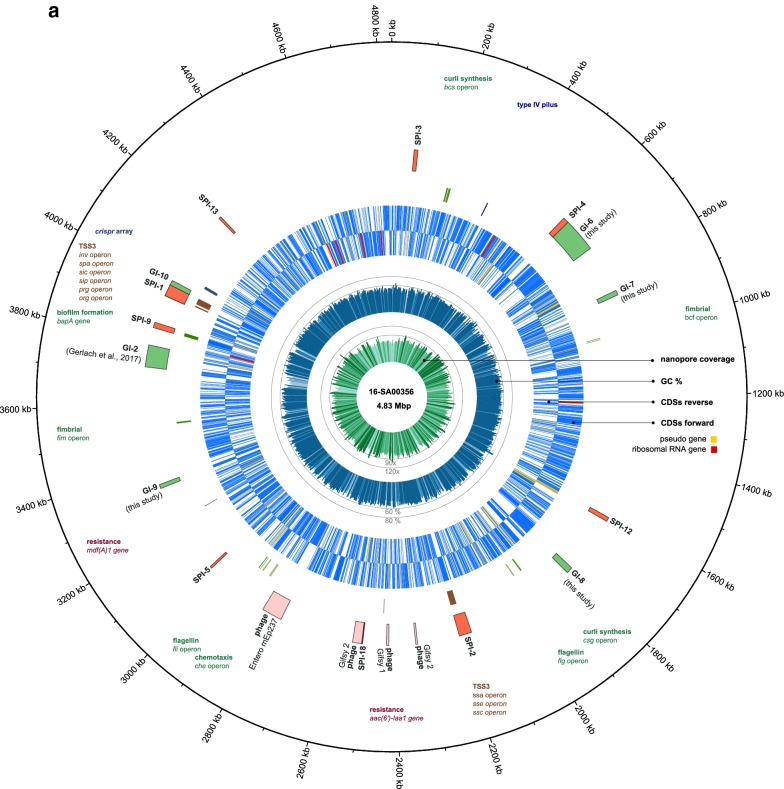
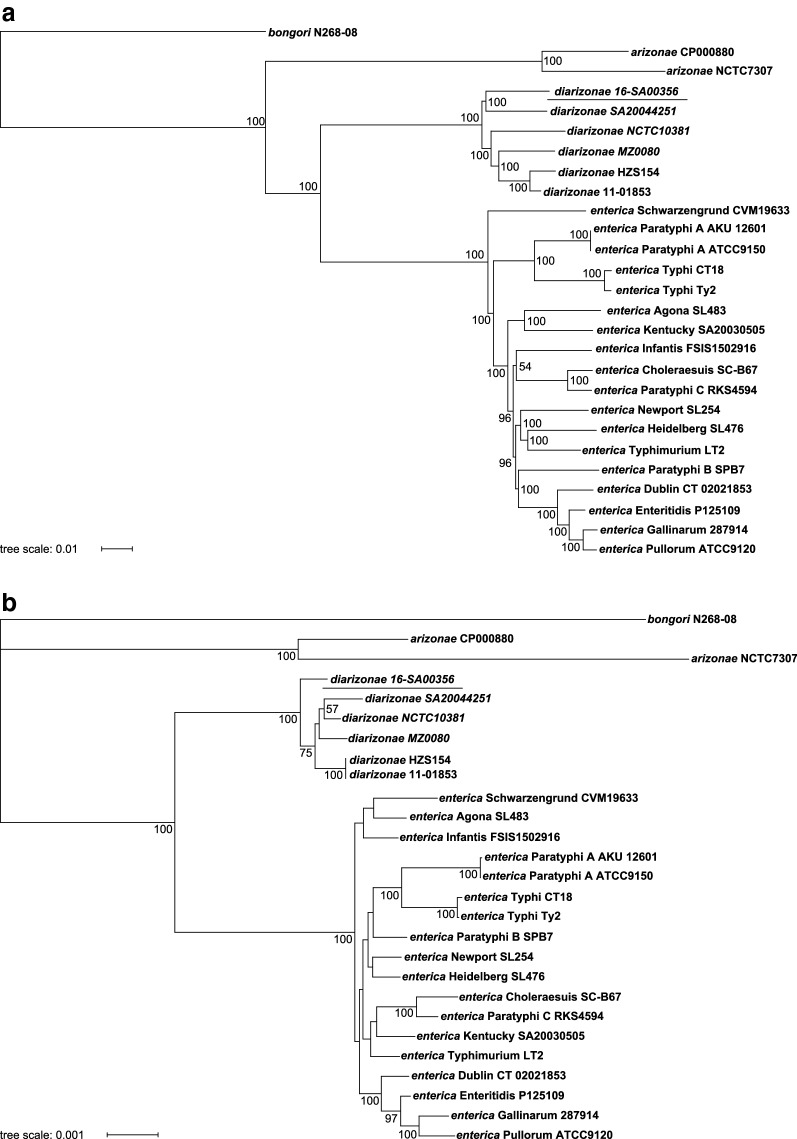
We utilized Nanopore and Illumina sequencing technologies to generate a de novo assembly of the 4.88-Mbp complete genome sequence of the SASd strain 16-SA00356, isolated from the organs of a deceased sheep in 2016. We annotated and analyzed the genome sequence with the aim to gain a deeper understanding of the genome characteristics associated with its pathogenicity and host adaptation to sheep. Overall, we found a number of interesting genomic features such as several prophage regions, a VirB4/D4 plasmid and novel genomic islands. By comparing the genome of 16-SA00356 to other serovars we found that SASd features an increased number of pseudogenes as well as a high level of genomic rearrangements, both known indicators of host-adaptation.
With this sequence, we provide the first complete and closed genome sequence of a SASd strain. With this study, we provide an important basis for an understanding of the genetic mechanism that underlie pathogenicity and host adaptation of SASd to sheep.
亚种血清型61:k:1,5,(7)(SASd)已被发现适应绵羊宿主,在全球绵羊群中具有高流行率。感染通常为亚临床感染,然而该血清型有导致腹泻、流产和慢性增生性鼻炎的可能性。尽管对绵羊中SASd感染的发生情况及其重要性已进行了广泛研究,但由于缺乏可用的高质量基因组序列,这种不寻常的宿主适应性背后的遗传机制仍不清楚。
我们利用纳米孔和Illumina测序技术,对2016年从一只死亡绵羊的器官中分离出的SASd菌株16-SA00356的4.88-Mbp完整基因组序列进行了从头组装。我们对基因组序列进行了注释和分析,目的是更深入地了解与其致病性和对绵羊的宿主适应性相关的基因组特征。总体而言,我们发现了一些有趣的基因组特征,如几个前噬菌体区域、一个VirB4/D4质粒和新的基因组岛。通过将16-SA00356的基因组与其他血清型进行比较,我们发现SASd具有更多数量的假基因以及高水平的基因组重排,这两者都是宿主适应性的已知指标。
通过这个序列,我们提供了首个SASd菌株的完整且封闭的基因组序列。通过这项研究,我们为理解SASd对绵羊的致病性和宿主适应性背后的遗传机制提供了重要依据。