Department of Microbiology & Infectious Disease Center, School of Basic Medical Sciences, Peking University Health Science Center, Beijing 100191, China.
Artificial Liver Center, Beijing Youan Hospital, Capital Medical University, Beijing 100069, China.
Dis Markers. 2019 Sep 17;2019:3862024. doi: 10.1155/2019/3862024. eCollection 2019.
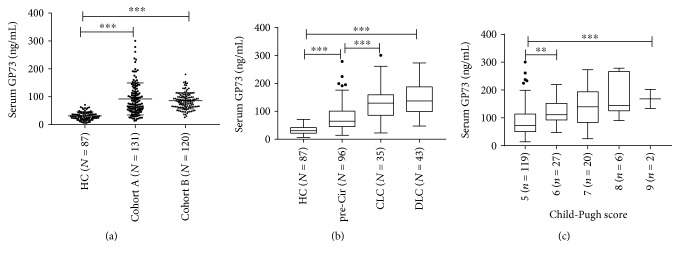
Serum Golgi protein 73 (GP73) is a promising alternative biomarker of chronic liver diseases, but most data are from patients with HBV infection rather than HCV.
Two independent cohorts of chronic hepatitis C (CHC) patients from the 5th Medical Centre of the Chinese PLA General Hospital ( = 174) and Beijing Youan Hospital ( = 120) with different histories of HCV infection were enrolled. The correlations between serum GP73 and other biochemical indices, as well as its correlations with different stages of liver disease progression, were investigated. The receiver operating characteristic (ROC) curve was employed to evaluate the diagnostic potential of serum GP73 for liver necroinflammation and fibrosis, and comparisons of the diagnostic efficiency with traditional indices of hepatic liver injuries were further investigated.
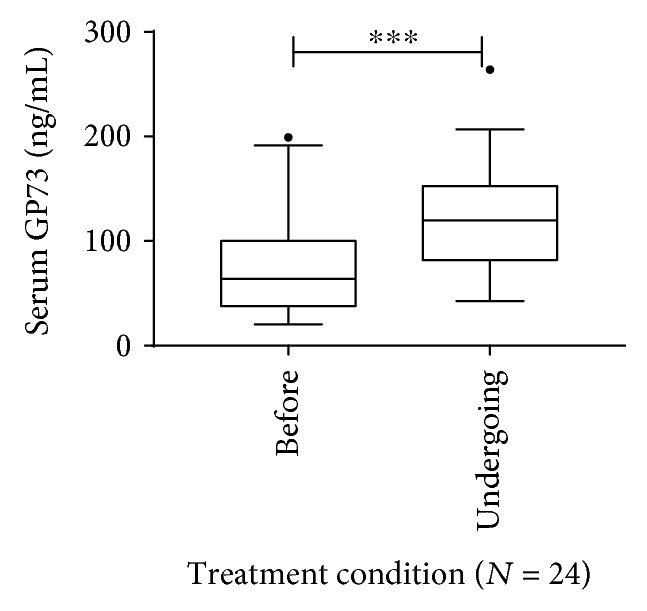
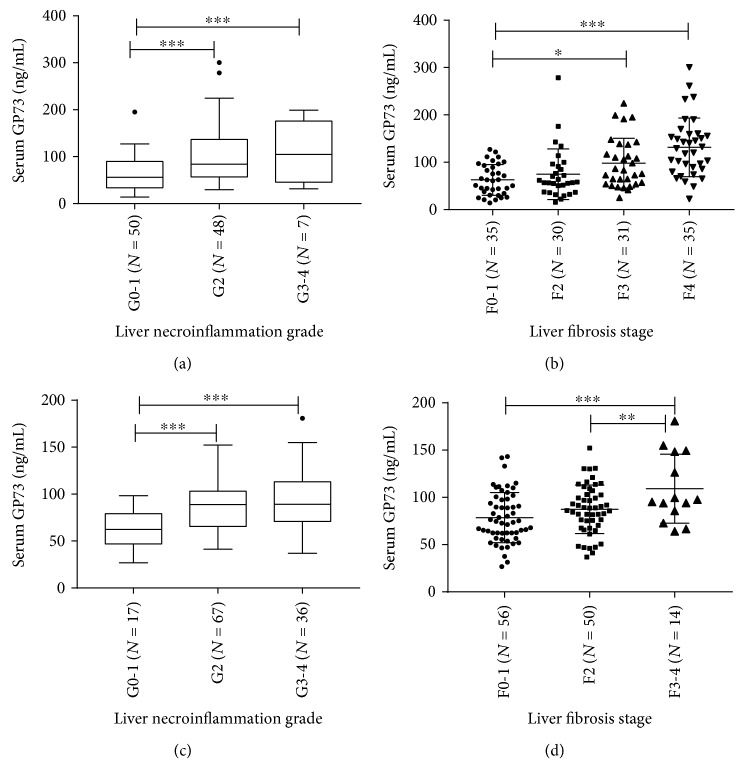
Levels of serum GP73 were found significantly elevated in patients with moderate to severe inflammatory grade ( ≥ 2) and/or with advanced fibrotic stages ( ≥ 3) in both cohorts ( < 0.05, respectively), as compared to those with a normal or mild liver lesion. Further ROC analysis demonstrated that serum GP73 was comparable to serum ALT and AST in diagnosing the liver necroinflammation grade at ≥ 2, but its diagnostic values for advanced fibrosis ( ≥ 3) and cirrhosis ( = 4) were limited when compared to APRI and FIB-4, and FIB-4 exhibited the best performance. Notably, an obvious elevation of serum GP73 was observed after patients received PEG-IFN and ribavirin treatment.
Serum GP73 is an important biomarker in evaluating and monitoring the disease progression including liver necroinflammation and fibrosis in patients with chronic HCV infection, but the value is limited for diagnosing advanced fibrosis and cirrhosis in comparison with APRI and FIB-4.
血清高尔基糖蛋白 73(GP73)是一种有前途的慢性肝病替代生物标志物,但大多数数据来自乙型肝炎病毒(HBV)感染患者,而非丙型肝炎病毒(HCV)感染患者。
本研究纳入了来自中国人民解放军总医院第五医学中心( = 174 例)和首都医科大学附属北京佑安医院( = 120 例)的两组慢性丙型肝炎(CHC)患者,他们的 HCV 感染史不同。研究了血清 GP73 与其他生化指标的相关性,以及其与肝病进展不同阶段的相关性。采用受试者工作特征(ROC)曲线评估血清 GP73 对肝坏死性炎症和纤维化的诊断潜力,并进一步比较了其与传统肝损伤指标的诊断效率。
在两个队列中,均发现中重度炎症(≥2 级)和/或晚期纤维化(≥3 级)患者的血清 GP73 水平显著升高(分别为 <0.05),与正常或轻度肝损伤患者相比。进一步的 ROC 分析表明,血清 GP73 在诊断肝坏死性炎症≥2 级时与血清丙氨酸氨基转移酶(ALT)和天冬氨酸氨基转移酶(AST)相当,但在诊断晚期纤维化(≥3 级)和肝硬化( = 4 级)时,其诊断价值低于 APRI 和 FIB-4,而 FIB-4 表现出最佳的性能。值得注意的是,在接受聚乙二醇干扰素(PEG-IFN)和利巴韦林治疗后,患者的血清 GP73 明显升高。
血清 GP73 是评估和监测慢性 HCV 感染患者疾病进展的重要生物标志物,包括肝坏死性炎症和纤维化,但与 APRI 和 FIB-4 相比,其在诊断晚期纤维化和肝硬化方面的价值有限。