
系统发育结构和气候梯度对墨西哥捕蝇鸟森林群落(雀形目:霸鹟科)形态地理变异的影响
Influence of phylogenetic structure and climate gradients on geographical variation in the morphology of Mexican flycatcher forests assemblages (Aves: Tyrannidae).
作者信息
Cortés-Ramírez Gala, Ríos-Muñoz César A, Navarro-Sigüenza Adolfo G
机构信息
Museo de Zoología "Alfonso L. Herrera", Facultad de Ciencias, Universidad Nacional Autónoma de México, Mexico City, Mexico.
Posgrado en Ciencias Biológicas, Universidad Nacional Autónoma de México, Mexico City, Mexico.
出版信息
PeerJ. 2019 Oct 15;7:e6754. doi: 10.7717/peerj.6754. eCollection 2019.
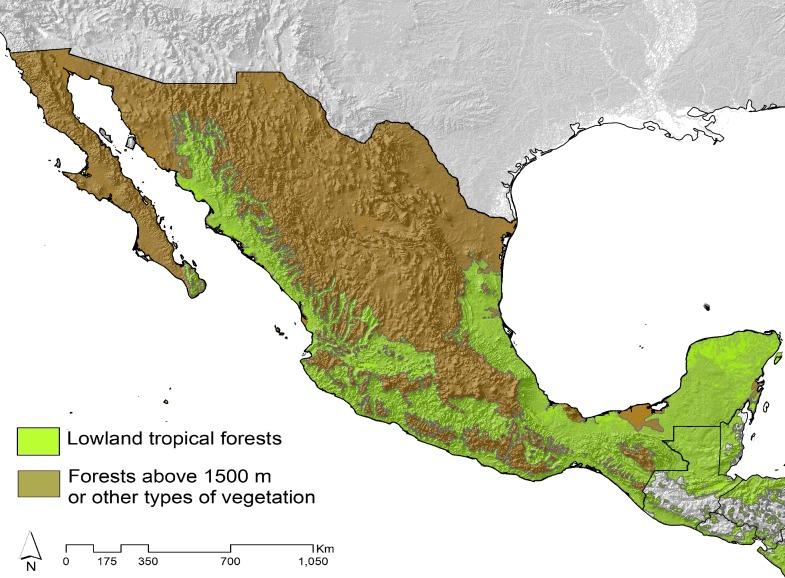
Morphological variation is strongly related to variation in the ecological characteristics and evolutionary history of each taxon. To explore how geographical variation in morphology is related to different climatic gradients and phylogenetic structure, we analyzed the variation of morphological traits (body size, bill, and wing) of 64 species of tyrant flycatchers (Tyrannidae) distributed in Mexico. We measured these morphological traits in specimens from biological collections and related them to the climatic and topographic data of each collection locality. We performed the analyses separately at two levels: (1) the regional level and (2) the assemblage level, which was split into (assemblage I) lowland forests and (assemblage II) highland forests and other vegetation types. We also calculated the phylogenetic structure of flycatchers of each locality in order to explore the influence of climatic variables and the phylogenetic structure on the morphological variation of tyrant flycatchers, by means of linear mixed-effects models. We mapped the spatial variation of the relationship between morphological traits and environmental gradients, taking into account the phylogenetic structure. Important climatic variables explaining the morphological variation were those of temperature ranges (seasonality) and the results suggest that the phylogenetic clustering increases towards the highlands of Sierra Madre Oriental and Sierra Madre del Sur, and the lowlands of Balsas Depression. For the regional level, the spatial distribution of body size showed a pattern coincident with Bergmann's rule, with increasing in size from south to north. In the tropical lowland forests assemblage, body size tend to increase in seasonally dry forests (western Mexico) and decrease in the humid ones (eastern Mexico). In the assemblage of highland forests and other types of vegetation, morphological trait values increased northeast to southwest. Phylogenetic structure helped to explain the variation of morphology at the assemblage level but not at the regional level. The patterns of trait variation in the lowland and highland assemblages suggest that parts of morphological variation are explained both by the climatic gradients and by the lineage relatedness of communities. Overall, our results suggest that morphological variation is best explained by a varied set of variables, and that regression models representing this variation, as well as integrating phylogenetic patterns at different community levels, provide a new understanding of the mechanisms underlying the links among biodiversity, its geographical setting, and environmental change.
形态变异与每个分类单元的生态特征和进化历史的变异密切相关。为了探究形态的地理变异如何与不同的气候梯度和系统发育结构相关联,我们分析了分布在墨西哥的64种霸鹟(霸鹟科)的形态特征(体型、喙和翅膀)的变异。我们在生物标本馆的标本中测量了这些形态特征,并将它们与每个采集地点的气候和地形数据相关联。我们在两个层面分别进行了分析:(1)区域层面;(2)群落层面,该层面又分为(群落I)低地森林和(群落II)高地森林及其他植被类型。我们还计算了每个地点霸鹟的系统发育结构,以便通过线性混合效应模型探究气候变量和系统发育结构对霸鹟形态变异的影响。我们绘制了形态特征与环境梯度之间关系的空间变异图,同时考虑了系统发育结构。解释形态变异的重要气候变量是温度范围(季节性),结果表明系统发育聚类朝着东马德雷山脉和南马德雷山脉的高地以及巴尔萨斯凹陷的低地增加。在区域层面,体型的空间分布呈现出与伯格曼法则一致的模式,即从南到北体型增大。在热带低地森林群落中,体型在季节性干燥森林(墨西哥西部)往往增大,而在湿润森林(墨西哥东部)则减小。在高地森林和其他植被类型的群落中,形态特征值从东北向西南增加。系统发育结构有助于解释群落层面而非区域层面的形态变异。低地和高地群落的特征变异模式表明,部分形态变异既可以由气候梯度解释,也可以由群落的谱系相关性解释。总体而言,我们的结果表明,形态变异最好由一系列不同的变量来解释,代表这种变异的回归模型以及整合不同群落层面的系统发育模式,为生物多样性、其地理环境和环境变化之间联系的潜在机制提供了新的理解。



 Zotero 插件