Xu Jinshi, Chen Yu, Zhang Lixia, Chai Yongfu, Wang Mao, Guo Yaoxin, Li Ting, Yue Ming
Key Laboratory of Resource Biology and Biotechnology in Western China (Northwest University) Ministry of Education Xi'an China.
School of Life Sciences Northwest University Xi'an China.
Ecol Evol. 2017 Jun 2;7(14):5056-5069. doi: 10.1002/ece3.3068. eCollection 2017 Jul.
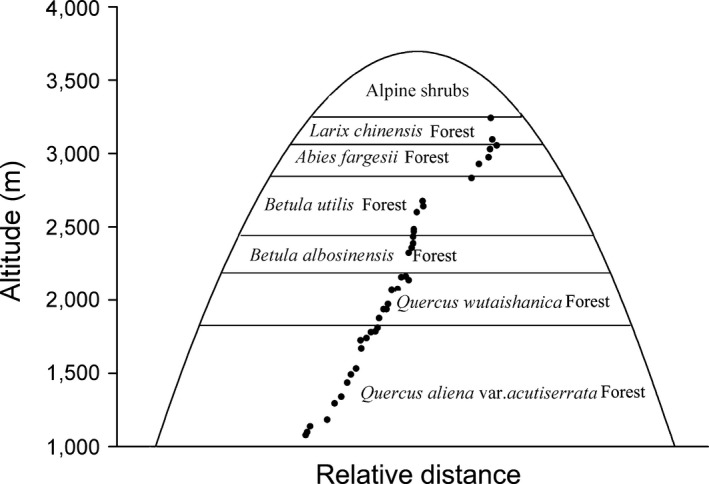
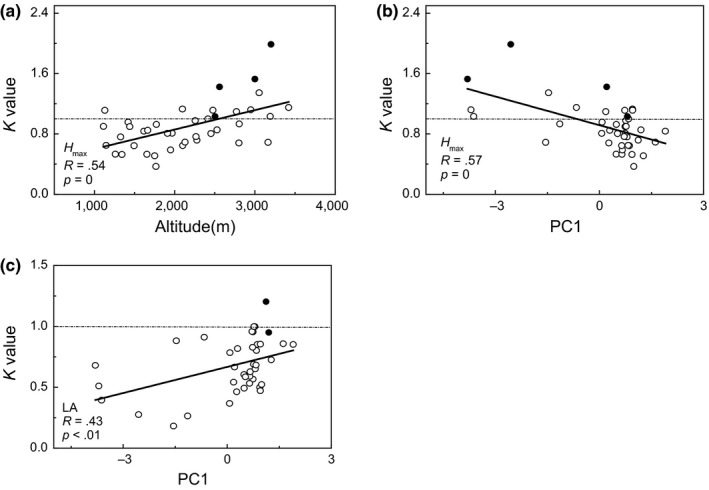
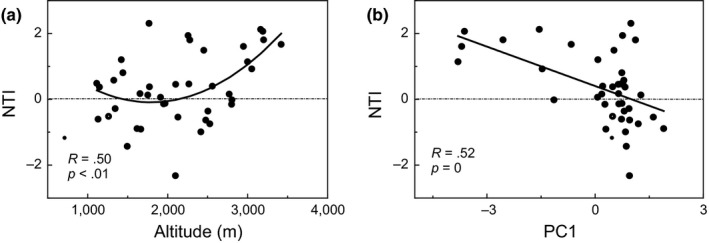
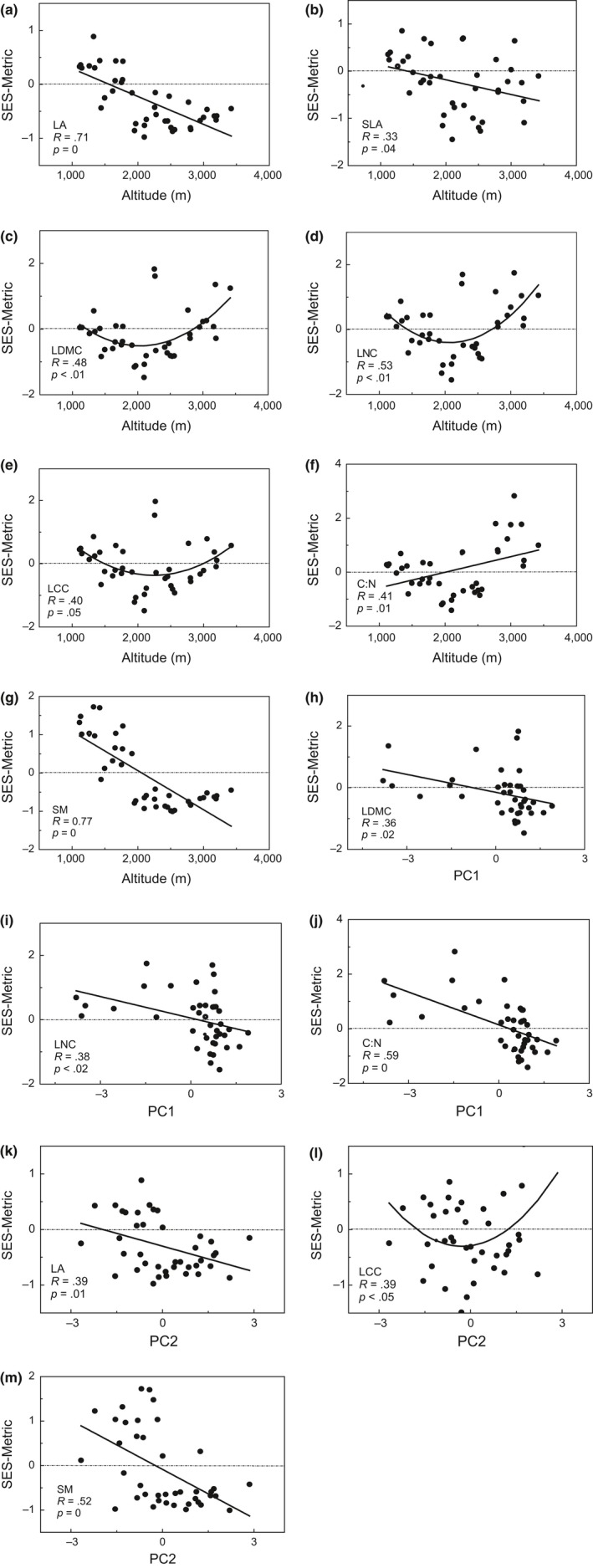
Community assembly processes is the primary focus of community ecology. Using phylogenetic-based and functional trait-based methods jointly to explore these processes along environmental gradients are useful ways to explain the change of assembly mechanisms under changing world. Our study combined these methods to test assembly processes in wide range gradients of elevation and other habitat environmental factors. We collected our data at 40 plots in Taibai Mountain, China, with more than 2,300 m altitude difference in study area and then measured traits and environmental factors. Variance partitioning was used to distinguish the main environment factors leading to phylogeny and traits change among 40 plots. Principal component analysis (PCA) was applied to colligate other environment factors. Community assembly patterns along environmental gradients based on phylogenetic and functional methods were studied for exploring assembly mechanisms. Phylogenetic signal was calculated for each community along environmental gradients in order to detect the variation of trait performance on phylogeny. Elevation showed a better explanatory power than other environment factors for phylogenetic and most traits' variance. Phylogenetic and several functional structure clustered at high elevation while some conserved traits overdispersed. Convergent tendency which might be caused by filtering or competition along elevation was detected based on functional traits. Leaf dry matter content (LDMC) and leaf nitrogen content along PCA 1 axis showed conflicting patterns comparing to patterns showed on elevation. LDMC exhibited the strongest phylogenetic signal. Only the phylogenetic signal of maximum plant height showed explicable change along environmental gradients. . Elevation is the best environment factors for predicting phylogeny and traits change. Plant's phylogenetic and some functional structures show environmental filtering in alpine region while it shows different assembly processes in middle- and low-altitude region by different trait/phylogeny. The results highlight deterministic processes dominate community assembly in large-scale environmental gradients. Performance of phylogeny and traits along gradients may be independent with each other. The novel method for calculating functional structure which we used in this study and the focus of phylogenetic signal change along gradients may provide more useful ways to detect community assembly mechanisms.
群落构建过程是群落生态学的主要研究重点。联合使用基于系统发育和基于功能性状的方法来探究沿环境梯度的这些过程,是解释在不断变化的世界中构建机制变化的有效途径。我们的研究结合了这些方法,以测试在广泛的海拔梯度和其他栖息地环境因素下的构建过程。我们在中国太白山的40个样地收集数据,研究区域内海拔差异超过2300米,然后测量性状和环境因素。方差分解用于区分导致40个样地间系统发育和性状变化的主要环境因素。主成分分析(PCA)用于综合其他环境因素。基于系统发育和功能方法研究了沿环境梯度的群落构建模式,以探索构建机制。计算每个群落沿环境梯度的系统发育信号,以检测性状表现沿系统发育的变化。海拔对系统发育和大多数性状变异的解释力优于其他环境因素。系统发育和一些功能结构在高海拔处聚类,而一些保守性状过度分散。基于功能性状检测到沿海拔可能由筛选或竞争引起的趋同趋势。与海拔上显示的模式相比,沿PCA 1轴的叶干物质含量(LDMC)和叶氮含量呈现出相互矛盾的模式。LDMC表现出最强的系统发育信号。只有最大株高的系统发育信号沿环境梯度表现出可解释的变化。海拔是预测系统发育和性状变化的最佳环境因素。植物的系统发育和一些功能结构在高山地区表现出环境筛选作用,而在中低海拔地区则通过不同的性状/系统发育表现出不同的构建过程。结果表明,在大规模环境梯度中,确定性过程主导群落构建。系统发育和性状沿梯度的表现可能相互独立。我们在本研究中使用的计算功能结构的新方法以及沿梯度的系统发育信号变化重点,可能为检测群落构建机制提供更有用的方法。