Department of Gastroenterology, Tongji Hospital, Tongji Medical College, Huazhong University of Science and Technology, Wuhan, Hubei 430030, P.R. China.
Mol Med Rep. 2019 Dec;20(6):4883-4892. doi: 10.3892/mmr.2019.10750. Epub 2019 Oct 16.
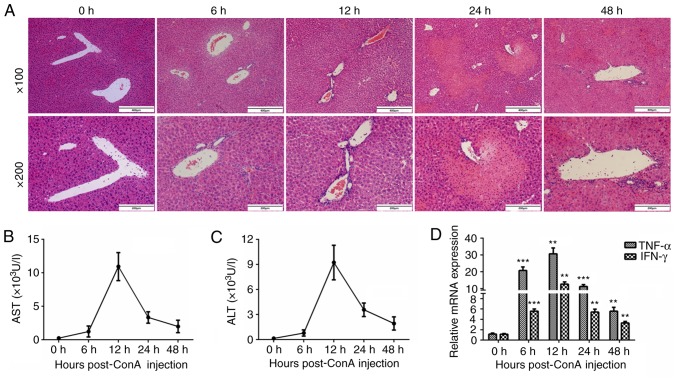
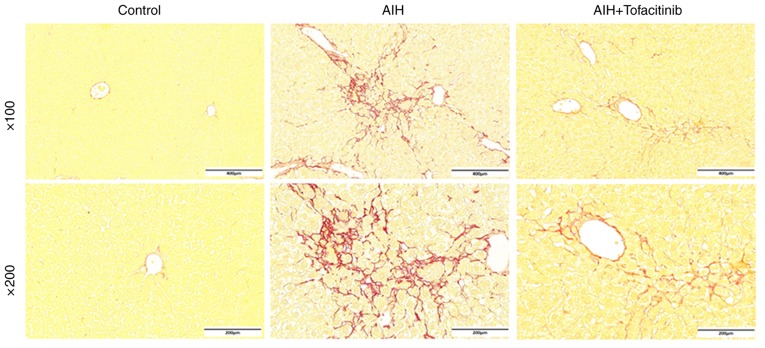
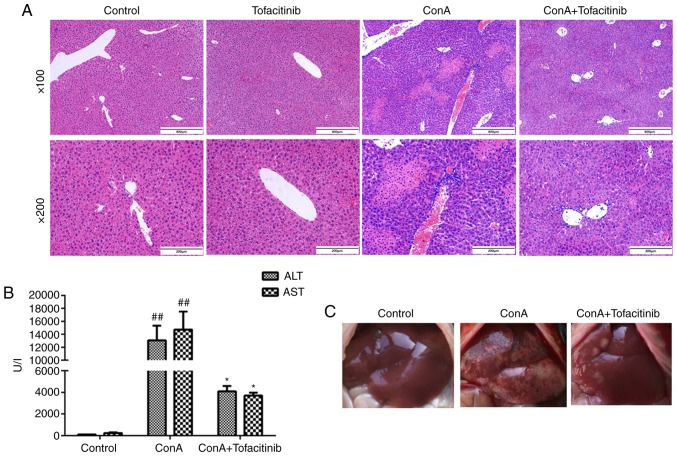
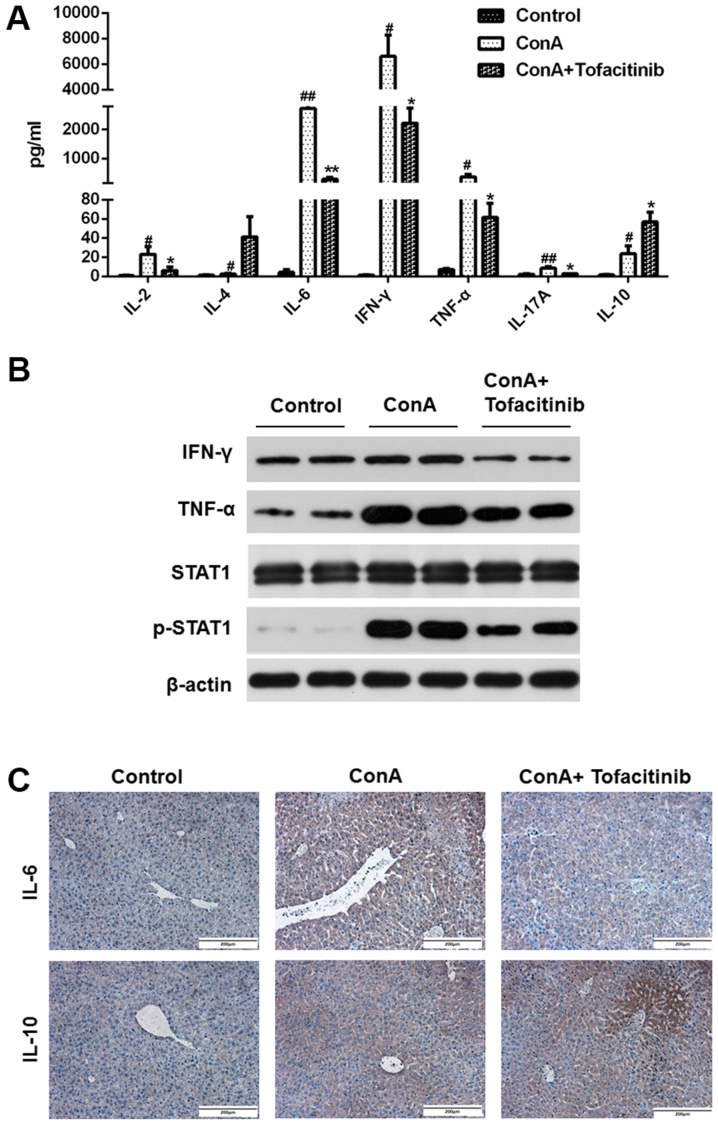
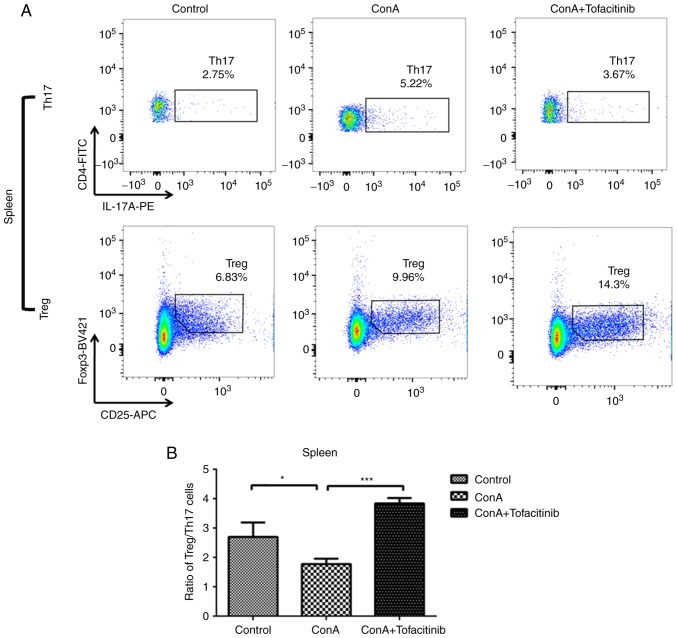
The prevalence of immune‑mediated liver diseases such as autoimmune liver disease or viral hepatitis has increased in recent years, and the side effects of pre‑existing treatments are a worldwide problem. Regulatory T cells (Tregs) and T helper 17 (Th17) cells play important roles in the development of immune‑mediated hepatitis and may serve as potential therapeutic targets. Tofacitinib, a new Janus kinase (JAK) inhibitor, is under investigation for the treatment of rheumatoid arthritis; it is also helpful in treating ulcerative colitis and psoriasis. The roles of tofacitinib were investigated in conferring protection against immune‑mediated liver injury in mice. T cell‑mediated hepatitis was induced by concanavalin A (ConA). The mice in the treatment groups were administered with tofacitinib intragastrically before the ConA injection. Histopathological examination was performed by hematoxylin and eosin (H&E) staining, and the serum transaminase and inflammatory cytokine levels were determined using an automatic biochemistry analysis apparatus or cytometric bead array (CBA) kits. Flow cytometric analysis was used to detect Tregs and Th17 cells. Tofacitinib significantly decreased the hepatic injury induced by ConA and prominently decreased the liver transaminase level. The secretion of several anti‑inflammatory cytokines such as interleukin (IL)‑10 was upregulated in mice from the treatment group, compared to that in mice treated with ConA alone, while the expression of interferon‑γ (IFN‑γ) and tumor necrosis factor‑α (TNF‑α) decreased. Tofacitinib treatment increased the number of Tregs and reduced the number of Th17 cells. Furthermore, tofacitinib could relieve liver fibrosis under conditions of autoimmune hepatitis (AIH). The present results indicated that tofacitinib improved immune‑mediated hepatitis and restored the impaired Treg/Th17 cell ratio, which suggests that it may serve as a novel treatment approach for immune‑mediated liver diseases.
近年来,自身免疫性肝病或病毒性肝炎等免疫介导性肝病的患病率有所增加,而现有治疗方法的副作用是一个全球性问题。调节性 T 细胞(Tregs)和辅助性 T 细胞 17(Th17)在免疫介导性肝炎的发展中发挥重要作用,可能成为潜在的治疗靶点。托法替尼是一种新型的 Janus 激酶(JAK)抑制剂,目前正在研究用于治疗类风湿关节炎;它对治疗溃疡性结肠炎和银屑病也有帮助。本研究旨在探讨托法替尼在预防小鼠免疫介导性肝损伤中的作用。通过使用伴刀豆球蛋白 A(ConA)诱导 T 细胞介导的肝炎。在 ConA 注射前,治疗组小鼠通过灌胃给予托法替尼。通过苏木精和伊红(H&E)染色进行组织病理学检查,使用自动生化分析仪器或流式细胞术微珠阵列(CBA)试剂盒测定血清转氨酶和炎症细胞因子水平。采用流式细胞术检测 Tregs 和 Th17 细胞。托法替尼显著减轻了 ConA 诱导的肝损伤,明显降低了肝转氨酶水平。与单独用 ConA 处理的小鼠相比,治疗组小鼠的几种抗炎细胞因子(如白细胞介素(IL)-10)的分泌增加,而干扰素-γ(IFN-γ)和肿瘤坏死因子-α(TNF-α)的表达减少。托法替尼治疗增加了 Tregs 的数量,减少了 Th17 细胞的数量。此外,托法替尼在自身免疫性肝炎(AIH)条件下可以缓解肝纤维化。这些结果表明,托法替尼改善了免疫介导性肝炎,并恢复了受损的 Treg/Th17 细胞比值,提示其可能成为免疫介导性肝病的一种新的治疗方法。