Immunology Research Center, National Health Research Institutes, 35 Keyan Road, Zhunan, 35053, Taiwan.
Department of Pathology & Immunology, Baylor College of Medicine, Houston, TX, 77030, USA.
J Biomed Sci. 2019 Oct 22;26(1):82. doi: 10.1186/s12929-019-0570-5.
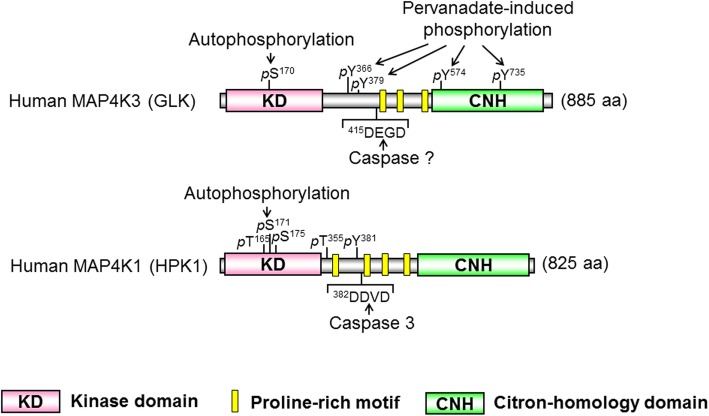
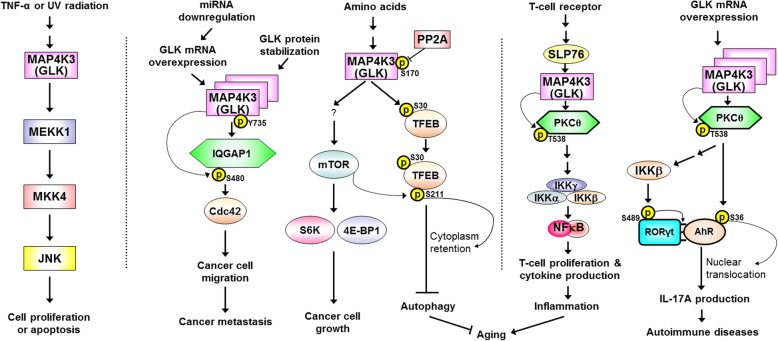
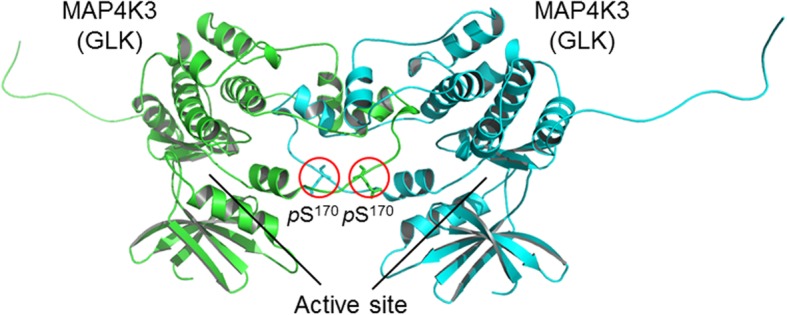
MAP4K3 (also named GLK) is a serine/threonine kinase, which belongs to the mammalian Ste20-like kinase family. At 22 years of age, GLK was initially cloned and identified as an upstream activator of the MAPK JNK under an environmental stress and proinflammatory cytokines. The data derived from GLK-overexpressing or shRNA-knockdown cell lines suggest that GLK may be involved in cell proliferation through mTOR signaling. GLK phosphorylates the transcription factor TFEB and retains TFEB in the cytoplasm, leading to inhibition of cell autophagy. After generating and characterizing GLK-deficient mice, the important in vivo roles of GLK in T-cell activation were revealed. In T cells, GLK directly interacts with and activates PKCθ through phosphorylating PKCθ at Ser-538 residue, leading to activation of IKK/NF-κB. Thus, GLK-deficient mice display impaired T-cell-mediated immune responses and decreased inflammatory phenotypes in autoimmune disease models. Consistently, the percentage of GLK-overexpressing T cells is increased in the peripheral blood from autoimmune disease patients; the GLK-overexpressing T cell population is correlated with disease severity of patients. The pathogenic mechanism of autoimmune disease by GLK overexpression was unraveled by characterizing T-cell-specific GLK transgenic mice and using biochemical analyses. GLK overexpression selectively promotes IL-17A transcription by inducing the AhR-RORγt complex in T cells. In addition, GLK overexpression in cancer tissues is correlated with cancer recurrence of human lung cancer and liver cancer; the predictive power of GLK overexpression for cancer recurrence is higher than that of pathologic stage. GLK directly phosphorylates and activates IQGAP1, resulting in induction of Cdc42-mediated cell migration and cancer metastasis. Furthermore, treatment of GLK inhibitor reduces disease severity of mouse autoimmune disease models and decreases IL-17A production of human autoimmune T cells. Due to the inhibitory function of HPK1/MAP4K1 in T-cell activation and the promoting effects of GLK on tumorigenesis, HPK1 and GLK dual inhibitors could be useful therapeutic drugs for cancer immunotherapy. In addition, GLK deficiency results in extension of lifespan in Caenorhabditis elegans and mice. Taken together, targeting MAP4K3 (GLK) may be useful for treating/preventing autoimmune disease, cancer metastasis/recurrence, and aging.
MAP4K3(也称为 GLK)是一种丝氨酸/苏氨酸激酶,属于哺乳动物 Ste20 样激酶家族。在 22 岁时,GLK 最初被克隆并鉴定为环境应激和促炎细胞因子下 MAPK JNK 的上游激活剂。来自 GLK 过表达或 shRNA 敲低细胞系的数据表明,GLK 可能通过 mTOR 信号参与细胞增殖。GLK 磷酸化转录因子 TFEB 并将 TFEB 保留在细胞质中,从而抑制细胞自噬。在生成和表征 GLK 缺陷型小鼠后,揭示了 GLK 在 T 细胞激活中的重要体内作用。在 T 细胞中,GLK 通过在 Ser-538 残基处磷酸化 PKCθ 直接与 PKCθ 相互作用并激活 PKCθ,导致 IKK/NF-κB 的激活。因此,GLK 缺陷型小鼠表现出 T 细胞介导的免疫反应受损和自身免疫疾病模型中炎症表型减少。一致地,自身免疫疾病患者外周血中 GLK 过表达 T 细胞的百分比增加;GLK 过表达 T 细胞群体与患者的疾病严重程度相关。通过表征 T 细胞特异性 GLK 转基因小鼠和使用生化分析,揭示了 GLK 过表达引起的自身免疫疾病的发病机制。GLK 过表达通过诱导 T 细胞中的 AhR-RORγt 复合物选择性促进 IL-17A 转录。此外,癌组织中 GLK 的过表达与人类肺癌和肝癌的癌症复发相关;GLK 过表达对癌症复发的预测能力高于病理分期。GLK 直接磷酸化并激活 IQGAP1,导致 Cdc42 介导的细胞迁移和癌症转移。此外,GLK 抑制剂的治疗可降低小鼠自身免疫疾病模型的疾病严重程度并减少人类自身免疫 T 细胞的 IL-17A 产生。由于 HPK1/MAP4K1 在 T 细胞激活中的抑制功能和 GLK 对肿瘤发生的促进作用,HPK1 和 GLK 双重抑制剂可能是癌症免疫治疗的有用治疗药物。此外,GLK 缺陷导致秀丽隐杆线虫和小鼠的寿命延长。总之,靶向 MAP4K3(GLK)可能有助于治疗/预防自身免疫疾病、癌症转移/复发和衰老。