Sultan Sundus, Shah Afzal, Khan Burhan, Nisar Jan, Shah Muhammad Raza, Ashiq Muhammad Naeem, Akhter Mohammad Salim, Shah Aamir Hassan
Department of Chemistry, Quaid-i-Azam University, 45320 Islamabad, Pakistan.
Department of Chemistry, College of Science, University of Bahrain, Sakhir 32038, Bahrain.
ACS Omega. 2019 Oct 4;4(16):16860-16866. doi: 10.1021/acsomega.9b01869. eCollection 2019 Oct 15.
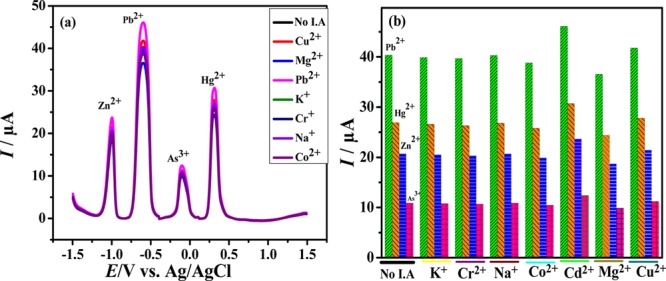
The glassy carbon electrode was fabricated with multifunctional bis-triazole-appended calix[4]arene and then used for the simultaneous detection of Zn(II), Pb(II), As(III), and Hg(II). Before applying the square-wave anodic stripping voltammetry, the sensitivity and precision of the modified electrode was assured by optimizing various conditions such as the modifier concentration, pH of the solution, deposition potential, accumulation time, and supporting electrolytes. The modified glassy carbon electrode was found to be responsive up to picomolar limits for the aforementioned heavy metal ions, which is a concentration limit much lower than the threshold level permitted by the World Health Organization. Importantly, the designed sensing platform showed anti-interference ability, good stability, repeatability, reproducibility, and applicability for the detection of multiple metal ions. The detection limits obtained for Zn(II), Pb(II), As(III), and Hg(II) are 66.3, 14.6, 71.9, and 28.9 pM, respectively.
用多功能双三唑修饰的杯[4]芳烃制备玻碳电极,然后用于同时检测Zn(II)、Pb(II)、As(III)和Hg(II)。在应用方波阳极溶出伏安法之前,通过优化各种条件,如修饰剂浓度、溶液pH值、沉积电位、富集时间和支持电解质,确保修饰电极的灵敏度和精密度。发现修饰后的玻碳电极对上述重金属离子的响应可达皮摩尔级,这一浓度极限远低于世界卫生组织允许的阈值水平。重要的是,所设计的传感平台具有抗干扰能力、良好的稳定性、重复性、再现性以及对多种金属离子检测的适用性。Zn(II)、Pb(II)、As(III)和Hg(II)的检测限分别为66.3、14.6、71.9和28.9 pM。