Steinberg Amir, Van Cleave Janet H, Parikh Anish B, Moshier Erin, Ru Meng, Lawson Molly, Marks Douglas, Montelibano Antoinette, Philpott Amanda, Garner Kourtney, Hammer Marilyn J
Division of Hematology/Oncology, Tisch Cancer Institute, Icahn School of Medicine Mount Sinai, New York, NY, USA.
Department of Nursing, Mount Sinai Hospital, Icahn School of Medicine at Mount Sinai, New York, NY, USA.
Int J Hematol Oncol Stem Cell Res. 2019 Jul 1;13(3):122-131.
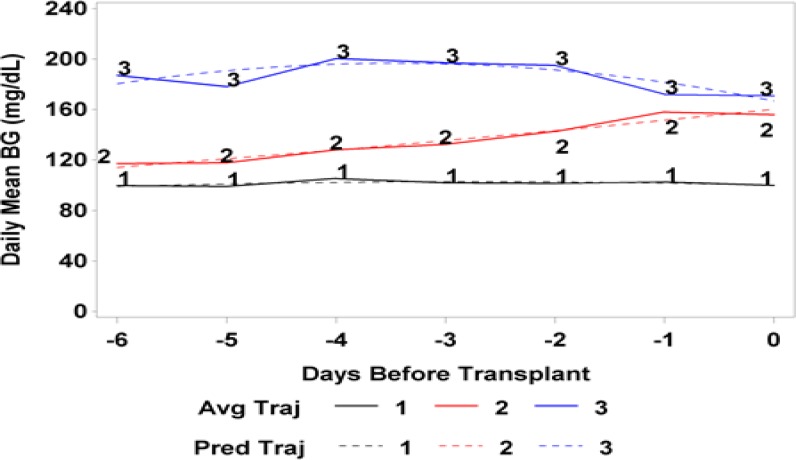
Abnormal blood glucose (BG) levels during hematopoietic cell transplantation (HCT) are associated with increased infections, delayed engraftment, and prolonged hospitalization, though little is known about these associations. We retrospectively evaluated mean BG levels in the week prior to HCT and subsequent outcomes for 852 HCTs at our hospital from 1/2009 - 12/2013 pertaining to 745 patients. Outcomes included infections (pneumonia, , positive cultures, administration of antimicrobials, or neutropenic fever), time-to-engraftment (TTE), and quality indicators (30- and 90-day readmission rates [RR] and median length-of-stay [LOS]). 404 patients met the criteria for involvement in this study. The population was 55% male and was racially and ethnically mixed (White 38%, African American 23%, Hispanic 6%, Asian 7%, Other 21%). Mean age was 57+14 years. Significantly more patients in Group 2 were diagnosed with pneumonia (19%) compared with the Group 1 (7%) and Group 3 (10%) [p=.0054]. Patients in Group 2 also had significantly longer median LOS: Group 1-23 days, Group 2-26 days, Group 3-22 days [p = .0157]. No significant differences were noted in terms of the other infectious complications or in time-to-engraftment or readmissions. Pre-HCT BG trends may be a prognostic biomarker for adverse outcomes, and thus can help improve quality of care for HCT patients.
造血细胞移植(HCT)期间血糖(BG)水平异常与感染增加、植入延迟和住院时间延长有关,尽管人们对这些关联了解甚少。我们回顾性评估了2009年1月至2013年12月在我院进行的852例HCT(涉及745例患者)移植前一周的平均BG水平及后续结果。结果包括感染(肺炎、培养阳性、使用抗菌药物或中性粒细胞减少性发热)、植入时间(TTE)和质量指标(30天和90天再入院率[RR]以及中位住院时间[LOS])。404例患者符合本研究的纳入标准。该人群中55%为男性,种族和民族混合(白人38%,非裔美国人23%,西班牙裔6%,亚洲人7%,其他21%)。平均年龄为57±14岁。与第1组(7%)和第3组(10%)相比,第2组中诊断为肺炎的患者明显更多(19%)[p = .0054]。第2组患者的中位LOS也明显更长:第1组为23天,第2组为26天,第3组为22天[p = .0157]。在其他感染并发症、植入时间或再入院方面未发现显著差异。移植前BG趋势可能是不良结局的预后生物标志物,因此有助于提高HCT患者的护理质量。