Thangavel Hariprasad, De Angelis Carmine, Vasaikar Suhas, Bhat Raksha, Jolly Mohit Kumar, Nagi Chandandeep, Creighton Chad J, Chen Fengju, Dobrolecki Lacey E, George Jason T, Kumar Tanya, Abdulkareem Noor Mazin, Mao Sufeng, Nardone Agostina, Rimawi Mothaffar, Osborne C Kent, Lewis Michael T, Levine Herbert, Zhang Bing, Schiff Rachel, Giuliano Mario, Trivedi Meghana V
Department of Pharmacy Practice and Translational Research, University of Houston College of Pharmacy, Houston, TX 77204, USA.
Lester and Sue Smith Breast Center, Baylor College of Medicine, Houston, TX 77030, USA.
J Clin Med. 2019 Oct 24;8(11):1772. doi: 10.3390/jcm8111772.
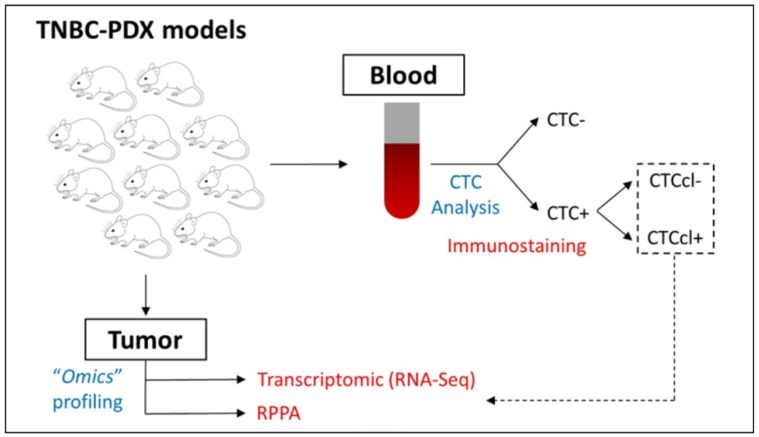
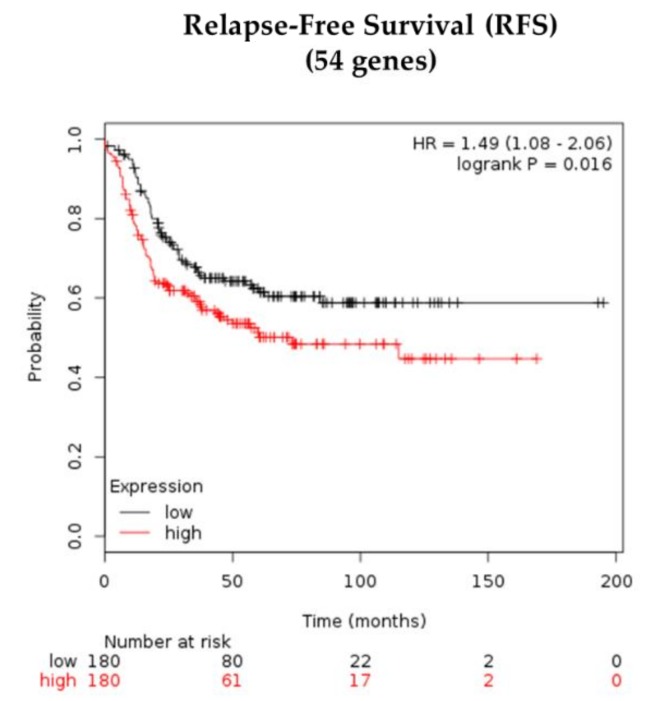
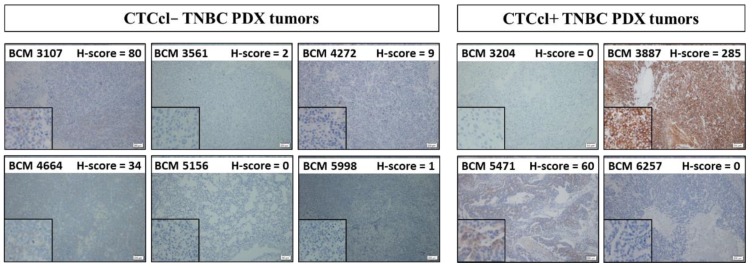
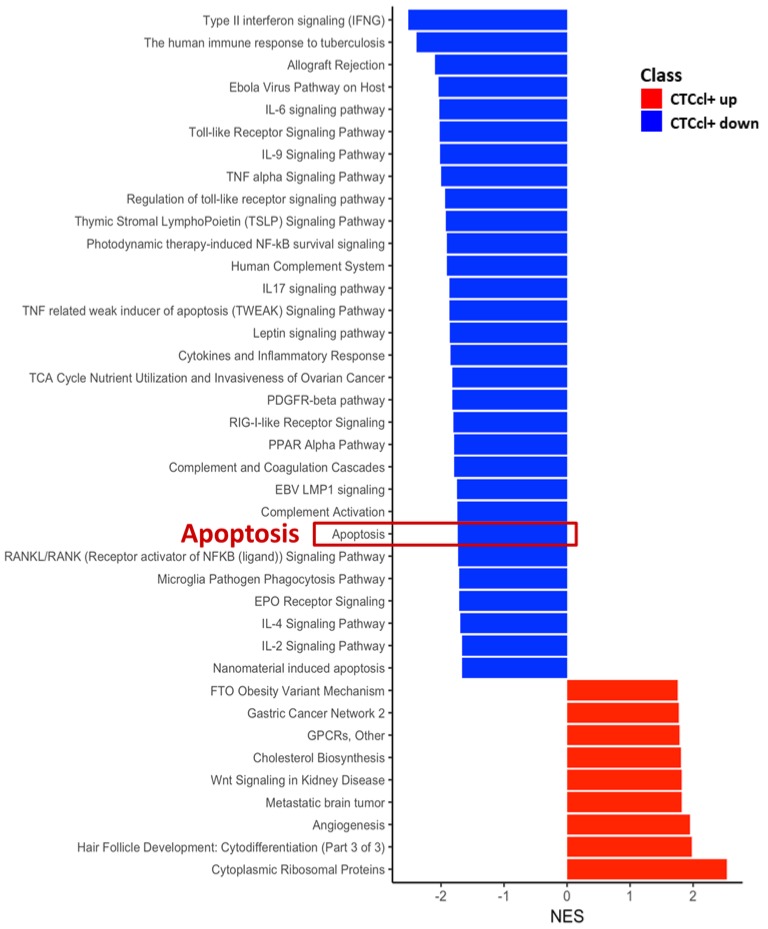
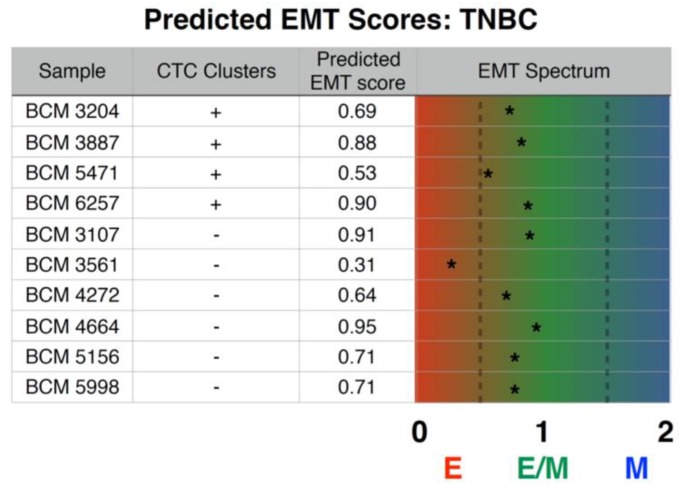
Circulating tumor cell clusters (CTCcl) have a higher metastatic potential compared to single CTCs and predict long-term outcomes in breast cancer (BC) patients. Because of the rarity of CTCcls, molecular characterization of primary tumors that give rise to CTCcl hold significant promise for better diagnosis and target discovery to combat metastatic BC. In our study, we utilized the reverse-phase protein array (RPPA) and transcriptomic (RNA-Seq) data of 10 triple-negative BC patient-derived xenograft (TNBC PDX) transplantable models with CTCs and evaluated expression of upregulated candidate protein Bcl2 (B-cell lymphoma 2) by immunohistochemistry (IHC). The sample-set consisted of six CTCcl-negative (CTCcl-) and four CTCcl-positive (CTCcl+) models. We analyzed the RPPA and transcriptomic profiles of CTCcl- and CTCcl+ TNBC PDX models. In addition, we derived a CTCcl-specific gene signature for testing if it predicted outcomes using a publicly available dataset from 360 patients with basal-like BC. The RPPA analysis of CTCcl+ vs. CTCcl- TNBC PDX tumors revealed elevated expression of Bcl2 (false discovery rate (FDR) < 0.0001, fold change (FC) = 3.5) and reduced acetyl coenzyme A carboxylase-1 (ACC1) (FDR = 0.0005, FC = 0.3) in CTCcl+ compared to CTCcl- tumors. Genome-wide transcriptomic analysis of CTCcl+ vs. CTCcl- tumors revealed 549 differentially expressed genes associated with the presence of CTCcls. Apoptosis was one of the significantly downregulated pathways (normalized enrichment score (NES) = -1.69; FDR < 0.05) in TNBC PDX tumors associated with CTCcl positivity. Two out of four CTCcl+ TNBC PDX primary tumors had high Bcl2 expression by IHC (H-score > 34); whereas, only one of six CTCcl- TNBC PDX primary tumors met this criterion. Evaluation of epithelial-mesenchymal transition (EMT)-specific signature did not show significant differences between CTCcl+ and CTCcl- tumors. However, a gene signature associated with the presence of CTCcls in TNBC PDX models was associated with worse relapse-free survival in the publicly available dataset from 360 patients with basal-like BC. In summary, we identified the multigene signature of primary PDX tumors associated with the presence of CTCcls. Evaluation of additional TNBC PDX models and patients can further illuminate cellular and molecular pathways facilitating CTCcl formation.
循环肿瘤细胞簇(CTCcl)相比于单个循环肿瘤细胞(CTC)具有更高的转移潜能,并且可预测乳腺癌(BC)患者的长期预后。由于CTCcl十分罕见,对产生CTCcl的原发性肿瘤进行分子特征分析,对于更好地诊断和发现治疗转移性BC的靶点具有重大意义。在我们的研究中,我们利用了10个携带CTC的三阴性乳腺癌患者来源异种移植(TNBC PDX)可移植模型的反相蛋白质阵列(RPPA)和转录组学(RNA测序)数据,并通过免疫组织化学(IHC)评估上调的候选蛋白Bcl2(B细胞淋巴瘤2)的表达。样本集包括6个CTCcl阴性(CTCcl-)和4个CTCcl阳性(CTCcl+)模型。我们分析了CTCcl-和CTCcl+ TNBC PDX模型的RPPA和转录组学图谱。此外,我们推导了一个CTCcl特异性基因特征,以使用来自360例基底样BC患者的公开可用数据集测试其是否能预测预后。对CTCcl+与CTCcl- TNBC PDX肿瘤的RPPA分析显示,与CTCcl-肿瘤相比,CTCcl+肿瘤中Bcl2表达升高(错误发现率(FDR)<0.0001,倍数变化(FC)=3.5),而乙酰辅酶A羧化酶-1(ACC1)表达降低(FDR = 0.0005,FC = 0.3)。对CTCcl+与CTCcl-肿瘤的全基因组转录组分析显示,有549个差异表达基因与CTCcl的存在相关。凋亡是与CTCcl阳性相关的TNBC PDX肿瘤中显著下调的通路之一(标准化富集分数(NES)=-1.69;FDR < 0.05)。4个CTCcl+ TNBC PDX原发性肿瘤中有2个通过IHC显示Bcl2高表达(H评分>34);而6个CTCcl- TNBC PDX原发性肿瘤中只有1个符合该标准。对上皮-间质转化(EMT)特异性特征的评估未显示CTCcl+和CTCcl-肿瘤之间存在显著差异。然而,在来自360例基底样BC患者的公开可用数据集中,与TNBC PDX模型中CTCcl存在相关的基因特征与无复发生存期较差相关。总之,我们确定了与CTCcl存在相关的原发性PDX肿瘤的多基因特征。对更多TNBC PDX模型和患者的评估可以进一步阐明促进CTCcl形成的细胞和分子途径。