Department of Otolaryngology-Head and Neck Surgery, Harvard Medical School, Boston, MA, USA.
Eaton-Peabody Laboratories, Massachusetts Eye & Ear, Boston, MA, USA.
Sci Rep. 2019 Oct 25;9(1):15362. doi: 10.1038/s41598-019-51724-6.
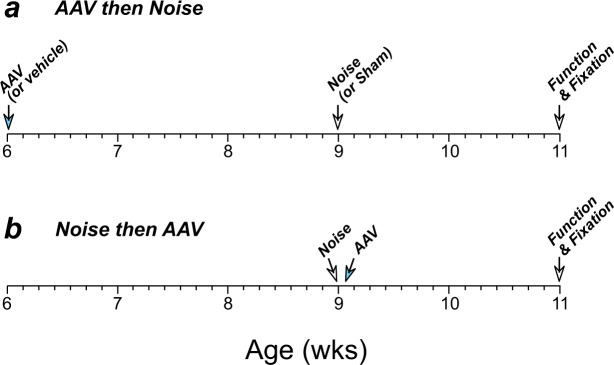
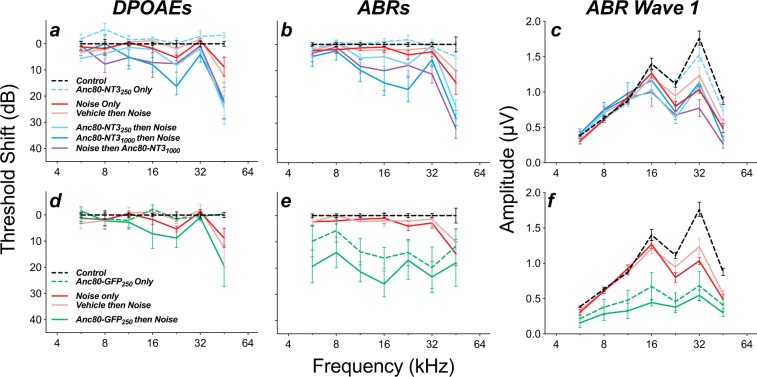
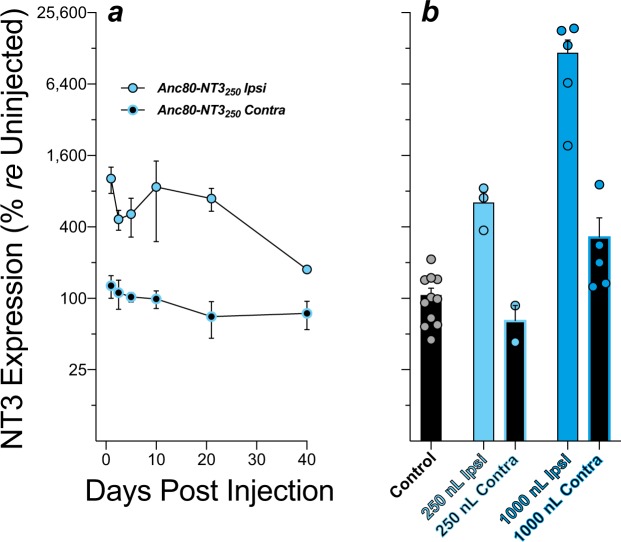
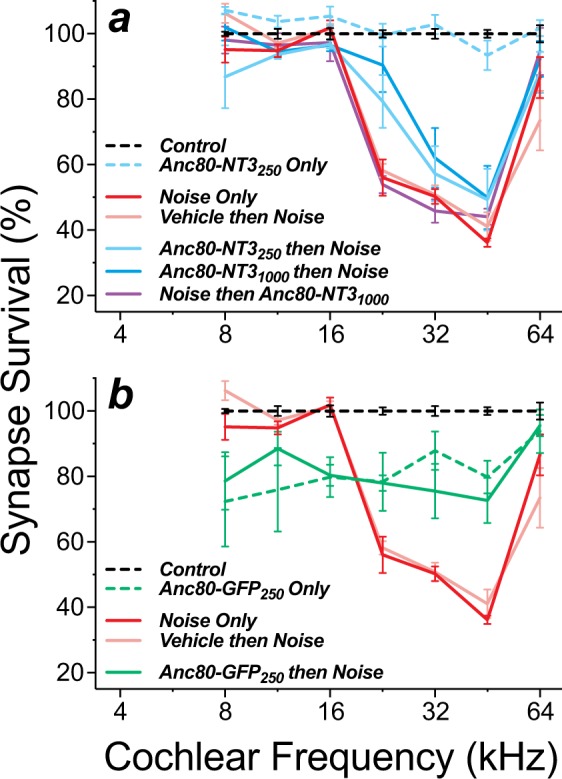
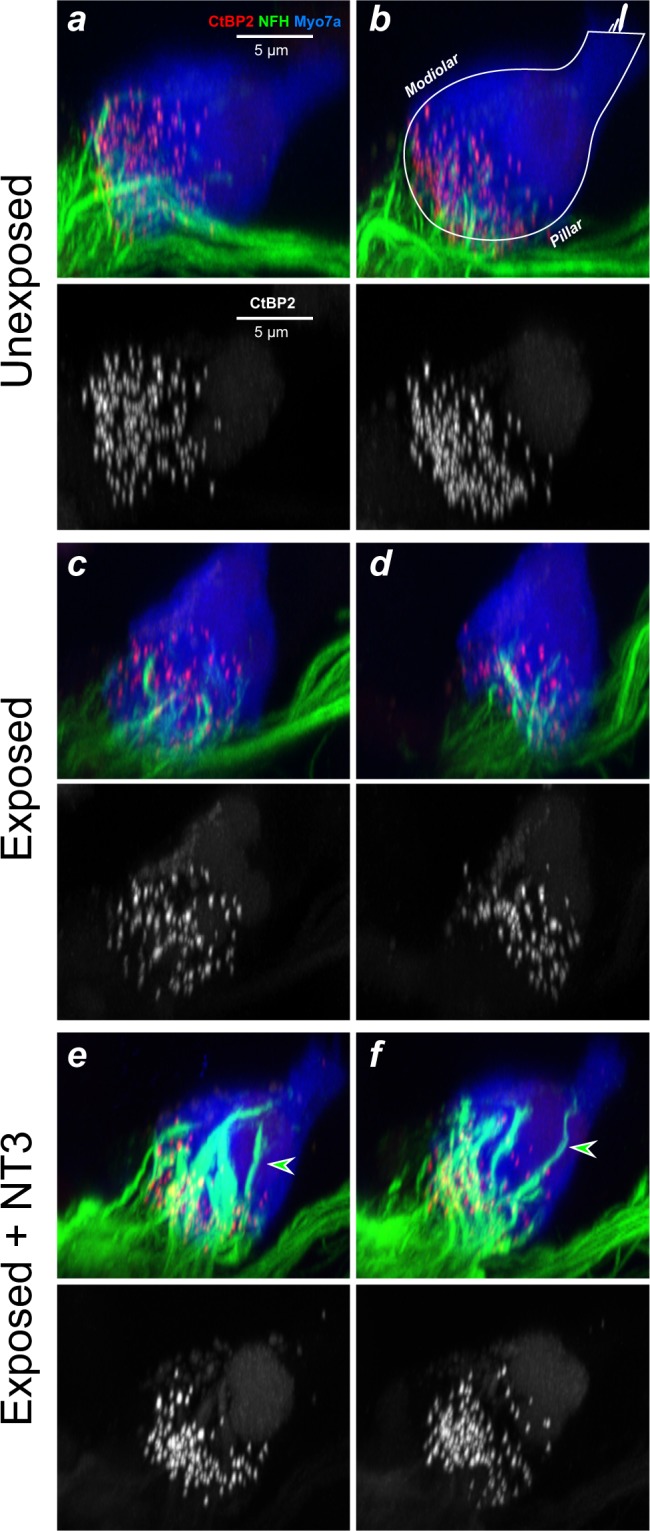
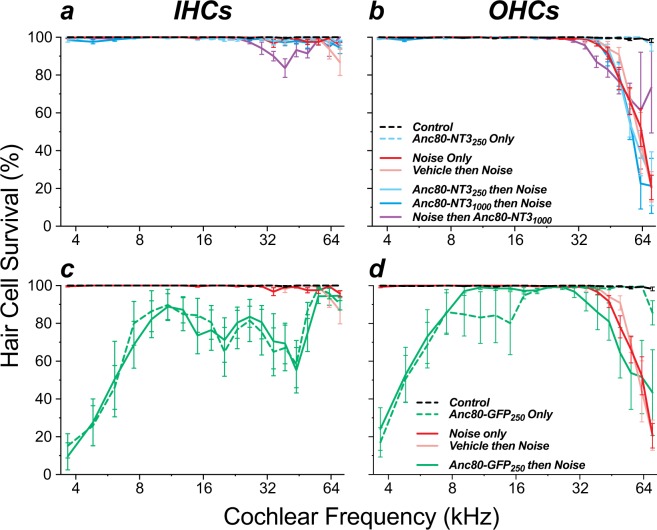
Noise exposures causing only transient threshold shifts can destroy auditory-nerve synapses without damaging hair cells. Here, we asked whether virally mediated neurotrophin3 (NT3) overexpression can repair this damage. CBA/CaJ mice at 6 wks were injected unilaterally with adeno-associated virus (AAV) containing either NT3 or GFP genes, via the posterior semicircular canal, 3 wks prior to, or 5 hrs after, noise exposure. Controls included exposed animals receiving vehicle only, and unexposed animals receiving virus. Thresholds were measured 2 wks post-exposure, just before cochleas were harvested for histological analysis. In separate virus-injected animals, unexposed cochleas were extracted for qRT-PCR. The GFP reporter showed that inner hair cells (IHCs) were transfected throughout the cochlea, and outer hair cells mainly in the apex. qRT-PCR showed 4- to 10-fold overexpression of NT3 from 1-21 days post-injection, and 1.7-fold overexpression at 40 days. AAV-NT3 delivered prior to noise exposure produced a dose-dependent reduction of synaptopathy, with nearly complete rescue at some cochlear locations. In unexposed ears, NT3 overexpression did not affect thresholds, however GFP overexpression caused IHC loss. In exposed ears, NT3 overexpression increased permanent threshold shifts. Thus, although NT3 overexpression can minimize noise-induced synaptic damage, the forced overexpression may be harmful to hair cells themselves during cochlear overstimulation.
仅导致瞬态阈值移位的噪声暴露可破坏听觉神经突触而不损伤毛细胞。在这里,我们询问病毒介导的神经营养因子 3 (NT3) 过表达是否可以修复这种损伤。6 周龄的 CBA/CaJ 小鼠通过后半规管单侧注射携带 NT3 或 GFP 基因的腺相关病毒 (AAV),在噪声暴露前 3 周或暴露后 5 小时进行。对照组包括仅接受载体的暴露动物和接受病毒的未暴露动物。暴露后 2 周测量阈值,刚好在收获耳蜗进行组织学分析之前。在单独的病毒注射动物中,提取未暴露的耳蜗进行 qRT-PCR。GFP 报告基因显示内毛细胞 (IHC) 在整个耳蜗中被转染,外毛细胞主要在顶点。qRT-PCR 显示 NT3 的表达在注射后 1-21 天内增加了 4-10 倍,在 40 天内增加了 1.7 倍。在噪声暴露前给予 AAV-NT3 可产生剂量依赖性的突触病变减少,在某些耳蜗部位几乎完全得到挽救。在未暴露的耳朵中,NT3 过表达不会影响阈值,但是 GFP 过表达会导致 IHC 损失。在暴露的耳朵中,NT3 过表达增加了永久性阈值移位。因此,尽管 NT3 过表达可以最小化噪声诱导的突触损伤,但在耳蜗过度刺激期间,强制过表达可能对毛细胞本身有害。