EPSRC Centre for Predictive Modelling in Healthcare and Centre for Systems, Dynamics & Control, Department of Mathematics, University of Exeter, Exeter, Devon, UK.
Philos Trans A Math Phys Eng Sci. 2019 Dec 16;377(2160):20190042. doi: 10.1098/rsta.2019.0042. Epub 2019 Oct 28.
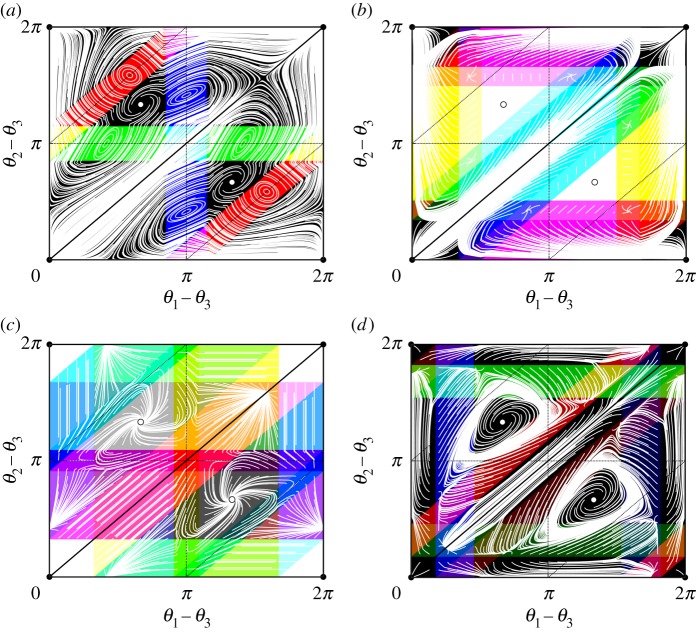
The dynamics of networks of interacting dynamical systems depend on the nature of the coupling between individual units. We explore networks of oscillatory units with coupling functions that have 'dead zones', that is the coupling functions are zero on sets with interior. For such networks, it is convenient to look at the effective interactions between units rather than the (fixed) structural connectivity to understand the network dynamics. For example, oscillators may effectively decouple in particular phase configurations. Along trajectories, the effective interactions are not necessarily static, but the effective coupling may evolve in time. Here, we formalize the concepts of dead zones and effective interactions. We elucidate how the coupling function shapes the possible effective interaction schemes and how they evolve in time. This article is part of the theme issue 'Coupling functions: dynamical interaction mechanisms in the physical, biological and social sciences'.
相互作用的动力系统网络的动态取决于个体单元之间耦合的性质。我们探索了具有“死区”的耦合函数的振荡单元网络,也就是说,在内部有集合的情况下,耦合函数为零。对于这样的网络,研究单元之间的有效相互作用而不是(固定的)结构连接性来理解网络动态是很方便的。例如,振荡器在特定的相位配置中可能会有效地解耦。在轨迹上,有效相互作用不一定是静态的,但有效耦合可能随时间演变。在这里,我们形式化了死区和有效相互作用的概念。我们阐明了耦合函数如何塑造可能的有效相互作用方案以及它们如何随时间演变。本文是“耦合函数:物理、生物和社会科学中的动力学相互作用机制”主题特刊的一部分。