Department of Epidemiology and Public Health Graduate School of Medical Sciences Kyushu University Fukuoka Japan.
Department of Anesthesiology and Critical Care Medicine Graduate School of Medical Sciences Kyushu University Fukuoka Japan.
J Am Heart Assoc. 2019 Nov 5;8(21):e013628. doi: 10.1161/JAHA.119.013628. Epub 2019 Oct 28.
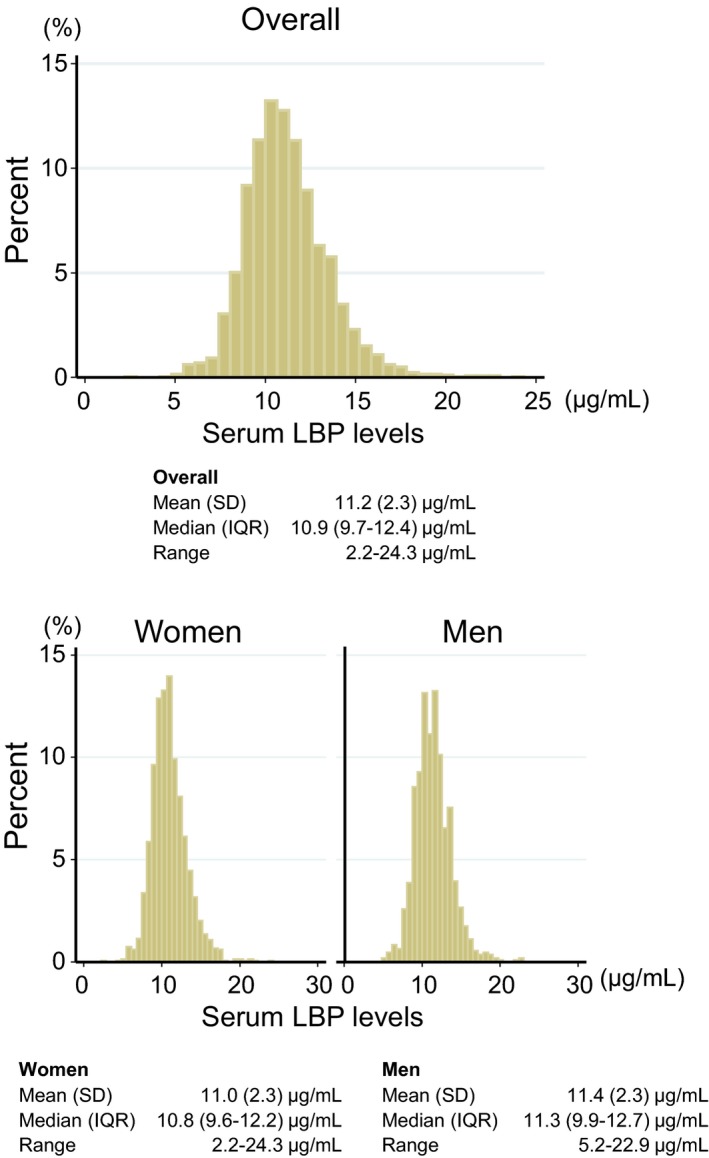
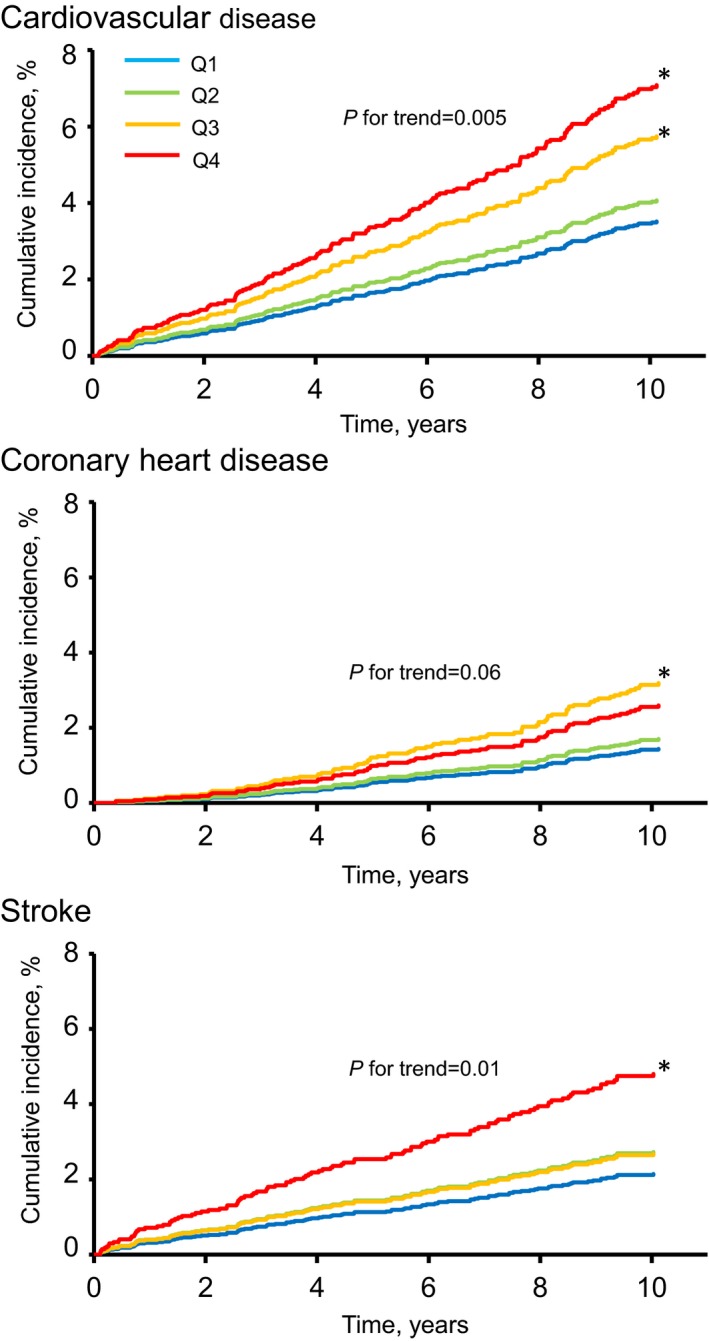
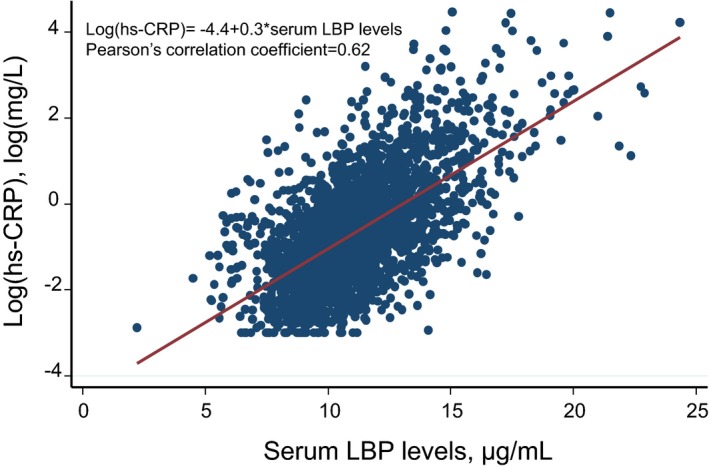
Background Epidemiological studies have reported a link between serum LBP (lipopolysaccharide-binding protein) levels and lifestyle-related diseases. However, there have been no longitudinal studies investigating the association of serum LBP levels and the incidence of cardiovascular disease (CVD) in general populations. Methods and Results A total of 2568 community-dwelling Japanese individuals 40 years and older without prior CVD were followed for 10 years (2002-2012). Serum LBP levels were divided into quartiles (quartile 1: 2.20-9.68 μg/mL; quartile 2: 9.69-10.93 μg/mL; quartile 3: 10.94-12.40 μg/mL; quartile 4: 12.41-24.34 μg/mL). The hazard ratios (HRs) and their 95% CIs for the incidence of CVD were computed using a Cox proportional hazards model. During the follow-up period, 180 individuals developed CVD. The age- and sex-adjusted cumulative incidence of CVD increased significantly with higher serum LBP levels ( for trend=0.005). Individuals with higher serum LBP levels had a significantly greater risk of the development of CVD after adjusting for conventional cardiovascular risk factors (quartile 1: HR, 1.00 [reference]; quartile 2: HR, 1.04 [95% CI, 0.60-1.78]; quartile 3: HR, 1.52 [95% CI, 0.92-2.51]; and quartile 4: HR, 1.90 [95% CI, 1.17-3.09]; for trend=0.01). This association remained significant after additional adjustment for homeostasis model assessment of insulin resistance ( for trend=0.01). However, when additional adjustment was made for high-sensitivity C-reactive protein, the association was attenuated to the nonsignificant level ( for trend=0.08). Conclusions The present findings suggest that higher serum LBP levels are associated with increased risk of the development of CVD in the general Japanese population. Low-grade endotoxemia may contribute to the pathogenesis of CVD through chronic systemic inflammation.
背景 流行病学研究报告称,血清 LBP(脂多糖结合蛋白)水平与生活方式相关疾病之间存在关联。然而,目前还没有纵向研究调查一般人群中血清 LBP 水平与心血管疾病(CVD)发病率之间的关系。
方法和结果 共纳入 2568 名无既往 CVD 的 40 岁及以上社区居民,随访 10 年(2002-2012 年)。将血清 LBP 水平分为四组(第 1 组:2.20-9.68μg/mL;第 2 组:9.69-10.93μg/mL;第 3 组:10.94-12.40μg/mL;第 4 组:12.41-24.34μg/mL)。采用 Cox 比例风险模型计算 CVD 发病率的风险比(HR)及其 95%CI。在随访期间,180 人发生 CVD。年龄和性别校正后的 CVD 累积发病率随血清 LBP 水平升高而显著升高(趋势=0.005)。在校正传统心血管危险因素后,血清 LBP 水平较高的个体发生 CVD 的风险显著增加(第 1 组:HR,1.00[参考值];第 2 组:HR,1.04[95%CI,0.60-1.78];第 3 组:HR,1.52[95%CI,0.92-2.51];第 4 组:HR,1.90[95%CI,1.17-3.09];趋势=0.01)。当进一步校正胰岛素抵抗的稳态模型评估(HOMA-IR)后,这种关联仍然显著(趋势=0.01)。然而,当进一步校正高敏 C 反应蛋白后,这种关联减弱至无统计学意义水平(趋势=0.08)。
结论 本研究结果表明,在日本普通人群中,较高的血清 LBP 水平与 CVD 发病风险增加相关。低度内毒素血症可能通过慢性全身炎症导致 CVD 的发病机制。