Division in Anatomy and Developmental Biology, Department of Oral Biology, Human Identification Research Institute, BK21 PLUS Project, Yonsei University College of Dentistry, Seoul, South Korea.
Department of Anatomy, Yonsei University College of Medicine, Seoul, South Korea.
PLoS One. 2019 Oct 28;14(10):e0224487. doi: 10.1371/journal.pone.0224487. eCollection 2019.
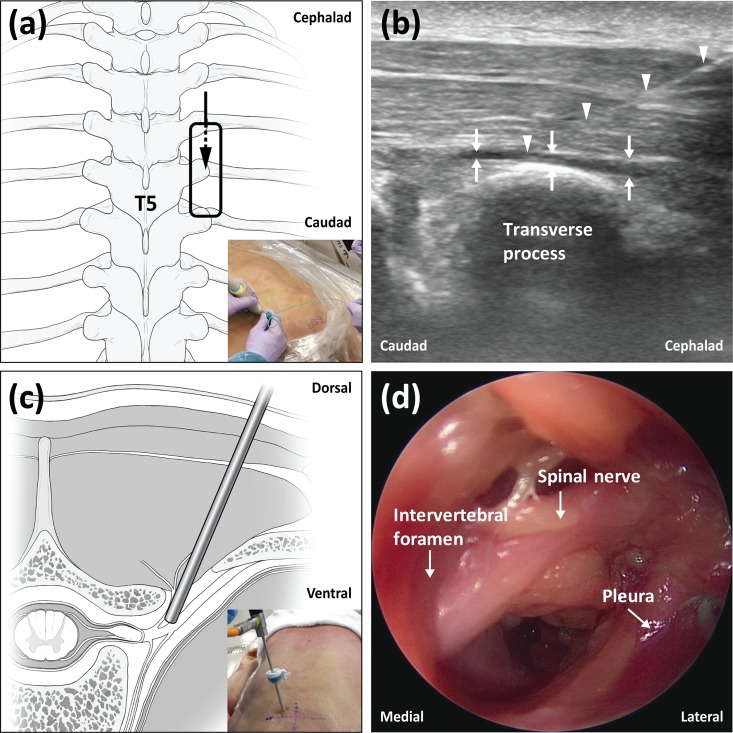
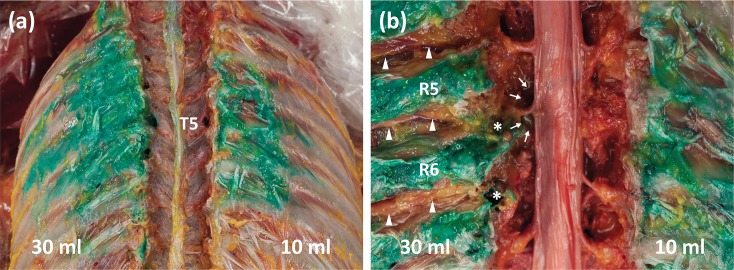
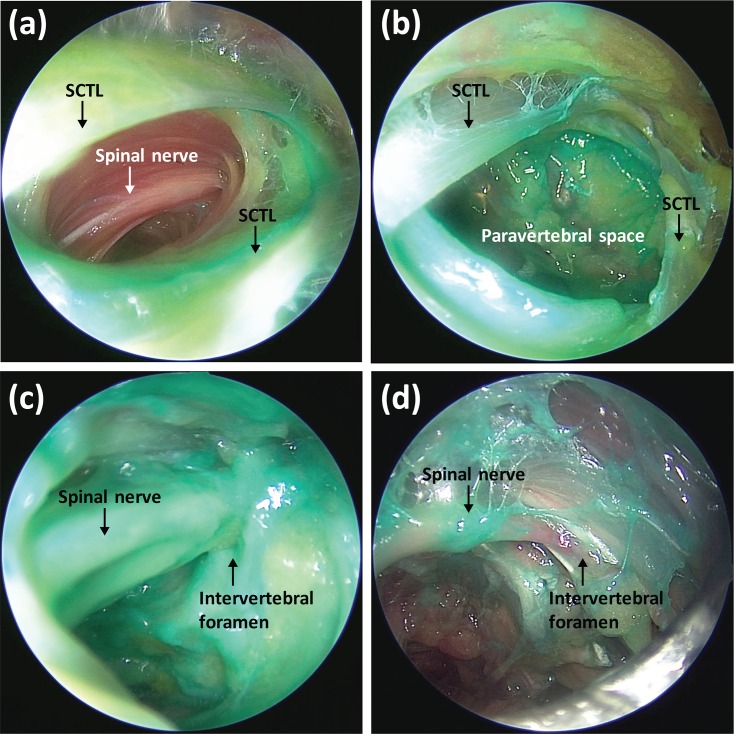
The paravertebral spread that occurs after erector spinae plane block may be volume-dependent. This cadaveric study was undertaken to compare the extent of paravertebral spread with erector spinae plane block using different dye volumes. After randomization, twelve erector spinae plane blocks were performed bilaterally with either 10 ml or 30 ml of dye at the level of T5 in seven unembalmed cadavers except for two cases of unexpected pleural puncture using the 10 ml injection. Direct visualization of the paravertebral space by endoscopy was performed immediately after the injections. The back regions were also dissected, and dye spread and nerve involvement were investigated. A total of five 10 ml injections and seven 30 ml injections were completed for both endoscopic and anatomical evaluations. No paravertebral spread was observed by endoscopy after any of the 10-ml injections. Dye spread to spinal nerves at the intervertebral foramen was identified by endoscopy at adjacent levels of T5 (median: three levels) in all 30 ml injections. In contrast, the cases with two, four, and three out of five were stained at only the T4, T5, and T6 levels, respectively, with the 10 ml injection. Upon anatomical dissection, all blocks were consistently associated with posterior and lateral spread to back muscles and fascial layers, especially with the 30 ml injections, which showed greater dye expansion. In one 30 ml injection, sympathetic nerve involvement and epidural spread were observed at the level of the injection site. Although paravertebral spread following erector spinae plane block increased in a volume-dependent manner, this increase was variable and not pronounced. As the injectate volume increased for the erector spinae blocks, the injectate spread to the back muscles and fascial layers seemed to be predominantly increased compared with, the extent of paravertebral spread.
竖脊肌平面阻滞(erector spinae plane block)后发生的椎旁扩散可能与容量有关。本尸体研究旨在比较使用不同染料量进行竖脊肌平面阻滞时椎旁扩散的程度。在七个未防腐的尸体中,除了两例使用 10ml 注射时发生意外胸膜穿刺的情况外,随机分为两组,每组 10 或 30ml 染料,在 T5 水平行双侧竖脊肌平面阻滞。注射后立即通过内窥镜直接观察椎旁间隙。背部区域也进行解剖,研究染料扩散和神经受累情况。共完成了 5 次 10ml 注射和 7 次 30ml 注射,分别用于内窥镜和解剖评估。任何 10ml 注射后,内窥镜均未观察到椎旁扩散。所有 30ml 注射后,内窥镜均可在 T5 相邻水平(中位数:三个水平)识别出染料扩散至椎间孔的脊神经。相比之下,10ml 注射仅在 T4、T5 和 T6 水平分别有两例、四例和三例染色。解剖后,所有阻滞均与背部肌肉和筋膜层的后向和侧向扩散一致,尤其是在 30ml 注射时,显示出更大的染料扩张。在一次 30ml 注射中,在注射部位观察到交感神经受累和硬膜外扩散。尽管竖脊肌平面阻滞后椎旁扩散呈剂量依赖性增加,但这种增加是可变的,并不明显。随着竖脊肌阻滞的注射量增加,与椎旁扩散程度相比,注射物向背部肌肉和筋膜层的扩散似乎主要增加。