MassGeneral Institute for Neurodegenerative Disease, Charlestown, MA, USA.
Department of Neurology, Massachusetts General Hospital, WACC Suite 715 15th Parkman St, Boston, MA, 02114, USA.
Acta Neuropathol Commun. 2019 Oct 28;7(1):164. doi: 10.1186/s40478-019-0808-1.
Chronic traumatic encephalopathy (CTE) is a tauopathy associated to repetitive head trauma. There are no validated in vivo biomarkers of CTE and a definite diagnosis can only be made at autopsy. Recent studies have shown that positron emission tomography (PET) tracer AV-1451 (Flortaucipir) exhibits high binding affinity for paired helical filament (PHF)-tau aggregates in Alzheimer (AD) brains but relatively low affinity for tau lesions in other tauopathies like temporal lobal degeneration (FTLD)-tau, progressive supranuclear palsy (PSP) or corticobasal degeneration (CBD). Little is known, however, about the binding profile of this ligand to the tau-containing lesions of CTE.
To study the binding properties of [F]-AV-1451 on pathologically confirmed CTE postmortem brain tissue samples.
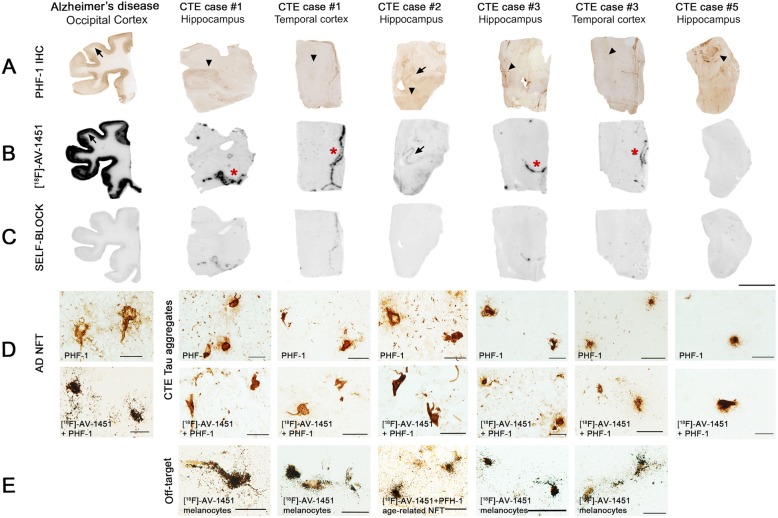
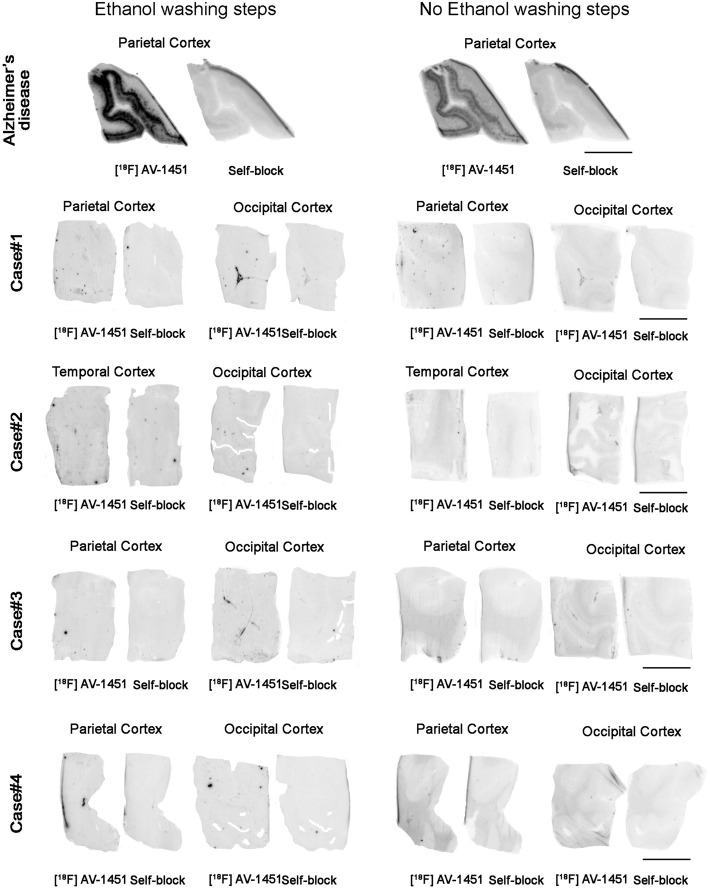
We performed [F]-AV-1451 phosphor screen and high resolution autoradiography, quantitative tau measurements by immunohistochemistry and Western blot and tau seeding activity assays in brain blocks containing hippocampus, superior temporal cortex, superior frontal cortex, inferior parietal cortex and occipital cortex from 5 cases of CTE, across the stages of disease: stage II-III (n = 1), stage III (n = 3), and stage IV (n = 1). Importantly, low or no concomitant classic AD pathology was present in these brains.
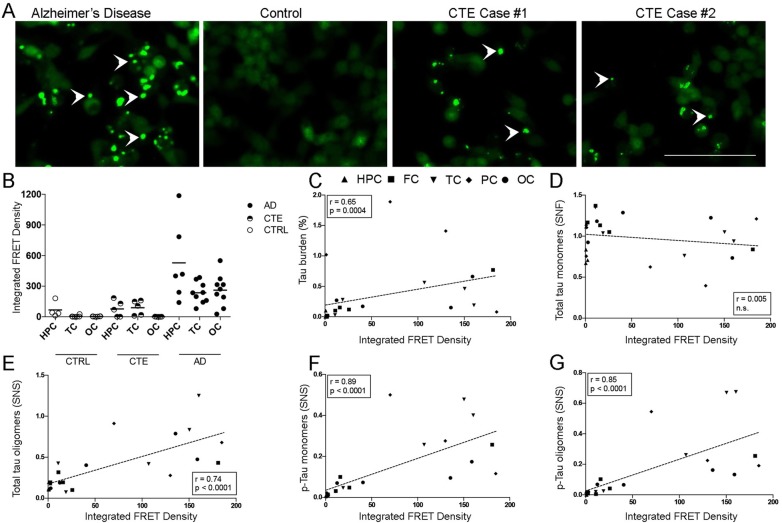
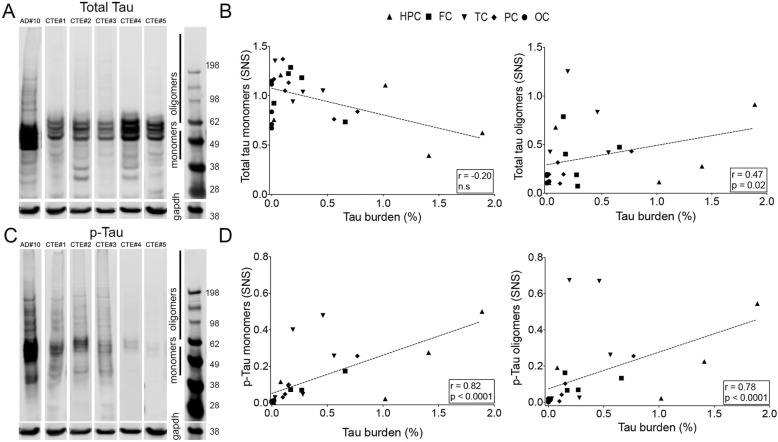
Despite the presence of abundant tau aggregates in multiple regions in all CTE brains, only faint or no [F]-AV-1451 binding signal could be detected by autoradiography. The only exception was the presence of a strong signal confined to the region of the choroid plexus and the meninges in two of the five cases. Tau immunostaining and Thioflavin-S staining ruled out the presence of tau aggregates in those regions. High resolution nuclear emulsion autoradiography revealed the presence of leptomeningeal melanocytes as the histologic source of this off-target binding. Levels of abnormally hyperphosphorylated tau species, as detected by Western Blotting, and tau seeding activity were both found to be lower in extracts from cases CTE when compared to AD.
AV-1451 may have limited utility for in vivo selective and reliable detection of tau aggregates in CTE. The existence of disease-specific tau conformations may likely explain the differential binding affinity of this tracer for tau lesions in different tauopathies.
慢性创伤性脑病(CTE)是一种与反复头部创伤相关的 tau 病。目前尚无经过验证的 CTE 体内生物标志物,只有在尸检时才能做出明确诊断。最近的研究表明,正电子发射断层扫描(PET)示踪剂 AV-1451(Flortaucipir)在阿尔茨海默病(AD)大脑中对双螺旋细丝(PHF)-tau 聚集物具有高结合亲和力,但对其他 tau 病(如颞叶变性(FTLD)-tau、进行性核上性麻痹(PSP)或皮质基底节变性(CBD)中的 tau 病变的亲和力相对较低。然而,对于这种配体与 CTE 中含 tau 病变的结合特征,我们知之甚少。
研究 [F]-AV-1451 在经病理证实的 CTE 尸检脑组织样本中的结合特性。
我们在含有海马、颞上皮质、额上皮质、顶下皮质和枕叶皮质的脑块中进行了 [F]-AV-1451 磷屏和高分辨率放射自显影、免疫组化和 Western blot 定量 tau 测量以及 tau 接种活性测定,这些脑块来自 5 例 CTE 病例,跨越疾病阶段:II-III 期(n=1)、III 期(n=3)和 IV 期(n=1)。重要的是,这些大脑中几乎没有或没有同时存在典型的 AD 病理学。
尽管所有 CTE 大脑的多个区域都存在丰富的 tau 聚集物,但仅通过放射自显影检测到微弱或不存在 [F]-AV-1451 结合信号。唯一的例外是在 5 例中的 2 例中,仅在脉络丛和脑膜区域存在强烈信号。tau 免疫染色和硫黄素-S 染色排除了这些区域存在 tau 聚集物的可能性。高分辨率核乳胶放射自显影显示,脑膜黑色素细胞是这种脱靶结合的组织来源。Western Blotting 检测到异常高磷酸化 tau 物种的水平以及 tau 接种活性均发现 CTE 病例提取物中的水平低于 AD。
AV-1451 可能对 CTE 中 tau 聚集物的体内选择性和可靠检测的应用有限。这种示踪剂对不同 tau 病中的 tau 病变的不同结合亲和力可能归因于疾病特异性 tau 构象的存在。