School of Economics and Management, Tongji University, Shanghai 200092, China.
School of Management and Labor Relations, Rutgers University, New Brunswick, NJ 08854, USA.
Int J Environ Res Public Health. 2019 Oct 28;16(21):4162. doi: 10.3390/ijerph16214162.
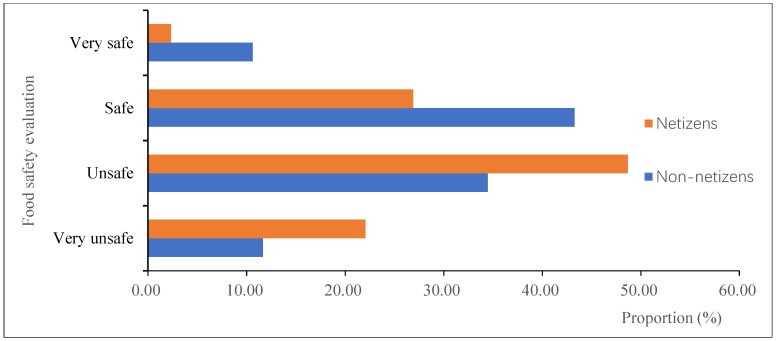
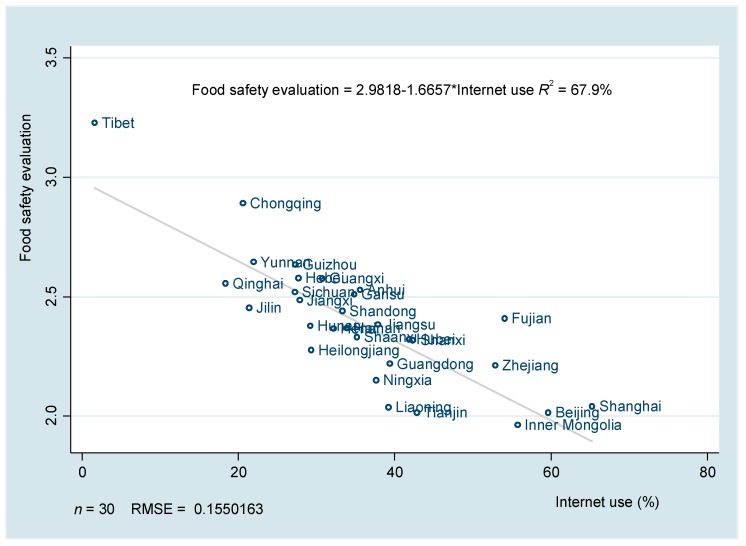
A growing body of research has shown that people's attitudes toward food safety is affected by their availability and accessibility to food risk information. In the digital era, the Internet has become the most important channel for information acquisition. However, empirical evidence related to the impact of Internet use on people's attitudes towards food safety is inadequate. In this study, by employing the Chinese Social Survey for 2013 and 2015, we have investigated the current situation of food safety perceptions and evaluations among Chinese residents and the association between Internet use and individuals' food safety evaluations. Empirical results indicate that there is a significant negative correlation between Internet use and people's food safety evaluation in China. Furthermore, heterogeneity analysis shows that Internet use has a stronger negative correlation with food safety evaluation for those lacking rational judgment regarding Internet information. Specifically, the negative correlation between Internet use and food safety evaluations is more obvious among rural residents, young people, and less educated residents. Finally, propensity score matching (PSM) is applied to conduct a robustness check. This paper provides new evidence for studies on the relationship between Internet use and an individuals' food safety cognition, as well as additional policy enlightenment for food safety risk management in the digital age.
越来越多的研究表明,人们对食品安全的态度受到他们获取和接触食品风险信息的可及性和便利性的影响。在数字时代,互联网已成为获取信息的最重要渠道。然而,有关互联网使用对人们对食品安全态度影响的实证证据还不够充分。在这项研究中,我们利用 2013 年和 2015 年的中国社会调查数据,调查了中国居民对食品安全的认知和评价现状,以及互联网使用与个人食品安全评价之间的关系。实证结果表明,互联网使用与中国人的食品安全评价之间存在显著的负相关关系。此外,异质性分析表明,对于那些缺乏对互联网信息进行理性判断的人来说,互联网使用与食品安全评价的负相关性更强。具体而言,互联网使用与食品安全评价之间的负相关性在农村居民、年轻人和受教育程度较低的居民中更为明显。最后,我们应用倾向得分匹配(PSM)进行稳健性检验。本文为研究互联网使用与个人食品安全认知之间的关系提供了新的证据,并为数字时代的食品安全风险管理提供了额外的政策启示。