Niederhauser Andrea, Züllig Stephanie, Marschall Jonas, Schweiger Alexander, John Gregor, Kuster Stefan P, Schwappach David Lb
Swiss Patient Safety Foundation, Zurich, Switzerland
Swiss Patient Safety Foundation, Zurich, Switzerland.
BMJ Open. 2019 Oct 28;9(10):e028740. doi: 10.1136/bmjopen-2018-028740.
To evaluate changes in staff perspectives towards indwelling urinary catheter (IUC) use after implementation of a 1-year quality improvement project.
Repeated cross-sectional survey at baseline (October 2016) and 12-month follow-up (October 2017).
Seven acute care hospitals in Switzerland.
The survey was targeted at all nursing and medical staff members working at the participating hospitals at the time of survey distribution. A total of 1579 staff members participated in the baseline survey (T) (49% response rate) and 1527 participated in the follow-up survey (T) (47% response rate).
A multimodal intervention bundle, consisting of an evidence-based indication list, daily re-evaluation of ongoing catheter need and staff training, was implemented over the course of 9 months.
Staff knowledge (15 items), perception of current practices and culture (scale 1-7), self-reported responsibilities (multiple-response question) and determinants of behaviour (scale 1-7) before and after implementation of the intervention bundle.
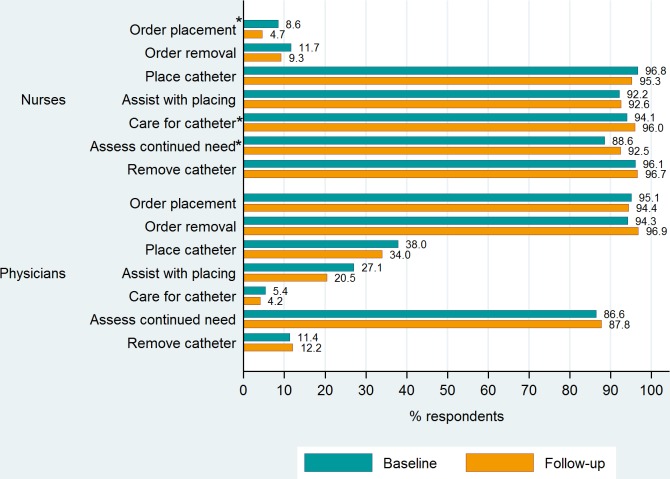
The mean number of correctly answered knowledge questions increased significantly between the two survey periods (T: 10.4, T: 11.0; p<0.001). Self-reported responsibilities with regard to IUC management by nurses and physicians changed only slightly over time. Perception of current practices and culture in regard to safe urinary catheter use increased significantly (T: 5.3, T: 5.5; p<0.001). Significant changes were also observed for determinants of behaviour (T: 5.3, T: 5.6; p<0.001).
We found small but significant changes in staff perceptions after implementation of an evidence-based intervention bundle. Efforts now need to be targeted at sustaining and reinforcing these changes, so that restrictive use of IUCs becomes an integral part of the hospital culture.
评估在实施一项为期1年的质量改进项目后,工作人员对留置导尿管(IUC)使用的看法变化。
在基线期(2016年10月)和12个月随访期(2017年10月)进行重复横断面调查。
瑞士的7家急症护理医院。
调查对象为在调查分发时在参与医院工作的所有护理和医务人员。共有1579名工作人员参与了基线调查(T1)(应答率49%),1527名参与了随访调查(T2)(应答率47%)。
在9个月的时间里实施了一个多模式干预包,包括基于证据的适应证清单、对持续导尿需求的每日重新评估和工作人员培训。
干预包实施前后工作人员的知识(15项)、对当前做法和文化的认知(1-7分制)、自我报告的职责(多项选择题)以及行为决定因素(1-7分制)。
两个调查期之间,正确回答的知识问题平均数量显著增加(T1:10.4,T2:11.0;p<0.001)。护士和医生在IUC管理方面自我报告的职责随时间变化不大。对安全使用导尿管的当前做法和文化的认知显著增加(T1:5.3,T2:5.5;p<0.001)。行为决定因素也有显著变化(T1:5.3,T2:5.6;p<0.001)。
我们发现,在实施基于证据的干预包后,工作人员的看法有微小但显著的变化。现在需要努力维持和加强这些变化,以使IUC的限制性使用成为医院文化的一个组成部分。