Department of Epidemiology, School of Public Health, University of Michigan, Ann Arbor, Michigan.
Department of Surgery, Michigan Medicine, Ann Arbor, Michigan.
Ann Surg. 2021 Jun 1;273(6):1127-1134. doi: 10.1097/SLA.0000000000003621.
To measure the association between patient-reported satisfaction and regret and clinical outcomes.
Patient-reported outcomes are becoming an increasingly important marker of the quality of patient care. It is unclear however, how well patient-reported outcomes adequately reflect care quality and clinical outcomes in surgical patients.
Retrospective, population-based analysis of adults ages 18 and older undergoing surgery across 38 hospitals in Michigan between January 1, 2017 and May 31, 2018.
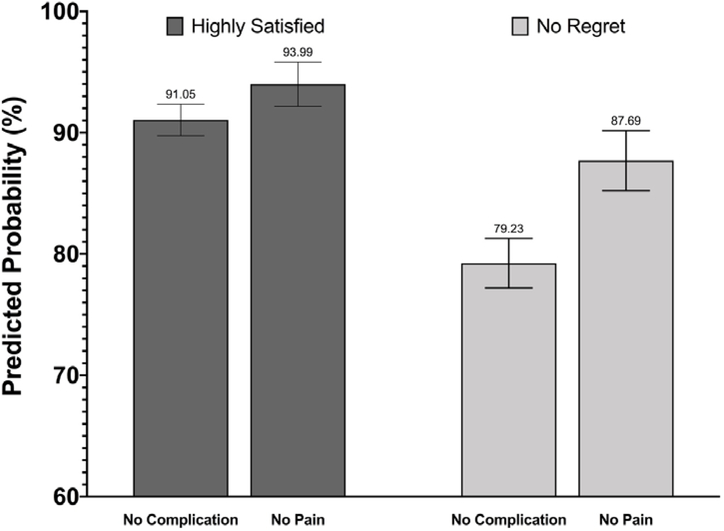
In this study, 9953 patients (mean age 56 years; 5634 women (57%)) underwent 1 of 16 procedures. 9550 (96%) patients experienced no complication, whereas 240 (2%) and 163 (2%) patients experienced Grade 1 and Grade 2-3 complications, respectively. Postoperative pain scores were: none (908 (9%) patients), mild (3863 (40%) patients), moderate (3893 (40%) patients), and severe (1075 (11%) patients). Overall, 7881 (79%) patients were highly satisfied and 8911 (91%) had absolutely no regret after surgery. Patients were less likely to be highly satisfied if they experienced a Grade 1 complication [odds ratio (OR) 0.50, 95% confidence interval (CI) 0.37-0.66], Grade 2-3 complication (OR 0.44, 95% CI 0.31-0.62), minimal pain (OR 0.80, 95% CI 0.64-0.99, moderate pain (OR 0.39, 95% CI 0.32-0.49), or severe pain (OR 0.23, 95% CI 0.18-0.29). Patients were less likely to have no regret if they experienced a Grade 1 complication (OR 0.48, 95% CI 0.33-0.70), Grade 2-3 complication (OR 0.39, 95% CI 0.25-0.60), moderate pain (OR 0.55, 95% CI 0.40-0.76), or severe pain (OR 0.22, 95% CI 0.16-0.31). The predicted probability of being highly satisfied was 79% for patients who had no complications and 88% for patients who had no pain.
Patients who experienced postoperative complications and pain were less likely to be highly satisfied or have no regret. Notably, postoperative pain had a more significant effect on satisfaction and regret after surgery, suggesting focused postsurgical pain management is an opportunity to substantially improve patient experiences. More research and patient education are needed for managing expectations of postoperative pain, and use of adjuncts and regional anesthesia.
测量患者报告的满意度和遗憾与临床结果之间的关联。
患者报告的结果正成为衡量患者护理质量的一个越来越重要的指标。然而,目前尚不清楚患者报告的结果在多大程度上能充分反映手术患者的护理质量和临床结果。
对 2017 年 1 月 1 日至 2018 年 5 月 31 日期间在密歇根州 38 家医院接受手术的 18 岁及以上成年人进行回顾性、基于人群的分析。
在这项研究中,9953 名患者(平均年龄 56 岁;5634 名女性(57%))接受了 16 种手术中的 1 种。9550 名(96%)患者无并发症,240 名(2%)和 163 名(2%)患者分别出现 1 级和 2-3 级并发症。术后疼痛评分如下:无(908 名患者(9%))、轻度(3863 名患者(40%))、中度(3893 名患者(40%))和重度(1075 名患者(11%))。总体而言,7881 名(79%)患者非常满意,8911 名(91%)患者术后绝对没有遗憾。如果患者出现 1 级并发症[比值比(OR)0.50,95%置信区间(CI)0.37-0.66]、2-3 级并发症(OR 0.44,95% CI 0.31-0.62)、轻微疼痛(OR 0.80,95% CI 0.64-0.99)、中度疼痛(OR 0.39,95% CI 0.32-0.49)或严重疼痛(OR 0.23,95% CI 0.18-0.29),他们不太可能非常满意。如果患者出现 1 级并发症(OR 0.48,95% CI 0.33-0.70)、2-3 级并发症(OR 0.39,95% CI 0.25-0.60)、中度疼痛(OR 0.55,95% CI 0.40-0.76)或严重疼痛(OR 0.22,95% CI 0.16-0.31),他们不太可能没有遗憾。无并发症和无疼痛的患者中,非常满意的预测概率分别为 79%和 88%。
出现术后并发症和疼痛的患者不太可能非常满意或没有遗憾。值得注意的是,术后疼痛对手术后的满意度和遗憾有更显著的影响,这表明集中进行术后疼痛管理有机会显著改善患者体验。需要进一步研究和患者教育,以管理对术后疼痛的预期,并使用辅助药物和区域麻醉。