Adelaide Medical School and Robinson Research Institute, University of Adelaide, Adelaide, 5005, SA, Australia.
Institute of Translational Pharmacology, National Research Council, Rome, Italy.
Nat Commun. 2019 Oct 29;10(1):4920. doi: 10.1038/s41467-019-12671-y.
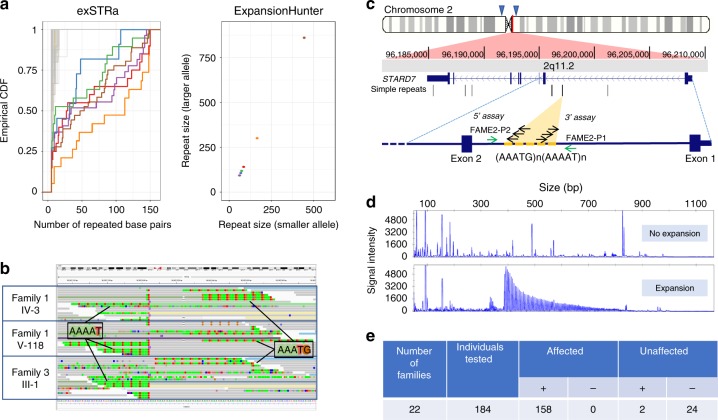
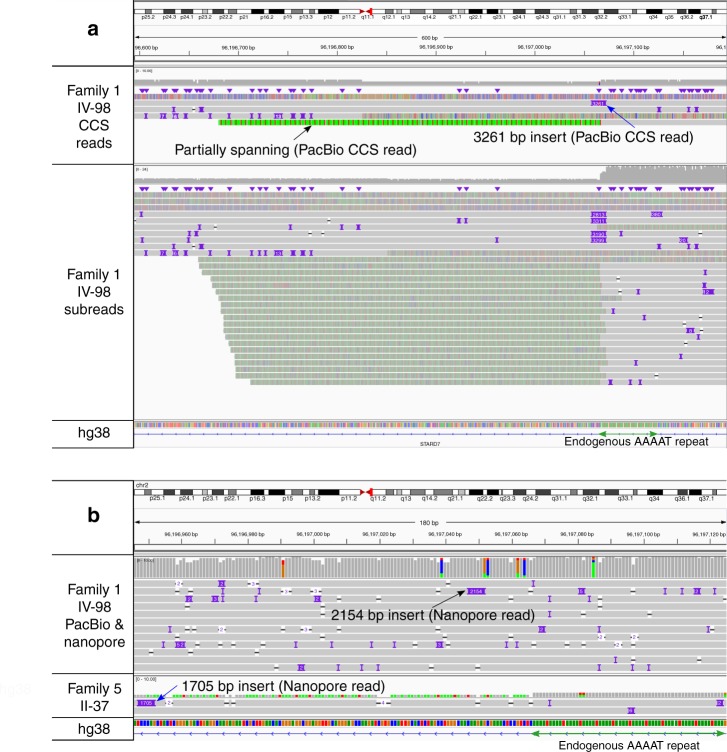
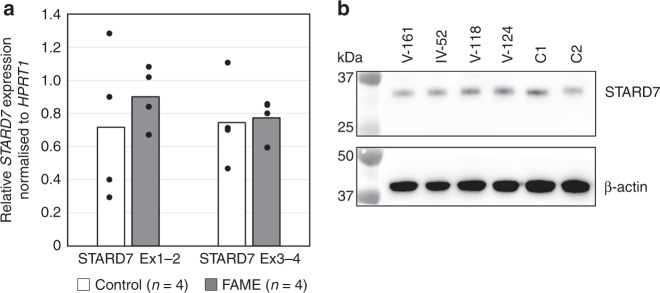
Familial Adult Myoclonic Epilepsy (FAME) is characterised by cortical myoclonic tremor usually from the second decade of life and overt myoclonic or generalised tonic-clonic seizures. Four independent loci have been implicated in FAME on chromosomes (chr) 2, 3, 5 and 8. Using whole genome sequencing and repeat primed PCR, we provide evidence that chr2-linked FAME (FAME2) is caused by an expansion of an ATTTC pentamer within the first intron of STARD7. The ATTTC expansions segregate in 158/158 individuals typically affected by FAME from 22 pedigrees including 16 previously reported families recruited worldwide. RNA sequencing from patient derived fibroblasts shows no accumulation of the AUUUU or AUUUC repeat sequences and STARD7 gene expression is not affected. These data, in combination with other genes bearing similar mutations that have been implicated in FAME, suggest ATTTC expansions may cause this disorder, irrespective of the genomic locus involved.
家族性成年肌阵挛性癫痫(FAME)的特征是皮质肌阵挛性震颤,通常始于生命的第二个十年,并有明显的肌阵挛或全面强直阵挛发作。已经在染色体(chr)2、3、5 和 8 上确定了四个与 FAME 相关的独立基因座。使用全基因组测序和重复引物 PCR,我们提供的证据表明,chr2 相关的 FAME(FAME2)是由 STARD7 第一个内含子内的 ATTTC 五聚体扩展引起的。ATTTC 扩展在来自 22 个家系的 158/158 个通常受 FAME 影响的个体中分离,包括在全球范围内招募的 16 个先前报道的家系。源自患者衍生成纤维细胞的 RNA 测序未显示 AUUUU 或 AUUUC 重复序列的积累,并且 STARD7 基因表达不受影响。这些数据,结合其他被认为与 FAME 相关的基因具有类似的突变,表明 ATTTC 扩展可能导致这种疾病,而与涉及的基因组基因座无关。