Berge Andreas, Kronberg Karin, Sunnerhagen Torgny, Nilson Bo H K, Giske Christian G, Rasmussen Magnus
Unit of Infectious Diseases, Department of Medicine, Solna, Karolinska Institutet, Stockholm, Sweden.
Department of Infectious Diseases, Karolinska University Hospital, Stockholm, Sweden.
Open Forum Infect Dis. 2019 Oct 4;6(10):ofz437. doi: 10.1093/ofid/ofz437. eCollection 2019 Oct.
Many genera and species of -like bacteria (SLB) can cause infective endocarditis (IE), but little is known about the epidemiology of and the risk factors for IE in SLB-bacteremia. The aim of the study was to analyze this in a cohort of patients with SLB-bacteremia, focusing on , , , and We also evaluated whether published scoring systems generated for other Gram-positive bacteria known to cause IE (HANDOC for streptococci and NOVA and DENOVA for enterococci) could be used in SLB bacteremia to decide whether transesophageal echocardiography (TEE) could be omitted.
Positive blood cultures with SLB were retrieved from population-based registries in Sweden (3.2 million inhabitants), from January 2012 to December 2017. Clinical data were collected from medical records. Risk factors for IE were analyzed and the performances of the scoring systems were calculated.
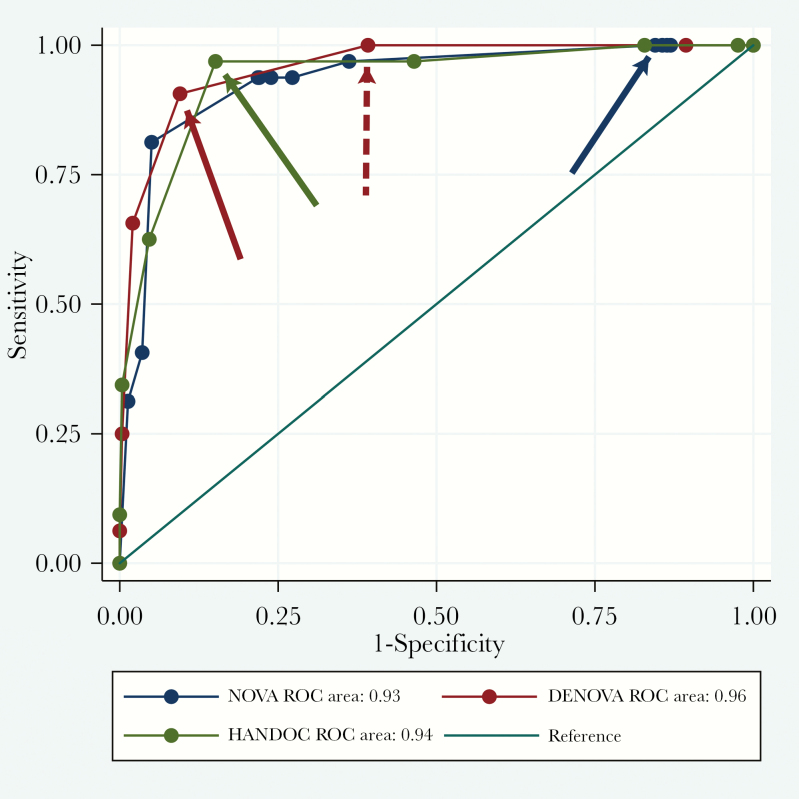
The incidence of bacteremia with the 4 SLB genera was 30 episodes/1 000 000 population per year, of which contributed with 18. Among 568 episodes of bacteremia, 32 cases of IE were identified (5.6%). Infective endocarditis was most common in bacteremia with (4 of 19) followed by (9 of 124), (6 of 87), and (13 of 338). NOVA had 100% sensitivity to identify IE but a low specificity (15%). For HANDOC and DENOVA, the sensitivities were 97% and 91%, respectively, whereas specificities were 85% and 90%, respectively, and numbers needed to screen were 3.6 and 2.8, respectively.
Bacteremia with these SLB is relatively rare, and the decision whether TEE should be performed or not could be based on either HANDOC or DENOVA.
许多类杆菌属(SLB)细菌可引起感染性心内膜炎(IE),但对于SLB菌血症中IE的流行病学及危险因素知之甚少。本研究旨在对一组SLB菌血症患者进行分析,重点关注[此处可能有缺失信息],我们还评估了针对其他已知可引起IE的革兰氏阳性菌所发布的评分系统(链球菌的HANDOC以及肠球菌的NOVA和DENOVA)是否可用于SLB菌血症,以决定是否可省略经食管超声心动图(TEE)检查。
从瑞典基于人群的登记处(320万居民)中检索2012年1月至2017年12月期间SLB血培养阳性结果。从病历中收集临床数据。分析IE的危险因素并计算评分系统的性能。
这4种SLB菌属的菌血症发病率为每年30例/100万人口,其中[此处可能有缺失信息]占18例。在568例菌血症发作中,确诊32例IE(5.6%)。感染性心内膜炎在[此处可能有缺失信息]菌血症中最为常见(19例中有4例),其次是[此处可能有缺失信息](124例中有9例)、[此处可能有缺失信息](87例中有6例)和[此处可能有缺失信息](338例中有13例)。NOVA识别IE的敏感性为100%,但特异性较低(15%)。对于HANDOC和DENOVA,敏感性分别为97%和91%,而特异性分别为85%和90%,筛查所需人数分别为3.6和2.8。
这些SLB菌血症相对罕见,是否进行TEE检查的决定可基于HANDOC或DENOVA。