Department of Internal Medicine, Fukuwatari Municipal Hospital, 1000 Fukuwatari, Takebe-cho, Kitaku, Okayama, 709-3111, Japan.
Department of Internal Medicine, Nippon Kokan Fukuyama Hospital, 1840 Tsunoshita, Daimon-cho, Fukuyama, 721-0927, Japan.
J Gastroenterol. 2020 Mar;55(3):281-288. doi: 10.1007/s00535-019-01639-w. Epub 2019 Oct 30.
Eradication of Helicobacter pylori reduces the risk of gastric cancer. In this study, we investigated the risk beyond 10 years after eradication of H. pylori.
We conducted a retrospective cohort study of 2737 patients who had yearly endoscopic follow-up after cure of H. pylori infection. For comparison of gastric cancer risk in the second decade of follow-up with that in the first decade, we calculated standardized incidence ratios (SIRs) by dividing the number of observed cases of gastric cancer in the second decade of follow-up by that of expected cases which was estimated using the incidence rate ratio of age in the first decade.
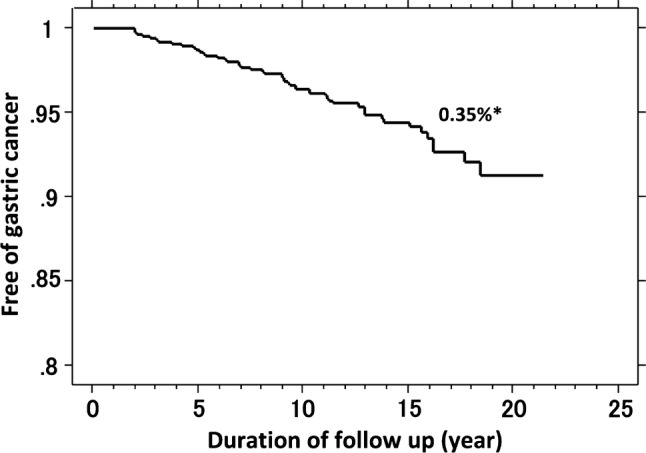
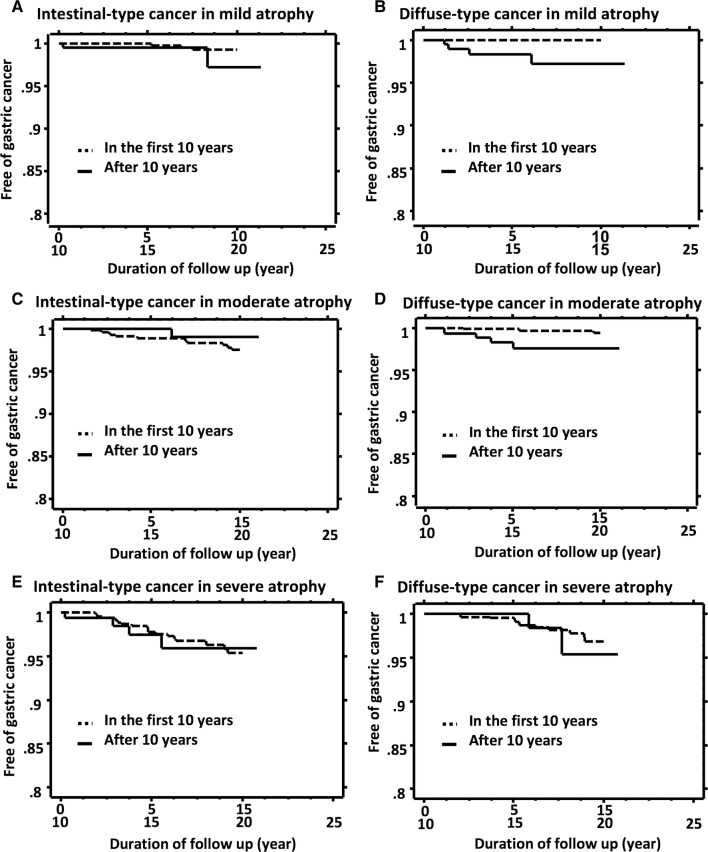
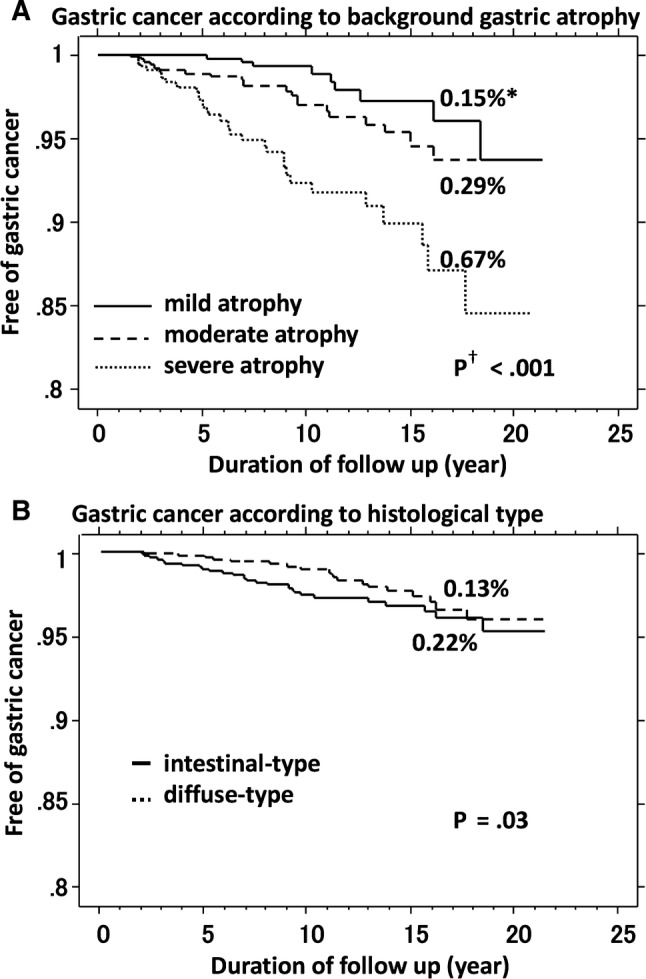
During the follow-up for as long as 21.4 years (mean 7.1 years), gastric cancer developed in 68 patients (0.35% per year). The SIRs for diffuse-type gastric cancer was infinity (0 expected case and 4 observed cases) in patients with mild gastric mucosal atrophy and 10.9 (95% confidence interval 4.53-26.1) with moderate atrophy, whereas no significant increase of SIRs was observed in intestinal-type cancer regardless of the grade of baseline gastric atrophy or in diffuse-type cancer in patients with severe atrophy even though who had the highest risk.
The longer the follow-up, the greater the risk of developing diffuse-type gastric cancer becomes in patients with mild-to-moderate gastric atrophy at baseline. Endoscopic surveillance should be continued beyond 10 years after cure of H. pylori irrespective of the severity of gastric atrophy.
根除幽门螺杆菌可降低胃癌风险。本研究旨在探讨根除幽门螺杆菌 10 年后的风险。
我们对 2737 例幽门螺杆菌感染治愈后每年进行内镜随访的患者进行了回顾性队列研究。为了比较第二十年随访期间和第一十年随访期间胃癌风险,我们通过将第二十年随访期间观察到的胃癌病例数除以第一十年的年龄发病率比估计的预期病例数来计算标准化发病比(SIR)。
在长达 21.4 年(平均 7.1 年)的随访期间,68 例患者(每年 0.35%)发生胃癌。轻度胃黏膜萎缩患者弥漫型胃癌 SIR 为无穷大(预期 0 例,观察 4 例),中度萎缩患者 SIR 为 10.9(95%置信区间 4.53-26.1),而无论基线胃萎缩程度如何,肠型胃癌或严重萎缩患者弥漫型胃癌的 SIR 均无显著增加,尽管这些患者的风险最高。
基线时轻度至中度胃萎缩的患者,随访时间越长,发生弥漫型胃癌的风险越高。无论胃萎缩的严重程度如何,根除幽门螺杆菌后,内镜监测应持续 10 年以上。