Lund University, Clinical Memory Research Unit, Lund, Sweden.
Alzheimer Center Amsterdam, Department of Neurology, Amsterdam Neuroscience, Vrije Universiteit Amsterdam, Amsterdam UMC, Amsterdam, the Netherlands.
Alzheimers Dement. 2020 Feb;16(2):335-344. doi: 10.1016/j.jalz.2019.08.201. Epub 2020 Jan 4.
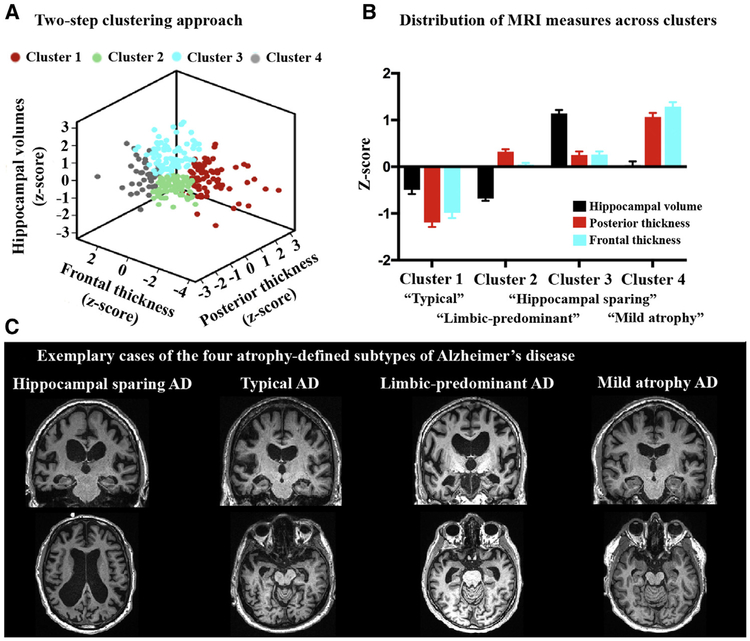
Differential patterns of brain atrophy on structural magnetic resonance imaging (MRI) revealed four reproducible subtypes of Alzheimer's disease (AD): (1) "typical", (2) "limbic-predominant", (3) "hippocampal-sparing", and (4) "mild atrophy". We examined the neurobiological characteristics and clinical progression of these atrophy-defined subtypes.
The four subtypes were replicated using a clustering method on MRI data in 260 amyloid-β-positive patients with mild cognitive impairment or AD dementia, and we subsequently tested whether the subtypes differed on [ F]flortaucipir (tau) positron emission tomography, white matter hyperintensity burden, and rate of global cognitive decline.
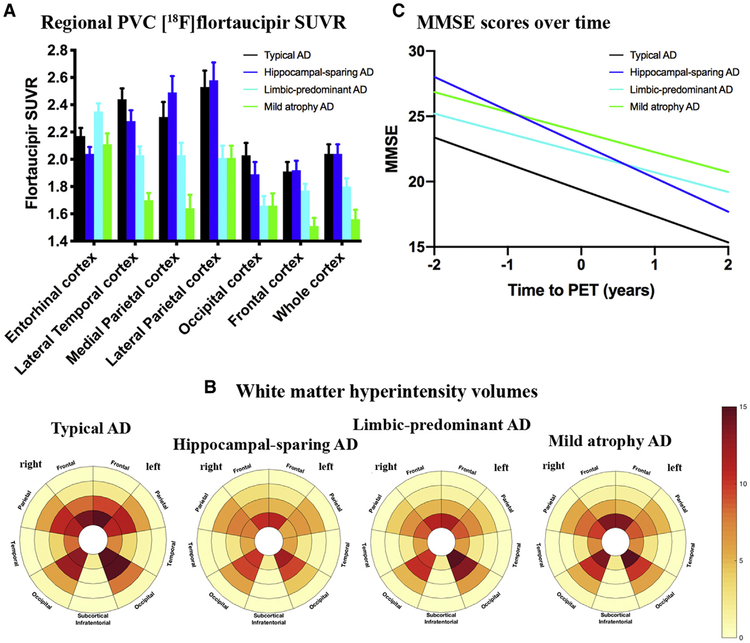
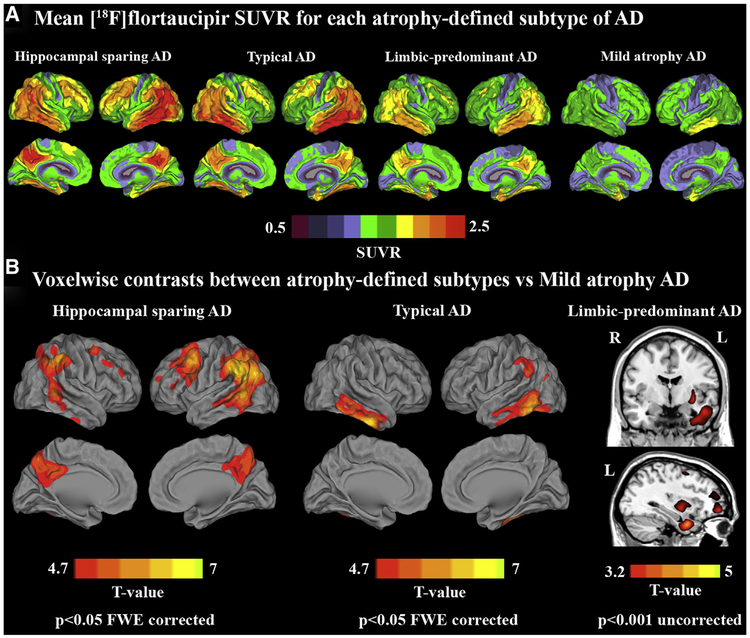
Voxel-wise and region-of-interest analyses revealed the greatest neocortical tau load in hippocampal-sparing (frontoparietal-predominant) and typical (temporal-predominant) patients, while limbic-predominant patients showed particularly high entorhinal tau. Typical patients with AD had the most pronounced white matter hyperintensity load, and hippocampal-sparing patients showed the most rapid global cognitive decline.
Our data suggest that structural MRI can be used to identify biologically and clinically meaningful subtypes of AD.
结构磁共振成像(MRI)显示的大脑萎缩的差异模式揭示了阿尔茨海默病(AD)的四种可重复的亚型:(1)“典型”,(2)“边缘优势型”,(3)“海马保留型”和(4)“轻度萎缩型”。我们研究了这些萎缩定义亚型的神经生物学特征和临床进展。
我们使用聚类方法在 260 名淀粉样蛋白-β阳性的轻度认知障碍或 AD 痴呆患者的 MRI 数据中复制了这四种亚型,随后测试了这些亚型在[F]flortaucipir(tau)正电子发射断层扫描、白质高信号负担和全球认知下降率上是否存在差异。
体素和感兴趣区域分析显示,在海马保留型(额顶叶优势型)和典型型(颞叶优势型)患者中,新皮质 tau 负荷最大,而边缘优势型患者表现出特别高的内嗅皮质 tau。AD 典型患者的白质高信号负荷最明显,海马保留型患者的全球认知下降最快。
我们的数据表明,结构 MRI 可用于识别具有生物学和临床意义的 AD 亚型。