Park Gil-Chun, Moon Deok-Bog, Kang Sang-Hyun, Ahn Chul-Soo, Hwang Shin, Kim Ki-Hun, Ha Tae-Yong, Song Gi-Won, Jung Dong-Hwan, Yoon Yong-In, Lee Sung-Gyu
Division of Hepatobiliary Surgery and Liver Transplantation, Department of Surgery, Asan Medical Center, University of Ulsan College of Medicine, Seoul, South Korea.
Ann Transplant. 2019 Nov 1;24:588-593. doi: 10.12659/AOT.919650.
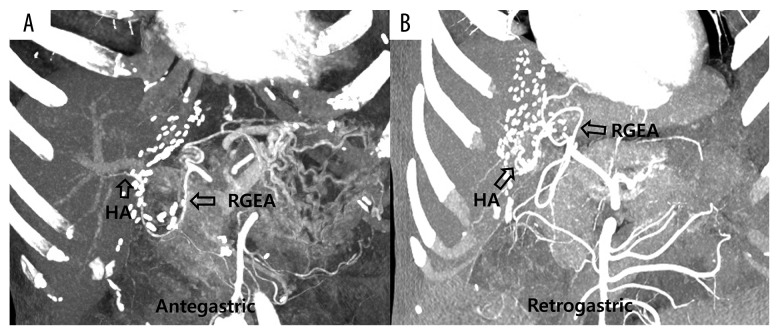
BACKGROUND Hepatic artery (HA) reconstruction in living donor liver transplantation (LDLT) is more technically demanding than deceased donor LT (DDLT) because of the small diameter and short HA stump of the partial liver graft. Hence, hepatic artery thrombosis (HAT) can occur infrequently even though the HA is reconstructed microscopically. HAT is closely related to graft failure and mortality. Therefore, HAT should be detected early and HA flow reconstituted using several arterial inflows. We successfully performed redo HA reconstruction in LDLT and report our management process and outcomes. MATERIAL AND METHODS The right gastroepiploic artery (RGEA) was used in 15 patients, previous native HA in 3, and interposition graft from the aorta in 1. All HA reconstructions were performed under a microscope using the end-to-end interrupted suture method. We reviewed technical feasibility, cause of hepatic artery revision (HAR), patency of redo HA flow, graft salvage rate, time of revision, biliary complications, and mortality. RESULTS Ten of 21 cases were salvage LT. Biliary complications developed in 6 cases. The mean interval of HAR with the RGEA was 1.5±1.2 postoperative days. All patients were alive without lethal complications of HAT during the mean follow-up period of 23.3 months. In the other 6 cases of HAR without using the RGEA, we performed redo HA reconstruction after thrombectomy with the native right HA (n=2), right gastric artery, left HA, gastroduodenal artery, and jump graft from the aorta (n=1, respectively). Among them, 3 died from biliary sepsis, graft dysfunction from large-sized ischemic injury, and pneumonia. CONCLUSIONS HAR with the RGEA is feasible for HAT management in LDLT patients without adequate hepatic arteries. When all inflows mentioned are unavailable, jump graft from the aorta using a cadaveric fresh iliac artery may be feasible.
背景 在活体肝移植(LDLT)中,肝动脉(HA)重建在技术上比尸体肝移植(DDLT)要求更高,因为部分肝移植的肝动脉直径小且肝动脉残端短。因此,即使在显微镜下重建肝动脉,肝动脉血栓形成(HAT)仍可能偶尔发生。HAT与移植失败和死亡率密切相关。因此,应早期检测HAT,并使用多种动脉流入方式重建肝动脉血流。我们成功地在LDLT中进行了再次肝动脉重建,并报告了我们的处理过程和结果。
材料与方法 15例患者使用胃网膜右动脉(RGEA),3例使用先前的肝固有动脉,1例使用来自主动脉的间置移植物。所有肝动脉重建均在显微镜下采用端端间断缝合方法进行。我们回顾了技术可行性、肝动脉修复(HAR)的原因、再次肝动脉血流的通畅情况、移植挽救率、修复时间、胆道并发症和死亡率。
结果 21例中有10例为挽救性肝移植。6例发生胆道并发症。使用RGEA进行HAR的平均间隔时间为术后1.5±1.2天。在平均23.3个月的随访期内,所有患者均存活,无HAT的致命并发症。在其他6例未使用RGEA的HAR病例中,我们在血栓切除术后分别使用肝固有右动脉(n = 2)、胃右动脉、肝左动脉、胃十二指肠动脉和来自主动脉的跳跃移植物(各n = 1)进行了再次肝动脉重建。其中,3例死于胆源性败血症、大面积缺血性损伤导致的移植功能障碍和肺炎。
结论 对于肝动脉不充足的LDLT患者,使用RGEA进行HAR对HAT的处理是可行的。当上述所有流入血管均不可用时,使用尸体新鲜髂动脉进行来自主动脉的跳跃移植物可能是可行的。