School of Biological Sciences, University of Queensland, Brisbane, Queensland, 4072, Australia.
Queensland Brain Institute, University of Queensland, Brisbane, Queensland, 4072, Australia.
Sci Rep. 2019 Oct 31;9(1):15781. doi: 10.1038/s41598-019-51282-x.
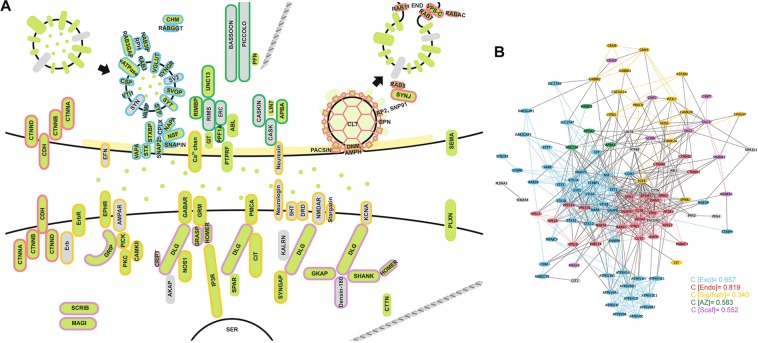
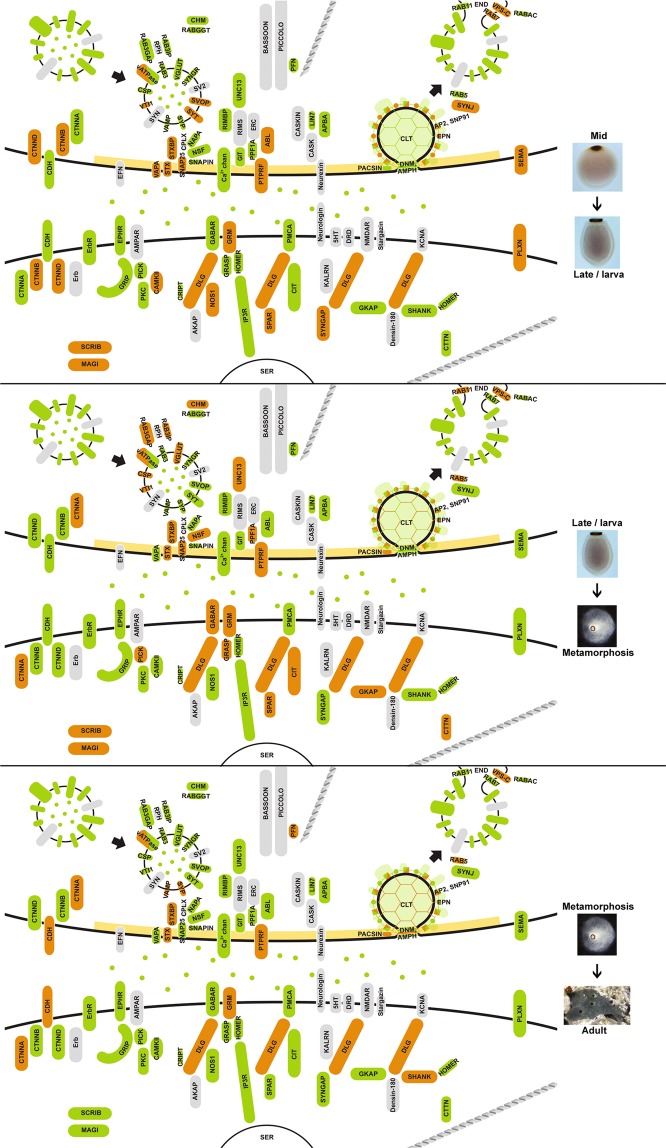
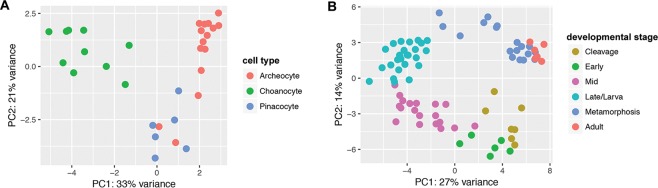
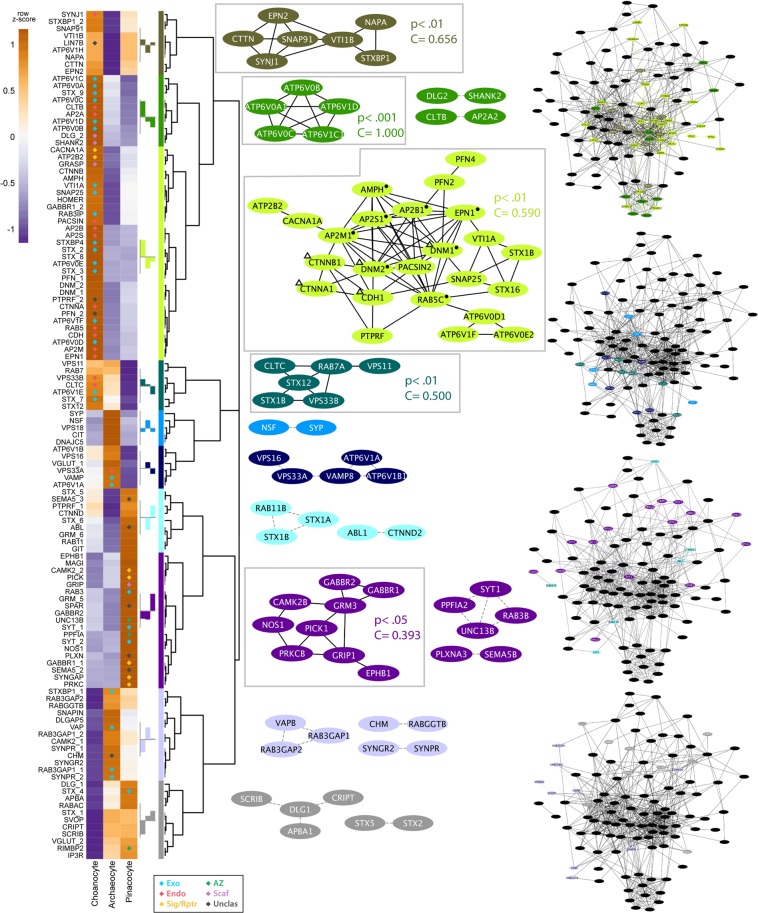
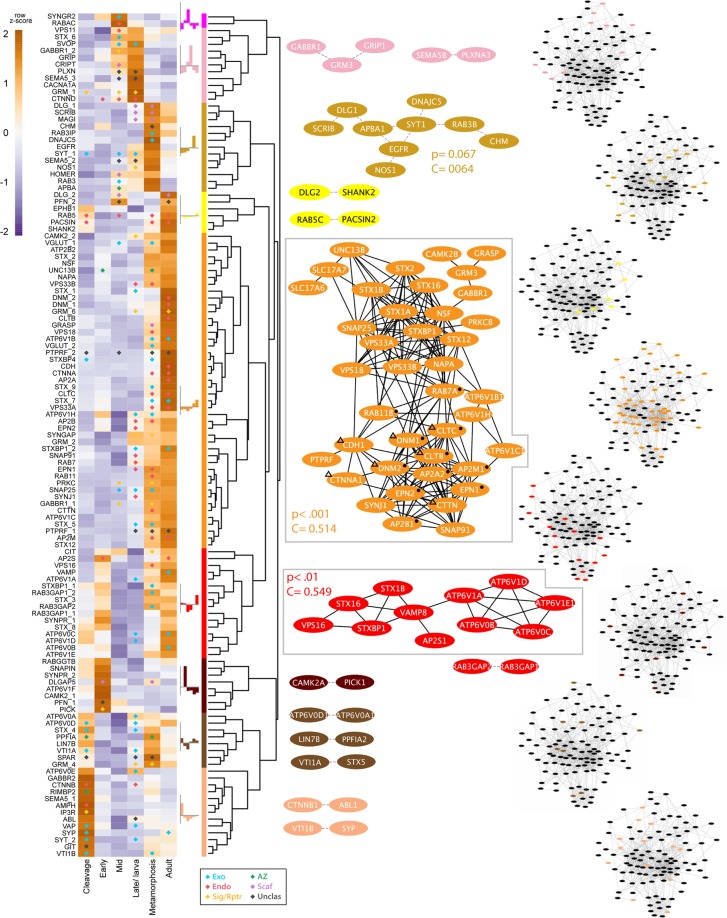
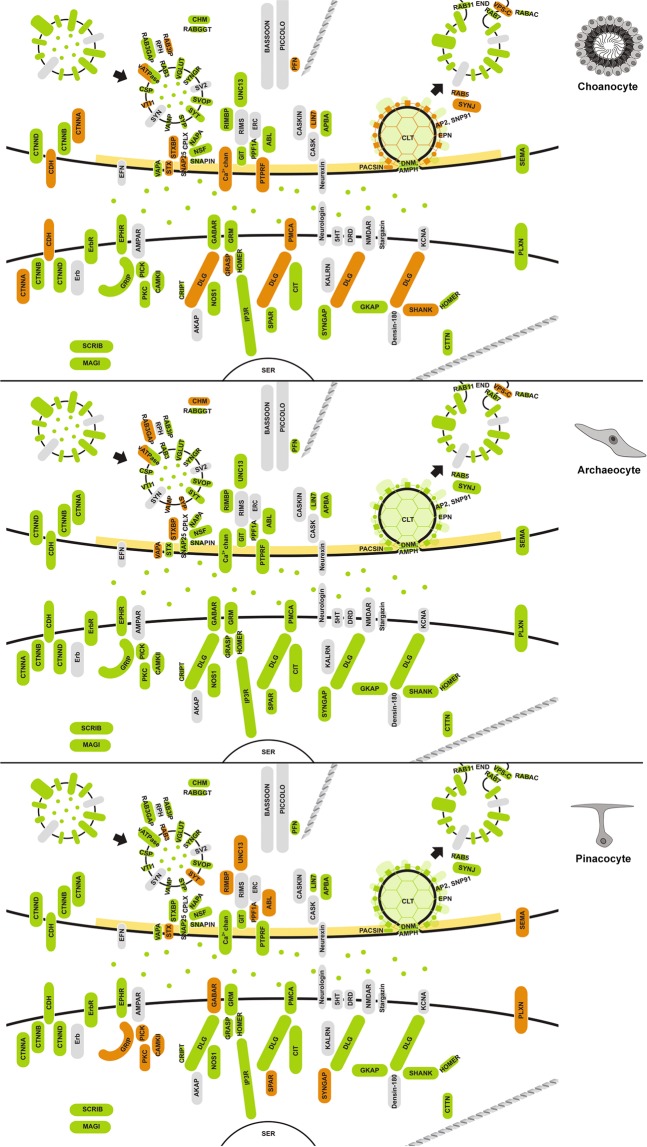
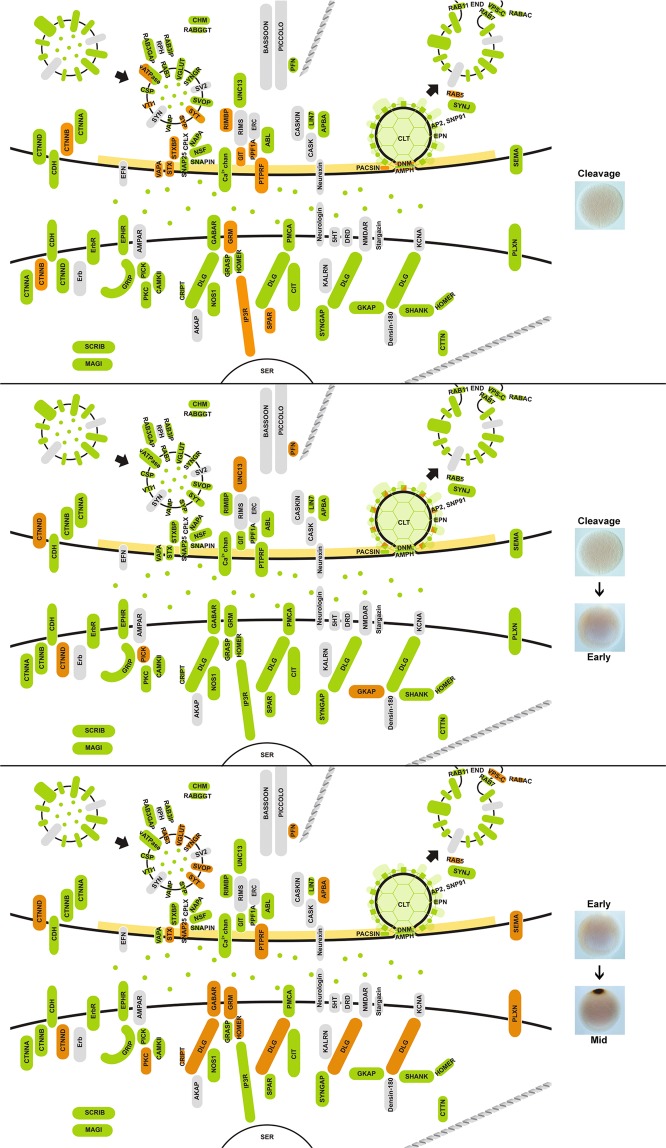
The synapse is a complex cellular module crucial to the functioning of neurons. It evolved largely through the exaptation of pre-existing smaller submodules, each of which are comprised of ancient sets of proteins that are conserved in modern animals and other eukaryotes. Although these ancient submodules themselves have non-neural roles, it has been hypothesized that they may mediate environmental sensing behaviors in aneural animals, such as sponges. Here we identify orthologues in the sponge Amphimedon queenslandica of genes encoding synaptic submodules in neural animals, and analyse their cell-type specific and developmental expression to determine their potential to be co-regulated. We find that genes comprising certain synaptic submodules, including those involved in vesicle trafficking, calcium-regulation and scaffolding of postsynaptic receptor clusters, are co-expressed in adult choanocytes and during metamorphosis. Although these submodules may contribute to sensory roles in this cell type and this life cycle stage, total synaptic gene co-expression profiles do not support the existence of a functional synapse in A. queenslandica. The lack of evidence for the co-regulation of genes necessary for pre- and post-synaptic functioning in A. queenslandica suggests that sponges, and perhaps the last common ancestor of sponges and other extant animals, had the ability to promulgate sensory inputs without complete synapse-like functionalities. The differential co-expression of multiple synaptic submodule genes in sponge choanocytes, which have sensory and feeding roles, however, is consistent with the metazoan ancestor minimally being able to undergo exo- and endocytosis in a controlled and localized manner.
突触是神经元功能的关键复杂细胞模块。它主要通过对先前存在的较小亚模块的适应进化而来,每个亚模块都由在现代动物和其他真核生物中保守的古老蛋白质组构成。尽管这些古老的亚模块本身具有非神经作用,但人们假设它们可能介导无神经动物(如海绵)的环境感应行为。在这里,我们在海绵 Amphimedon queenslandica 中鉴定了神经动物中突触亚模块基因的同源物,并分析了它们的细胞类型特异性和发育表达,以确定它们是否可能受到共同调控。我们发现,某些突触亚模块的基因,包括参与囊泡运输、钙调节和突触后受体簇支架的基因,在成年领细胞中和变态期间都有共表达。尽管这些亚模块可能有助于该细胞类型和生命周期阶段的感觉作用,但总的突触基因共表达谱并不支持 A. queenslandica 中存在功能性突触。在 A. queenslandica 中,缺乏与突触前和突触后功能相关基因的共同调控证据表明,海绵,也许是海绵和其他现存动物的最后共同祖先,具有在没有完整突触样功能的情况下传播感觉输入的能力。然而,在海绵领细胞中,多个突触亚模块基因的差异共表达,这些基因具有感觉和摄食作用,与后生动物祖先能够以受控和局部的方式进行胞吞和胞吐作用一致。