Corradetti Michael N, Torok Jordan A, Hatch Ace J, Xanthopoulos Eric P, Lafata Kyle, Jacobs Corbin, Rushing Christel, Calaway John, Jones Greg, Kelsey Chris R, Nixon Andrew B
Department of Radiation Oncology, Duke University School of Medicine, Durham, North Carolina.
Department of Medicine, Division of Medical Oncology, Duke University Medical Center, Durham, North Carolina.
Adv Radiat Oncol. 2019 May 22;4(4):748-752. doi: 10.1016/j.adro.2019.05.004. eCollection 2019 Oct-Dec.
Concurrent chemoradiation therapy (CRT) is the principal treatment modality for locally advanced lung cancer. Cell death due to CRT leads to the release of cell-free DNA (cfDNA) and circulating tumor DNA (ctDNA) into the bloodstream, but the kinetics and characteristics of this process are poorly understood. We hypothesized that there could be clinically meaningful changes in cfDNA and ctDNA during a course of CRT for lung cancer.
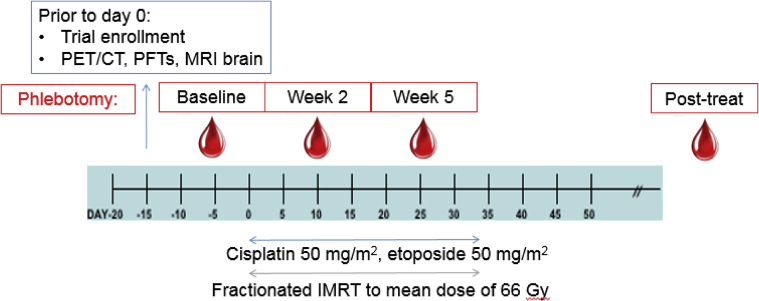
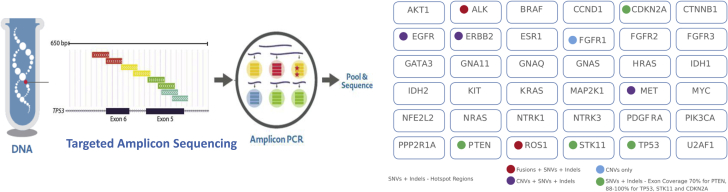
Multiple samples of plasma were obtained from 24 patients treated with CRT for locally advanced lung cancer to a mean dose of 66 Gy (range, 58-74 Gy) at the following intervals: before CRT, at weeks 2 and 5 during CRT, and 6 weeks after treatment. cfDNA was quantified, and a novel next generation sequencing (NGS) technique using enhanced tagged/targeted-amplicon sequencing was performed to analyze ctDNA.
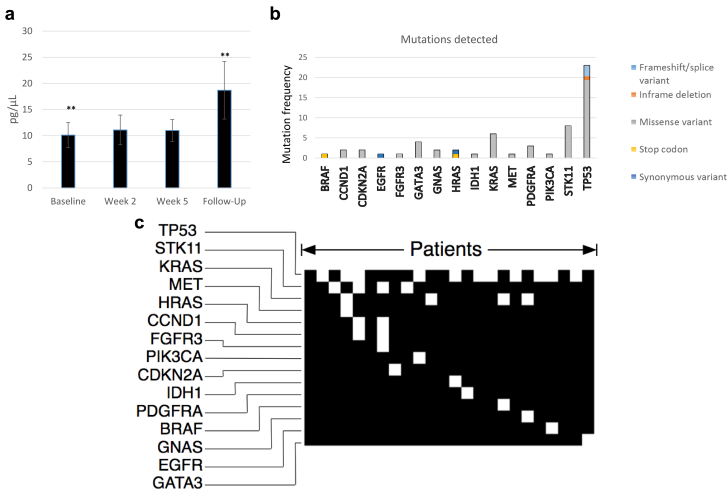
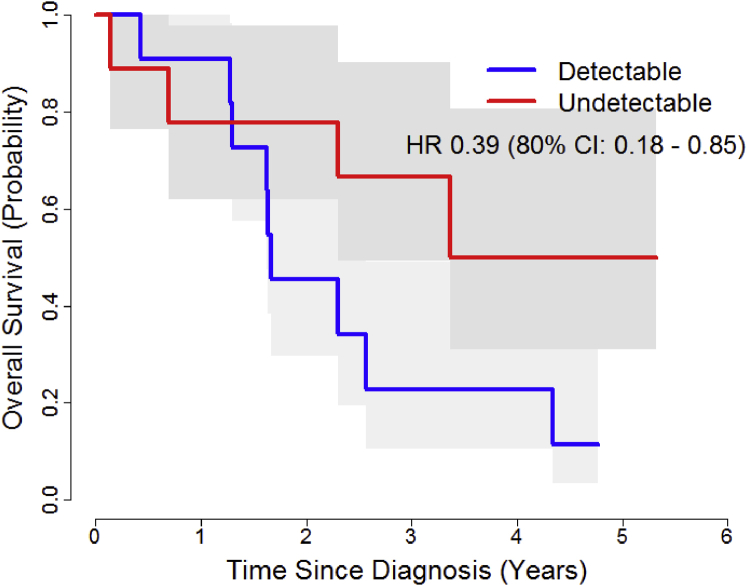
Patients for whom specific mutations in ctDNA were undetectable at the baseline time point had improved survival, and potentially etiologic driver mutations could be tracked throughout the course of CRT via NGS in multiple patients. We quantified the levels of cfDNA from patients before CRT, at week 2, week 5, and at 6 weeks after treatment. No differences were observed at weeks 2 and 5 of therapy, but we noted a significant increase in cfDNA in the posttreatment follow-up samples compared with samples collected before CRT ( = .05).
Dynamic changes in both cfDNA and ctDNA were observed throughout the course of CRT in patients with locally advanced lung cancer. Specific mutations with therapeutic implications can be identified and tracked using NGS methodologies. Further work is required to characterize the changes in cfDNA and ctDNA over time in patients treated with CRT and to assess the predictive and prognostic potential of this powerful technology.
同步放化疗(CRT)是局部晚期肺癌的主要治疗方式。CRT导致的细胞死亡会使游离DNA(cfDNA)和循环肿瘤DNA(ctDNA)释放入血液中,但这一过程的动力学和特征目前尚不清楚。我们推测,在肺癌CRT疗程中,cfDNA和ctDNA可能会发生具有临床意义的变化。
从24例接受CRT治疗的局部晚期肺癌患者中获取多个血浆样本,平均剂量为66 Gy(范围58 - 74 Gy),采样间隔如下:CRT前、CRT期间第2周和第5周、治疗后6周。对cfDNA进行定量,并采用一种使用增强型标记/靶向扩增子测序的新型下一代测序(NGS)技术分析ctDNA。
在基线时间点未检测到ctDNA特定突变的患者生存情况较好,并且在多名患者中可通过NGS在整个CRT疗程中追踪潜在的病因驱动突变。我们对患者CRT前、第2周、第5周以及治疗后6周的cfDNA水平进行了定量。治疗第2周和第5周未观察到差异,但我们注意到与CRT前采集的样本相比,治疗后随访样本中的cfDNA显著增加(P = 0.05)。
在局部晚期肺癌患者的CRT疗程中观察到cfDNA和ctDNA的动态变化。使用NGS方法可以识别和追踪具有治疗意义的特定突变。需要进一步开展工作来描述CRT治疗患者cfDNA和ctDNA随时间的变化,并评估这项强大技术的预测和预后潜力。