Yang Wentao, Zou Jianling, Li Ye, Liu Rujiao, Yan Zhengqing, Chen Shiqing, Zhao Xiaoying, Guo Weijian, Huang Mingzhu, Li Wenhua, Zhu Xiaodong, Chen Zhiyu
Department of Gastrointestinal Medical Oncology Fudan University Shanghai Cancer Center, Shanghai, China.
Department of Oncology, Shanghai Medical College, Fudan University, Shanghai, China.
Front Oncol. 2022 Feb 24;12:830816. doi: 10.3389/fonc.2022.830816. eCollection 2022.
Metastatic colorectal cancer (mCRC) is a heterogenous disease with limited precision medicine and targeted therapy options. Monoclonal antibodies against epidermal growth factor receptor (EGFR) have been a crucial treatment option for mCRC. However, proper biomarkers for predicting therapeutic response remain unknown. As a non-invasive test, circulating tumor DNA (ctDNA) is appropriately positioned to reveal tumor heterogeneity and evolution, as it can be used in real-time genomic profiling. To evaluate the significance of ctDNA in monitoring the dynamic therapeutic response and prognosis of mCRC, we detected the baseline and dynamic changes of ctDNA in mCRC patients receiving anti-EGFR therapies.
A single-center study was conducted retrospectively. Plasma samples from mCRC patients who received anti-EGFR therapies were collected at baseline and continuous treatment points. The ctDNA was extracted and sequenced with a target panel of tumor-related genes next-generation sequencing (NGS). Clinical information was also collected and analyzed.
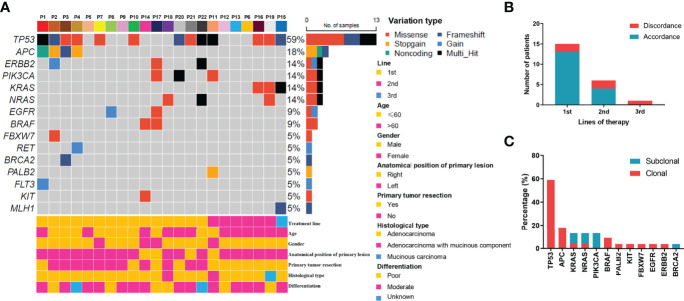
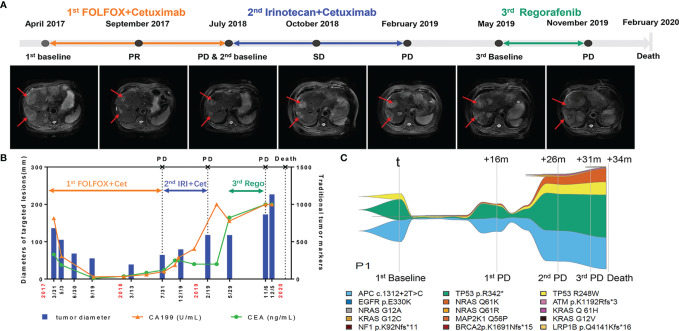
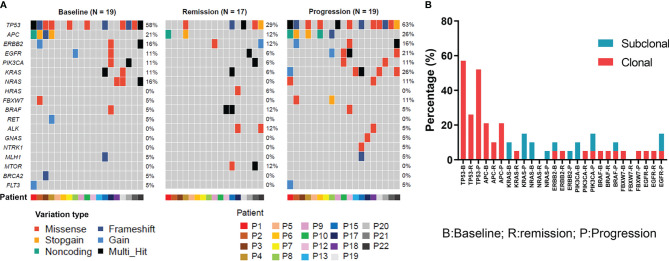
We conducted dynamic sampling of 22 mCRC patients, analyzed 130 plasma samples, obtained a baseline genomic mutation profile of the patients. In total, 54 variations were detected in 22 plasma samples, with a positive rate of 77.3% (17/22). TP53 was the most mutated gene (59.1%, 13/22), followed by APC (18.2%, 4/22). There was a high concordance rate of genomic characteristics between the tumor tissue test by polymerase chain reaction and ctDNA test by NGS. The mutation discrepancy increased with an extended course of treatment. During remission TP53 and APC were the most frequently decreased clonal mutations and KRAS, NRAS, ERBB2 and PIK3CA were the most decreased subclonal mutations. Both mutation types were increased during progression. The ctDNA decreased earlier than did the responses of computed tomography and traditional tumor markers (carbohydrate antigen 19-9 and carcinoembryonic antigen [CEA]). Lactate dehydrogenase level = 0.041), CEA level ( = 0.038), and primary lesion site ( = 0.038) were independent risk factors that influenced overall survival. Moreover, patients with RAS mutations tended to have a worse prognosis ( = 0.072).
This study demonstrates that ctDNA is a promising biomarker for monitoring the dynamic response to treatment and determining the prognosis of mCRC.
转移性结直肠癌(mCRC)是一种异质性疾病,精准医学和靶向治疗选择有限。抗表皮生长因子受体(EGFR)单克隆抗体一直是mCRC的关键治疗选择。然而,用于预测治疗反应的合适生物标志物仍不明确。作为一种非侵入性检测方法,循环肿瘤DNA(ctDNA)能够用于实时基因组分析,因而适合用于揭示肿瘤的异质性和演变。为了评估ctDNA在监测mCRC动态治疗反应和预后中的意义,我们检测了接受抗EGFR治疗的mCRC患者ctDNA的基线水平和动态变化。
进行了一项单中心回顾性研究。收集接受抗EGFR治疗的mCRC患者在基线和连续治疗时间点的血浆样本。提取ctDNA并使用肿瘤相关基因靶向panel进行二代测序(NGS)。同时收集并分析临床信息。
我们对22例mCRC患者进行了动态采样,分析了130份血浆样本,获得了患者的基线基因组突变谱。共在22份血浆样本中检测到54个变异,阳性率为77.3%(17/22)。TP53是突变最多的基因(59.1%,13/22),其次是APC(18.2%,4/22)。聚合酶链反应检测的肿瘤组织与NGS检测的ctDNA之间的基因组特征一致性较高。随着治疗疗程延长,突变差异增加。缓解期TP53和APC是最常减少的克隆性突变,KRAS、NRAS、ERBB2和PIK3CA是最常减少的亚克隆性突变。两种突变类型在疾病进展期均增加。ctDNA水平下降早于计算机断层扫描和传统肿瘤标志物(糖类抗原19-9和癌胚抗原[CEA])的反应。乳酸脱氢酶水平(=0.041)、CEA水平(=0.038)和原发灶部位(=0.038)是影响总生存的独立危险因素。此外,RAS突变患者的预后往往较差(=0.072)。
本研究表明,ctDNA是监测mCRC治疗动态反应和判断预后的有前景的生物标志物。