Chen Jing, Qian Mincai, Sun Conghao, Lin Min, Tang Weili
Psychosomatic Department, Third People's Hospital of Huzhou City, Huzhou City, China.
The Third People's Hospital of Huzhou City, Huzhou, China.
Gen Psychiatr. 2019 Oct 9;32(5):e100087. doi: 10.1136/gpsych-2019-100087. eCollection 2019.
With the continuous improvement of people's material living standards, the consumption of alcoholic beverages is increasing. Alcohol dependence caused by alcohol addiction has become a widespread concern in society. As the brand-new medical and health model created by the modern biomedical technology revolution and the information technology revolution, mobile health has been used more and more widely in the field of medical health with the characteristics of convenience, rapidity and generalisability. With the general use of the social software WeChat, it is feasible to implement mobile health on the WeChat platform.
We aimed to explore the clinical effect of WeChat platform used in the cognitive behavioural therapy (CBT) on the maintenance period of alcohol dependence and addiction.
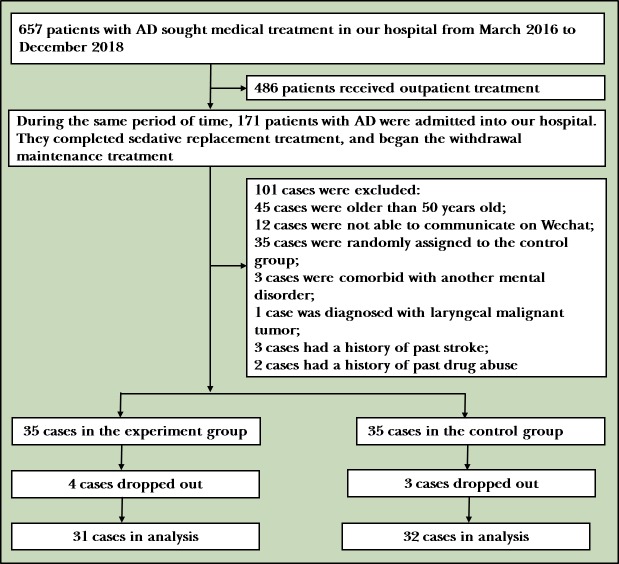
Seventy alcohol-dependent patients in the withdrawal maintenance stage admitted into our hospital were randomly divided into the CBT on WeChat platform group (the experiment group, n=35) and the general clinical treatment using sertraline group (the control group, n=35) with block randomisation grouping. They were evaluated with the Severity of Alcohol Dependence Questionnaire (SADQ-C) before the treatment, at the end of the fourth week, at the end of the eighth week and at the end of the twelfth week of treatment. In addition, Zung's Self-Rating Anxiety Scale (SAS) and Self-Rating Depression Scale (SDS) were employed to evaluate the degree of anxiety and depression of the two groups.
The SADQ-C, SAS and SDS scores of the two groups after treatment decreased markedly compared with those before treatments, and the differences were statistically significant. Between-group comparison: the SADQ-C scores of the experiment group at the end of the fourth, eighth and twelfth weeks were lower than those of the control group, and the difference was statistically significant, which indicated that the score reduction in the experiment group was larger than that in the control group. The SAS and SDS scores of the experiment group at these time points were not significantly different from those of the control group, which indicated that these two treatment methods were comparable in treating patients' anxiety and depression.
The CBT intervention using WeChat may improve the subjectively reported severity of alcohol dependence of patients who had completed detoxification. It is conducive to prevention of relapse, and is convenient for patients. It is worthy of clinical application and further study.
随着人们物质生活水平的不断提高,酒精饮料的消费量日益增加。酒精成瘾所致的酒精依赖已成为社会广泛关注的问题。作为现代生物医学技术革命和信息技术革命催生的全新医疗卫生模式,移动健康凭借便捷、快速、可推广的特点,在医疗卫生领域的应用越来越广泛。随着社交软件微信的普遍使用,在微信平台上开展移动健康成为可行之举。
探讨微信平台用于酒精依赖与成瘾维持期认知行为疗法(CBT)的临床效果。
将我院收治的70例处于戒断维持期的酒精依赖患者采用区组随机化分组法随机分为微信平台CBT组(实验组,n = 35)和使用舍曲林的常规临床治疗组(对照组,n = 35)。在治疗前、治疗第4周结束时、第8周结束时和第12周结束时,采用酒精依赖严重程度问卷(SADQ - C)对两组患者进行评估。此外,采用zung氏自评焦虑量表(SAS)和自评抑郁量表(SDS)评估两组患者的焦虑和抑郁程度。
两组治疗后的SADQ - C、SAS和SDS评分与治疗前相比均显著降低,差异有统计学意义。组间比较:实验组在第4、8和12周结束时的SADQ - C评分低于对照组,差异有统计学意义,表明实验组的评分降低幅度大于对照组。实验组在这些时间点的SAS和SDS评分与对照组无显著差异,表明这两种治疗方法在治疗患者焦虑和抑郁方面具有可比性。
利用微信进行CBT干预可能改善已完成脱毒患者主观报告的酒精依赖严重程度。有利于预防复发,且对患者方便。值得临床应用和进一步研究。