Department of Gynecology and Obstetrics, The Second Affiliated Hospital and Yuying Children's Hospital of Wenzhou Medical University, Wenzhou, Zhejiang, China.
Department of Biochemistry and Molecular Biology, Johns Hopkins Bloomberg School of Public Health, Baltimore, Maryland.
Endocr Rev. 2020 Feb 1;41(1):22-32. doi: 10.1210/endrev/bnz013.
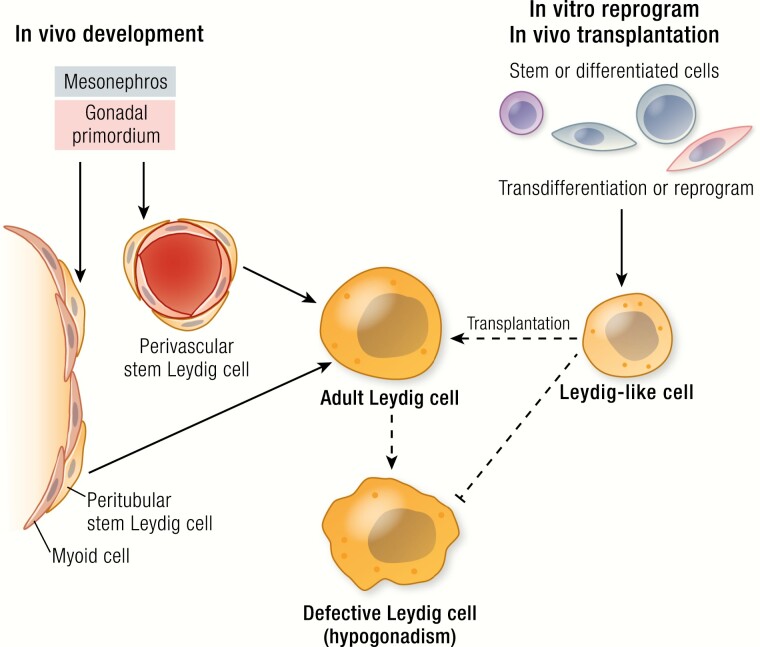
Androgen deficiency (hypogonadism) affects males of all ages. Testosterone replacement therapy (TRT) is effective in restoring serum testosterone and relieving symptoms. TRT, however, is reported to have possible adverse effects in part because administered testosterone is not produced in response to the hypothalamic-pituitary-gonadal (HPG) axis. Progress in stem cell biology offers potential alternatives for treating hypogonadism. Adult Leydig cells (ALCs) are generated by stem Leydig cells (SLCs) during puberty. SLCs persist in the adult testis. Considerable progress has been made in the identification, isolation, expansion and differentiation of SLCs in vitro. In addition to forming ALCs, SLCs are multipotent, with the ability to give rise to all 3 major cell lineages of typical mesenchymal stem cells, including osteoblasts, adipocytes, and chondrocytes. Several regulatory factors, including Desert hedgehog and platelet-derived growth factor, have been reported to play key roles in the proliferation and differentiation of SLCs into the Leydig lineage. In addition, stem cells from several nonsteroidogenic sources, including embryonic stem cells, induced pluripotent stem cells, mature fibroblasts, and mesenchymal stem cells from bone marrow, adipose tissue, and umbilical cord have been transdifferentiated into Leydig-like cells under a variety of induction protocols. ALCs generated from SLCs in vitro, as well as Leydig-like cells, have been successfully transplanted into ALC-depleted animals, restoring serum testosterone levels under HPG control. However, important questions remain, including: How long will the transplanted cells continue to function? Which induction protocol is safest and most effective? For translational purposes, more work is needed with primate cells, especially human.
雄激素缺乏(性腺功能减退症)影响所有年龄段的男性。睾丸激素替代疗法(TRT)可有效恢复血清睾丸激素并缓解症状。然而,TRT 据报道可能有不良反应,部分原因是给予的睾丸激素不是针对下丘脑-垂体-性腺(HPG)轴产生的。干细胞生物学的进展为治疗性腺功能减退症提供了潜在的替代方法。成年莱迪希细胞(ALC)是由青春期的干细胞莱迪希细胞(SLC)产生的。SLC 存在于成年睾丸中。在体外鉴定、分离、扩增和分化 SLC 方面已经取得了相当大的进展。除了形成 ALC 之外,SLC 还具有多能性,能够产生典型间充质干细胞的所有 3 个主要细胞谱系,包括成骨细胞、脂肪细胞和成软骨细胞。几种调节因子,包括沙漠刺猬和血小板衍生生长因子,已被报道在 SLC 增殖和分化为莱迪希谱系中发挥关键作用。此外,来自几种非甾体来源的干细胞,包括胚胎干细胞、诱导多能干细胞、成熟成纤维细胞以及来自骨髓、脂肪组织和脐带的间充质干细胞,已经在各种诱导方案下转化为莱迪希样细胞。体外培养的 SLC 生成的 ALC 以及莱迪希样细胞已成功移植到 ALC 耗竭的动物体内,在 HPG 控制下恢复血清睾丸激素水平。然而,仍有一些重要问题需要解决,包括:移植细胞能持续多久发挥作用?哪种诱导方案最安全、最有效?为了转化应用,需要使用灵长类细胞,尤其是人类细胞进行更多的工作。