Li Yu-Peng, Yan Zhong-Qing, Han Li-Ping, Yin Ai-Li, Xu Jin-Yong, Zhai Ya-Ran, Hao Sai, Zhang Lin, Xie Yun
Tianjin Medical University Metabolic Diseases Hospital & Tianjin Medical University Chu Hsien-I Memorial Hospital, Tianjin, China.
Tianjin Institute of Endocrinology, Tianjin, China.
Diabetes Ther. 2020 Jan;11(1):71-81. doi: 10.1007/s13300-019-00716-w. Epub 2019 Oct 30.
Small fiber neuropathy (SFN)-the early stage of diabetic peripheral neuropathy (DPN)-progresses gradually and is difficult to diagnose using neurophysiological tests. To facilitate the early diagnosis of SFN, biomarkers for SFN must be identified. The purpose of this study was to investigate the characteristics of SFN in prediabetic patients and the relationship between pNF-H and SFN.
44 IGT patients (inpatients and outpatients) were selected at random. 33 healthy subjects served as controls. Data on clinical characteristics and laboratory parameters were collected. Quantitative sensory testing (QST), electromyography (EMG), and Sudoscan were performed, and pNF-H was measured by ELISA.
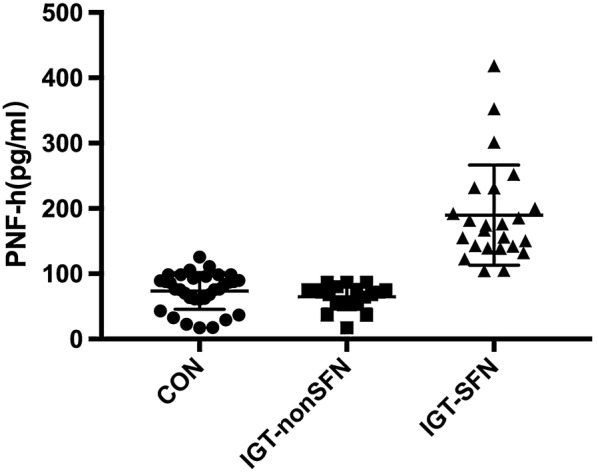
24 of the 44 patients with impaired glucose tolerance (IGT) were diagnosed with SFN according to the modified Toronto Diabetic Neuropathy Expert Group consensus criteria. The thermal sensory thresholds of the IGT-SFN group were significantly different from those of the CTRL group (p < 0.05), except for the heat pain threshold. The sensory nerve action potential (SNAP) of the sural nerve was 12.39 in the IGT-SFN group, which was significantly lower than those in the other groups. No significant difference in nerve conduction velocity (NCV) was observed among the three groups. The electrochemical skin conductance (ESC) in the IGT-SFN group was 69.78 ± 14.03uS, which was significantly lower than that in the CTRL group. The pNF-H in the IGT-SFN group was 170.6 (140.0, 223.6) pg/ml, which was significantly higher than those in the CTRL and IGT-non-SFN groups (76.55 and 64.7 pg/ml, respectively). Multivariate regression analysis demonstrated that pNF-H and 2h plasma glucose were independently correlated with SFN; the ORs (95% CI) were 1.429 (1.315, 1.924) and 2.375 (1.157, 4.837), respectively.
Serum pNF-H may be associated with SFN in IGT patients, and serum pNF-H could therefore serve as a sensitive biomarker for the detection of SFN.
小纤维神经病变(SFN)——糖尿病周围神经病变(DPN)的早期阶段——进展缓慢,难以通过神经生理学检查进行诊断。为便于早期诊断SFN,必须确定其生物标志物。本研究旨在探讨糖尿病前期患者中SFN的特征以及磷酸化神经丝蛋白重链(pNF-H)与SFN之间的关系。
随机选取44例糖耐量受损(IGT)患者(包括住院患者和门诊患者)。33名健康受试者作为对照。收集临床特征和实验室参数数据。进行定量感觉测试(QST)、肌电图(EMG)和Sudoscan检查,并通过酶联免疫吸附测定法(ELISA)测量pNF-H。
根据改良的多伦多糖尿病神经病变专家组共识标准,44例糖耐量受损(IGT)患者中有24例被诊断为SFN。IGT-SFN组的热感觉阈值与对照组相比有显著差异(p < 0.05),除热痛阈值外。IGT-SFN组腓肠神经的感觉神经动作电位(SNAP)为12.39,显著低于其他组。三组之间的神经传导速度(NCV)未观察到显著差异。IGT-SFN组的电化学皮肤传导(ESC)为69.78±14.03μS,显著低于对照组。IGT-SFN组的pNF-H为170.6(140.0,223.6)pg/ml,显著高于对照组和IGT-非SFN组(分别为76.55和64.7 pg/ml)。多因素回归分析表明,pNF-H和餐后2小时血糖与SFN独立相关;比值比(OR)(95%可信区间)分别为1.429(1.315,1.924)和2.375(1.157,4.837)。
血清pNF-H可能与IGT患者的SFN相关,因此血清pNF-H可作为检测SFN的敏感生物标志物。