Oh Jee-Hwan, Lin Xiaoxi B, Zhang Shenwei, Tollenaar Stephanie L, Özçam Mustafa, Dunphy Case, Walter Jens, van Pijkeren Jan-Peter
Department of Food Science, University of Wisconsin-Madison, Madison, Wisconsin, USA.
Department of Agriculture, Food and Nutritional Science, University of Alberta, Edmonton, Canada.
Appl Environ Microbiol. 2019 Dec 13;86(1). doi: 10.1128/AEM.01922-19.
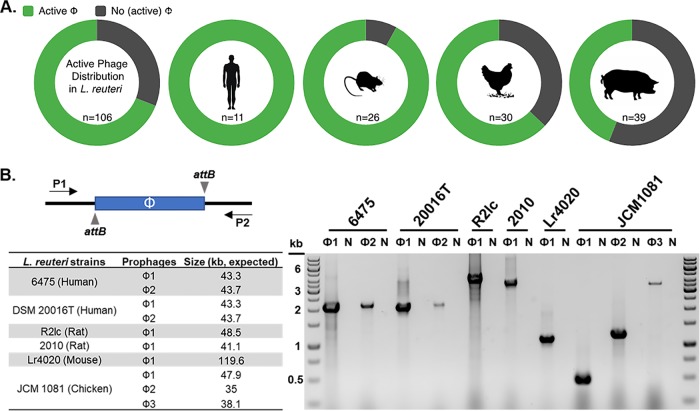
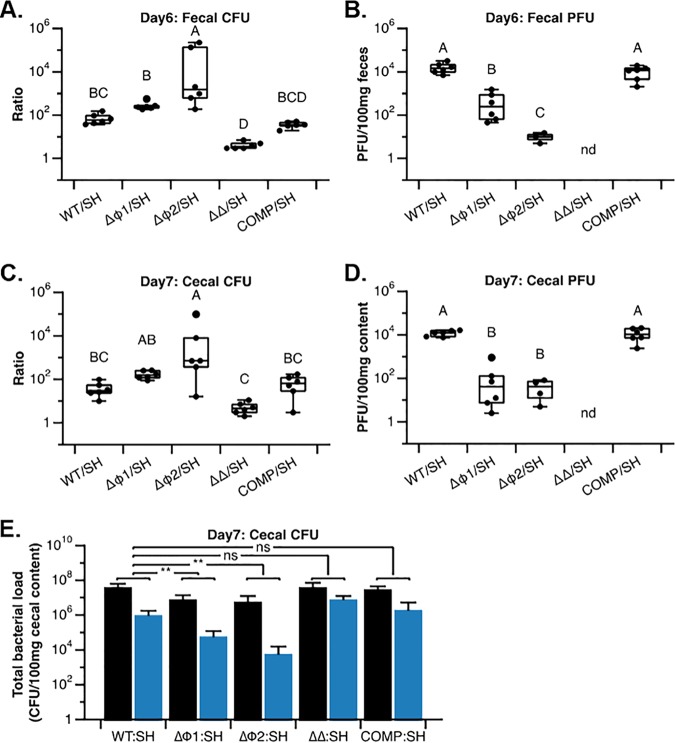
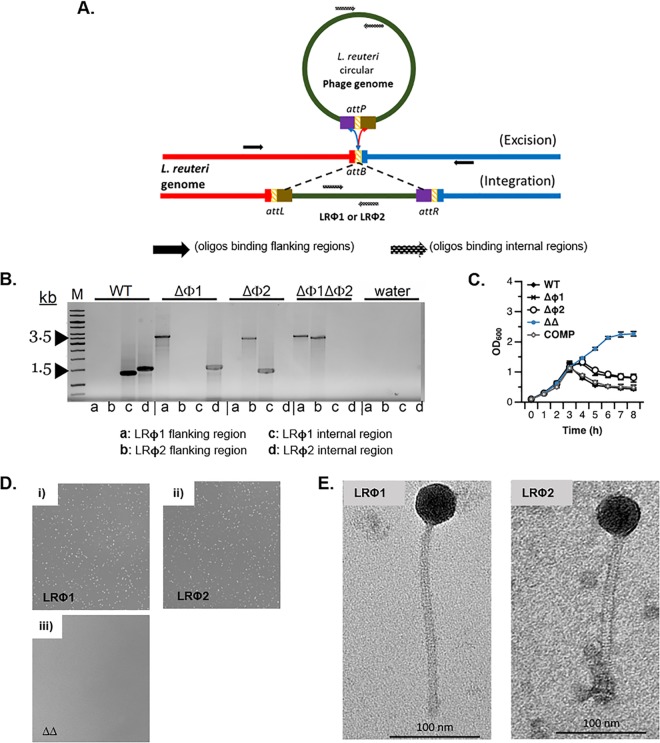
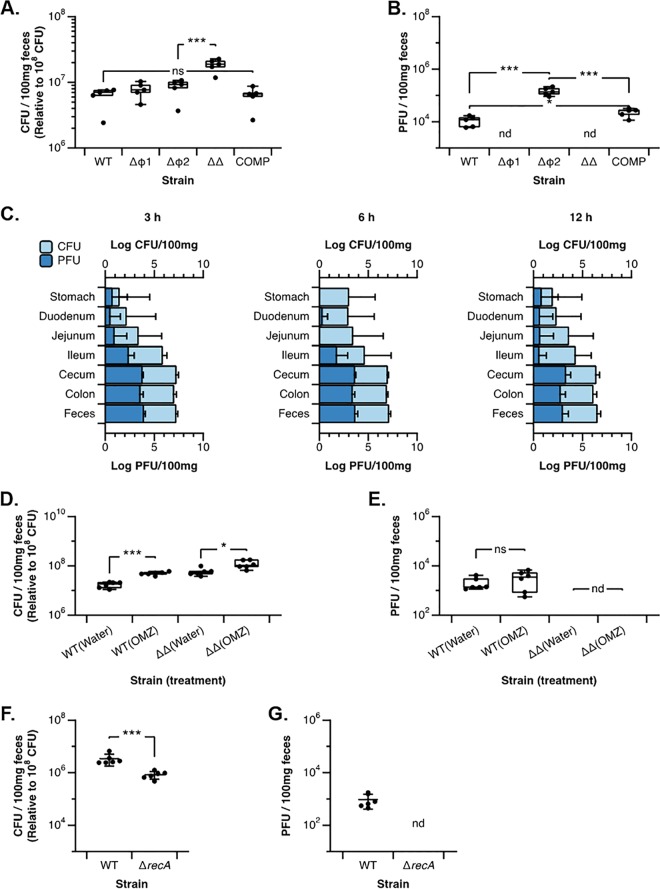
The gut microbiota harbors a diverse phage population that is largely derived from lysogens, which are bacteria that contain dormant phages in their genome. While the diversity of phages in gut ecosystems is getting increasingly well characterized, knowledge is limited on how phages contribute to the evolution and ecology of their host bacteria. Here, we show that biologically active prophages are widely distributed in phylogenetically diverse strains of the gut symbiont Nearly all human- and rodent-derived strains, but less than half of the tested strains of porcine origin, contain active prophages, suggesting different roles of phages in the evolution of host-specific lineages. To gain insight into the ecological role of phages, we developed strain 6475 as a model to study its phages. After administration to mice, 6475 produces active phages throughout the intestinal tract, with the highest number detected in the distal colon. Inactivation of abolished phage production, which suggests that activation of the SOS response drives phage production in the gut. In conventional mice, phage production reduces bacterial fitness as fewer wild-type bacteria survive gut transit compared to the mutant lacking prophages. However, in gnotobiotic mice, phage production provides with a competitive advantage over a sensitive host. Collectively, we uncovered that the presence of prophages, although associated with a fitness trade-off, can be advantageous for a gut symbiont by killing a competitor strain in its intestinal niche. Bacteriophages derived from lysogens are abundant in gut microbiomes. Currently, mechanistic knowledge is lacking on the ecological ramifications of prophage carriage yet is essential to explain the abundance of lysogens in the gut. An extensive screen of the bacterial gut symbiont revealed that biologically active prophages are widely distributed in this species. 6475 produces phages throughout the mouse intestinal tract, but phage production is associated with reduced fitness of the lysogen. However, phage production provides a competitive advantage in direct competition with a nonlysogenic strain of that is sensitive to these phages. This combination of increased competition with a fitness trade-off provides a potential explanation for the domination of lysogens in gut ecosystem and how lysogens can coexist with sensitive hosts.
肠道微生物群含有多种噬菌体种群,这些噬菌体大多来源于溶原菌,溶原菌是基因组中含有休眠噬菌体的细菌。虽然肠道生态系统中噬菌体的多样性越来越得到充分表征,但关于噬菌体如何影响其宿主细菌的进化和生态的知识仍然有限。在这里,我们表明具有生物活性的原噬菌体广泛分布于肠道共生菌的系统发育多样的菌株中。几乎所有源自人类和啮齿动物的菌株,但不到一半的受试猪源菌株含有活性原噬菌体,这表明噬菌体在宿主特异性谱系的进化中具有不同作用。为了深入了解噬菌体的生态作用,我们开发了菌株6475作为研究其噬菌体的模型。给小鼠施用后,6475在整个肠道中产生活性噬菌体,在远端结肠中检测到的数量最高。的失活消除了噬菌体的产生,这表明SOS反应的激活驱动了肠道中的噬菌体产生。在传统小鼠中,噬菌体的产生会降低细菌的适应性,因为与缺乏原噬菌体的突变体相比,野生型细菌在肠道转运后存活的数量更少。然而,在无菌小鼠中,噬菌体的产生为提供了相对于敏感宿主的竞争优势。总体而言,我们发现原噬菌体的存在虽然与适应性权衡相关,但通过杀死其肠道生态位中的竞争菌株,可能对肠道共生菌有利。源自溶原菌的噬菌体在肠道微生物群中丰富。目前,缺乏关于原噬菌体携带的生态影响的机制知识,但这对于解释肠道中溶原菌的丰度至关重要。对肠道细菌共生菌的广泛筛选表明,具有生物活性的原噬菌体广泛分布于该物种中。6475在整个小鼠肠道中产生噬菌体,但噬菌体的产生与溶原菌的适应性降低有关。然而,在与对这些噬菌体敏感的非溶原性菌株的直接竞争中,噬菌体的产生提供了竞争优势。这种增加的竞争与适应性权衡的组合为肠道生态系统中溶原菌的主导地位以及溶原菌如何与敏感宿主共存提供了一个潜在的解释。