Ruocco Gaetano, Feola Mauro, Nuti Ranuccio, Luschi Lorenzo, Evangelista Isabella, Palazzuoli Alberto
Department of Internal Medicine, Cardiovascular Disease Unit, Le Scotte Hospital, University of Siena, 53100 Siena, Italy.
Cardiology Section, Regina Montis Regalis Hospital, Mondovì, 12084 Cuneo, Italy.
J Clin Med. 2019 Nov 2;8(11):1854. doi: 10.3390/jcm8111854.
Despite the fact that loop diuretics are a landmark in acute heart failure (AHF) treatment, few trials exist that evaluate whether the duration and timing of their administration and drug amount affect outcome. In this study, we sought to evaluate different loop diuretic infusion doses in relation to outcome and to diuretic response (DR), which was serially measured during hospitalization.
This is a post-hoc analysis of a DIUR-HF trial. We divided our sample on the basis of intravenous diuretic dose during hospitalization. Patients taking less than 125 mg of intravenous furosemide (median value) were included in the low dose group (LD), patients with a diuretic amount above this threshold were inserted in the high dose group (HD). The DR formula was defined as weight loss/40 mg daily of furosemide and it was measured during the first 24 h, 72 h, and over the whole infusion period. Outcome was considered as death due to cardiovascular causes or heart failure hospitalization.
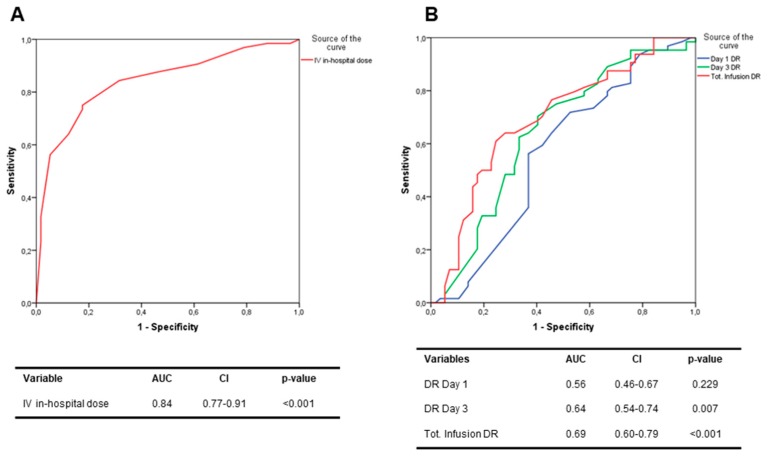
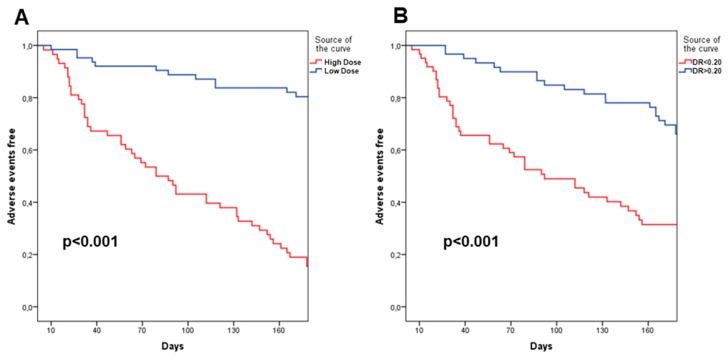
One hundred and twenty-one AHF patients with reduced ejection fractions (EF) were evaluated. The cardiovascular (CV) death/heart failure (HF) re-hospitalization rate was significantly higher in the HD group compared to the LD group (75% vs. 22%; < 0.001). Both low DR, measured during the entire infusion period (HR 3.25 (CI: 1.92-5.50); < 0.001) and the intravenous diuretic HD (HR 5.43 [CI: 2.82-10.45]; < 0.001) were related to outcome occurrence. Multivariable analysis showed that DR (HR 3.01 (1.36-6.65); = 0.006), intravenous diuretic HD (HR 2.83 (1.24-6.42); =0.01) and worsening renal function (WRF) (HR 2.21 (1.14-4.28); = 0.01) were related to poor prognosis.
HD intravenous loop diuretic administration is associated with poor prognosis and less DR. Low DR measured during the whole intravenous administration better predicts outcome compared to DR measured in the early phases. ClinicalTrials.gov Acronym and Identifier Number: DIUR-HF; NCT01441245; registered on 23 September 2011.
尽管袢利尿剂是急性心力衰竭(AHF)治疗的一个里程碑,但很少有试验评估其给药持续时间、给药时间和药物剂量是否会影响治疗结果。在本研究中,我们试图评估不同剂量的袢利尿剂输注与治疗结果以及利尿反应(DR)之间的关系,后者在住院期间进行了连续测量。
这是一项对DIUR-HF试验的事后分析。我们根据住院期间静脉注射利尿剂的剂量对样本进行了划分。静脉注射速尿少于125mg(中位数)的患者被纳入低剂量组(LD),利尿剂用量高于此阈值的患者被纳入高剂量组(HD)。DR公式定义为体重减轻/每日40mg速尿,并在最初24小时、72小时以及整个输注期间进行测量。治疗结果被视为心血管原因导致的死亡或因心力衰竭住院。
对121例射血分数(EF)降低的AHF患者进行了评估。与LD组相比,HD组的心血管(CV)死亡/心力衰竭(HF)再住院率显著更高(75%对22%;P<0.001)。在整个输注期间测量的低DR(风险比3.25[置信区间:1.92-5.50];P<0.001)和静脉注射利尿剂高剂量(风险比5.43[置信区间:2.82-10.45];P<0.001)均与治疗结果的发生有关。多变量分析显示,DR(风险比3.01[1.36-6.65];P=0.006)、静脉注射利尿剂高剂量(风险比2.83[1.24-6.42];P=0.01)和肾功能恶化(WRF)(风险比2.21[1.14-4.28];P=0.01)与不良预后有关。
静脉注射高剂量袢利尿剂与不良预后和较低的DR相关。与早期测量的DR相比,在整个静脉给药期间测量的低DR能更好地预测治疗结果。ClinicalTrials.gov标识符和编号:DIUR-HF;NCT01441245;于2011年9月23日注册。