Verma Rupesh, Banerjee Tamal
Department of Chemical Engineering Indian Institute of Technology Guwahati Guwahati 781039 Assam India.
Glob Chall. 2019 Jul 26;3(11):1900024. doi: 10.1002/gch2.201900024. eCollection 2019 Nov.
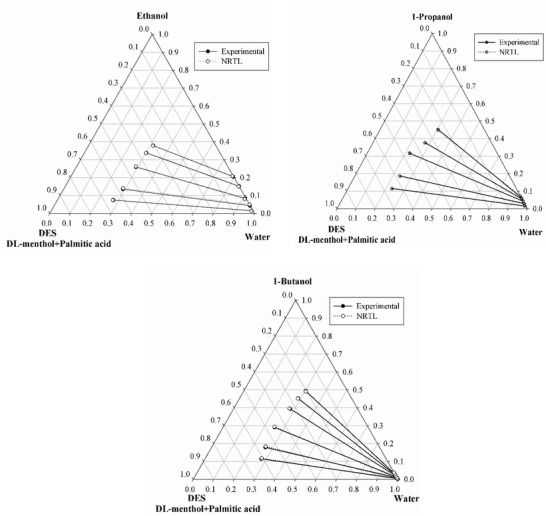
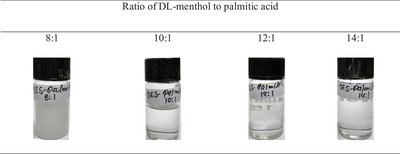
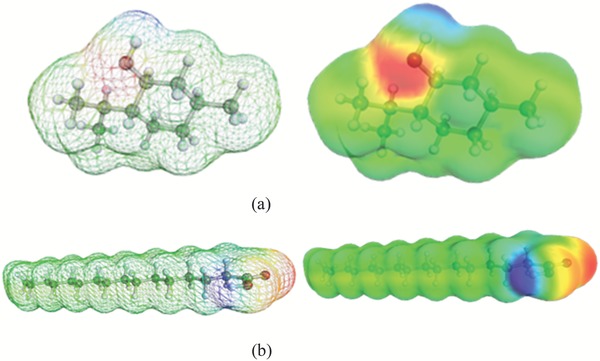
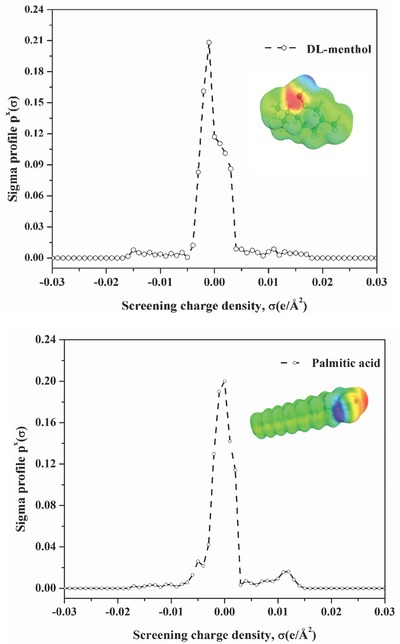
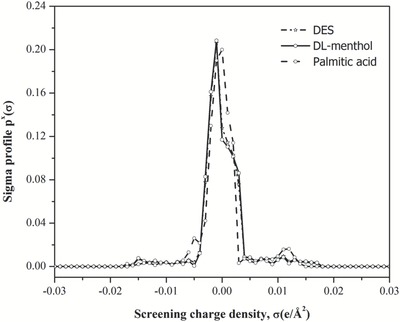
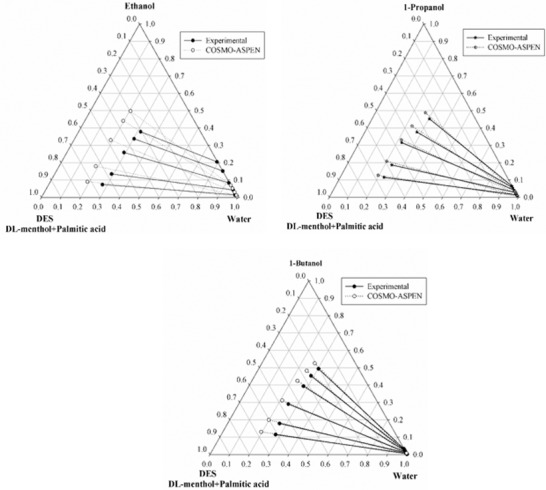
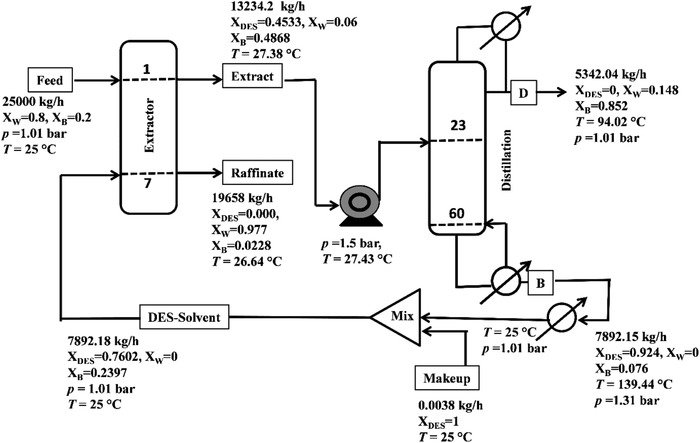
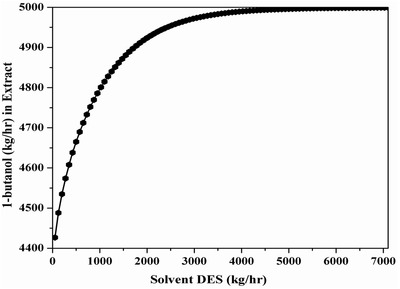
A new, natural, hydrophobic deep eutectic solvent (NADES) based on DL-menthol and palmitic acid is adopted for the extraction of alcohols from aqueous phase. DL-menthol is used as a hydrogen bond acceptor and palmitic acid, being a natural organic acid, as a hydrogen bond donor. The synthesis is carried out by the addition of DL-menthol and palmitic acid in a defined molar ratio. Physical properties of NADES along with water stability are then measured. Liquid-liquid equilibria (LLE) of lower alcohols, namely, DES (1) + lower alcohols (ethanol/1-propanol/1-butanol) (2) + water (3) are carried out at = 1 atm and = 298.15 K. LLE results show type-I phase behavior, where alcohol is preferentially attracted toward DES. The tie lines are then regressed via nonrandom two liquid and universal quasichemical models, which give root mean square deviation (RMSD) in the range of 0.29-0.35% and 0.39-0.75%, respectively. Finally, the quantum-chemical-based conductor-like screening model-segment activity coefficient is used to predict the tie lines, which gives an RMSD of 2.1-5.2%. A hybrid extractive distillation flowsheet is then used for scale up, process economics, and solvent recovery aspects in ASPEN using DES as a "pseudocomponent."
一种基于DL-薄荷醇和棕榈酸的新型天然疏水型低共熔溶剂(NADES)被用于从水相中萃取醇类。DL-薄荷醇用作氢键受体,而棕榈酸作为天然有机酸用作氢键供体。通过以特定摩尔比添加DL-薄荷醇和棕榈酸来进行合成。然后测量NADES的物理性质以及水稳定性。在1个大气压和298.15 K的条件下,研究了低级醇(即DES(1)+低级醇(乙醇/1-丙醇/1-丁醇)(2)+水(3))的液-液平衡(LLE)。LLE结果显示出I型相行为,其中醇优先被吸引到DES相中。然后通过非随机双液体模型和通用拟化学模型对连接线进行回归,其均方根偏差(RMSD)分别在0.29 - 0.35%和0.39 - 0.75%的范围内。最后,基于量子化学的导体类筛选模型-段活度系数用于预测连接线,其RMSD为2.1 - 5.2%。然后使用混合萃取精馏流程在ASPEN中进行放大、工艺经济性分析以及溶剂回收方面的研究,将DES用作“假组分”。