Xia Yuntao, Pfeifer Charlotte R, Cho Sangkyun, Discher Dennis E, Irianto Jerome
Physical Sciences Oncology Center at Penn (PSOC@Penn), University of Pennsylvania, Philadelphia, PA, U.S.A.
Molecular and Cell Biophysics Lab, University of Pennsylvania, Philadelphia, PA, U.S.A.
Emerg Top Life Sci. 2018 Dec;2(5):713-725. doi: 10.1042/ETLS20180051. Epub 2018 Dec 21.
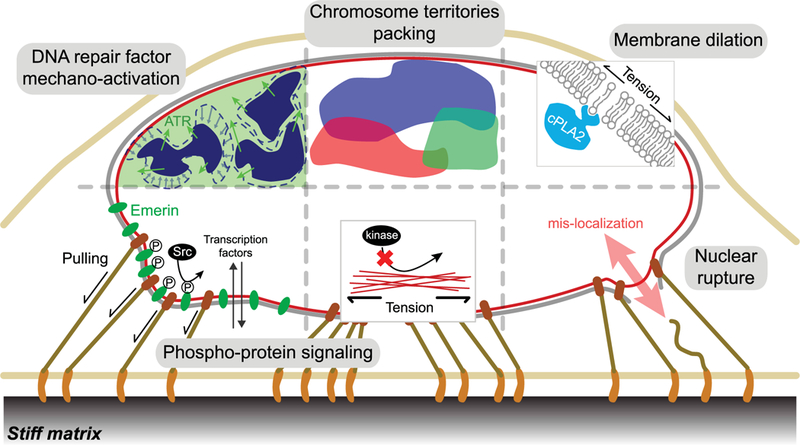
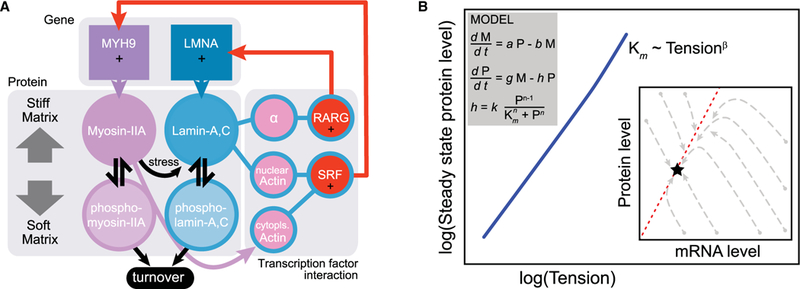
Structural links from the nucleus to the cytoskeleton and to the extracellular environment play a role in direct mechanosensing by nuclear factors. Here, we highlight recent studies that illustrate nuclear mechanosensation processes ranging from DNA repair and nuclear protein phospho-modulation to chromatin reorganization, lipase activation by dilation, and reversible rupture with the release of nuclear factors. Recent progresses demonstrate that these mechanosensing processes lead to modulation of gene expression such as those involved in the regulation of cytoskeletal programs and introduce copy number variations. The nuclear lamina protein lamin A has a recurring role, and various biophysical analyses prove helpful in clarifying mechanisms. The various recent observations provide further motivation to understand the regulation of nuclear mechanosensing pathways in both physiological and pathological contexts.
从细胞核到细胞骨架以及细胞外环境的结构连接在核因子的直接机械传感中发挥作用。在此,我们重点介绍最近的研究,这些研究阐述了从DNA修复、核蛋白磷酸化调节到染色质重组、通过扩张激活脂肪酶以及伴随核因子释放的可逆破裂等核机械传感过程。最近的进展表明,这些机械传感过程会导致基因表达的调节,例如参与细胞骨架程序调控的基因表达,并引发拷贝数变异。核纤层蛋白A发挥着反复出现的作用,各种生物物理分析有助于阐明其机制。最近的各种观察结果为在生理和病理背景下理解核机械传感途径的调控提供了进一步的动力。