University of Agder, Faculty of Health and Sport Sciences, Post-box 422, 4604, Kristiansand, Norway.
Sørlandet Hospital, Addiction Unit, Post-box 416, 4604, Kristiansand, Norway.
Subst Abuse Treat Prev Policy. 2019 Nov 6;14(1):47. doi: 10.1186/s13011-019-0237-y.
Health care workers in the addiction field have long emphasised the importance of a patient's motivation on the outcome of treatments for substance use disorders (SUDs). Many patients entering treatment are not yet ready to make the changes required for recovery and are often unprepared or sometimes unwilling to modify their behaviour. The present study compared stages of readiness to change and readiness to seek help among patients with SUDs involuntarily and voluntarily admitted to treatment to investigate whether changes in the stages of readiness at admission predict drug control outcomes at follow-up.
This prospective study included 65 involuntarily and 137 voluntarily admitted patients treated in three addiction centres in Southern Norway. Patients were evaluated using the Europ-ASI, Readiness to Change Questionnaire (RTCQ), and Treatment Readiness Tool (TReaT).
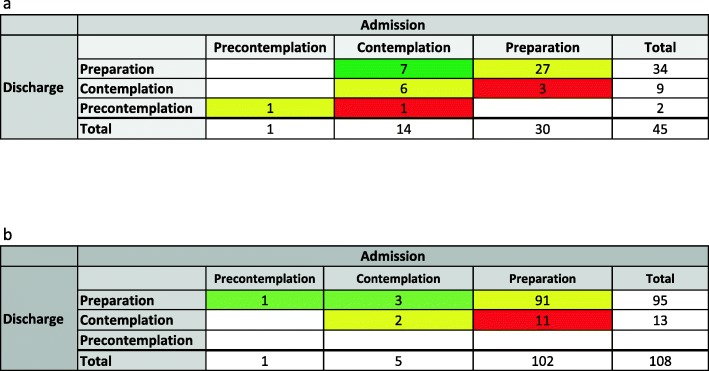
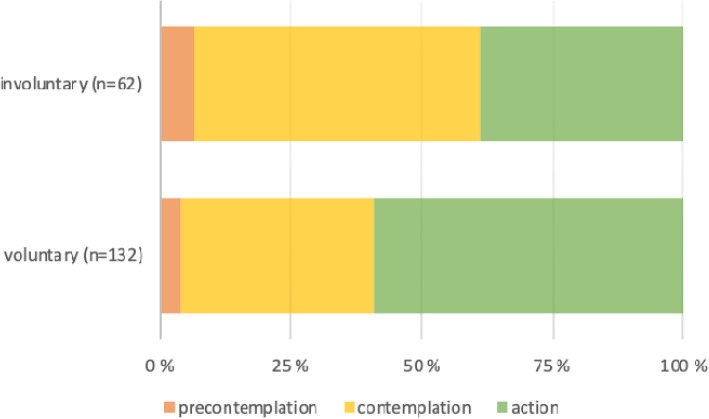
The involuntarily admitted patients had significantly lower levels of motivation to change than the voluntarily admitted patients at the time of admission (39% vs. 59%). The majority of both involuntarily and voluntarily admitted patients were in the highest stage (preparation) for readiness to seek help at admission and continued to be in this stage at discharge. The stage of readiness to change at admission did not predict abstinence at follow-up. The only significant predictor of ongoing drug use at 6 months was SUD severity at baseline.
The majority of involuntarily admitted patients scored high on motivation to seek help. Their motivation was stable at a fairly high level during their stay, and even improved in some patients. Thus, they were approaching the motivation stage similar to the voluntarily admitted patients at the end of hospitalization. Therapists should focus on both motivating patients in treatment and adapting the treatment according to SUD severity.
ClinicalTrials.gov, NCT00970372. Registered 1 September 2008, https://clinicaltrials.gov/ct2/show/NCT00970372. The trial was registered before the first participant was enrolled. The fist participant was enrolled September 02, 2009.
长期以来,成瘾领域的医疗保健工作者一直强调患者对物质使用障碍(SUD)治疗结果的动机的重要性。许多接受治疗的患者尚未准备好做出恢复所需的改变,并且通常准备不足或有时不愿意改变自己的行为。本研究比较了自愿和非自愿接受治疗的 SUD 患者在改变阶段和寻求帮助的准备阶段,以调查入院时的准备阶段变化是否预测随访时的药物控制结果。
这项前瞻性研究包括在挪威南部的三个成瘾中心治疗的 65 名非自愿和 137 名自愿入院的患者。使用 Europ-ASI、改变意愿问卷(RTCQ)和治疗准备工具(TReaT)对患者进行评估。
非自愿入院的患者在入院时的改变意愿明显低于自愿入院的患者(39%比 59%)。大多数非自愿和自愿入院的患者在入院时的寻求帮助准备阶段处于最高阶段(准备),并且在出院时仍处于该阶段。入院时的改变意愿阶段并不能预测随访时的戒断。6 个月时持续药物使用的唯一显著预测因素是基线时的 SUD 严重程度。
大多数非自愿入院的患者在寻求帮助的动机方面得分较高。他们的动机在住院期间保持在相当高的稳定水平,有些患者甚至有所提高。因此,他们在住院结束时接近与自愿入院患者相似的动机阶段。治疗师应注重在治疗中激励患者并根据 SUD 严重程度调整治疗。
ClinicalTrials.gov,NCT00970372。2008 年 9 月 1 日注册,https://clinicaltrials.gov/ct2/show/NCT00970372。试验在第一个参与者入组前注册。第一个参与者于 2009 年 9 月 2 日入组。