Danish Ramazzini Centre, Department of Occupational Medicine, University Research Clinic, Regional Hospital West Jutland, Gl. Landevej 61, 7400, Herning, Denmark.
Institute of Clinical Research, Department of Obstetrics & Gynecology, University of Southern Denmark, Odense University Hospital, Odense, Denmark.
BMC Public Health. 2019 Nov 7;19(1):1475. doi: 10.1186/s12889-019-7699-8.
Chronic stress in childhood may increase the risk of overweight and obesity in young people. Erik Hemmingsson has suggested a new obesity causation model which focuses on psychosocial stress. The aim was to examine the associations between socioeconomic disadvantage and overweight and obesity and examine if these associations attenuate, when the effect of the different domains from Eric Hemmingsson's obesity causation model were taken into account.
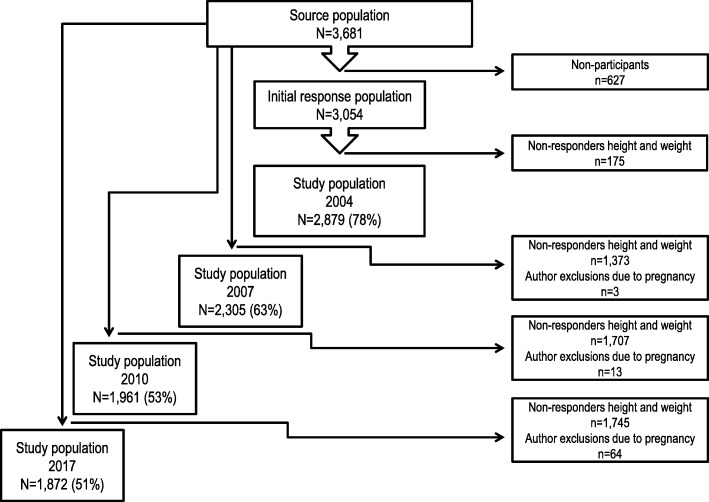
A longitudinal study using data from The West Jutland Cohort Study (N = 2879). Outcome was overweight and obesity combined derived from self-reported weight and height at age 15, 18, 21 and 28 years. Exposure variables were equivalised household income, educational level and labour market participation of the mother derived from registers and psychosocial variables derived from questionnaires. A three-step adjustment model using logistic regression and stratified by gender was applied.
Mother's low educational level was associated with a 3-fold increased odds of obesity in 18 year-old-girls, which attenuated when adjusting for the domains adult distress, disharmonious family environment and offspring distress. In 28 year-old girls, a 2.5-fold increased odds of obesity was observed, which attenuated when mutual adjusted for other socioeconomic variables and attenuated even further when adjusting for all the domains. In 18-year-old boys, a 3-fold increased odds of obesity was observed which attenuated after adjustments for adult distress, disharmonious family environment and offspring distress. In 21-year old boys, a four-fold increased odds of obesity was observed that attenuated after adjustments. At age 28 years, a three-fold increased odds of obesity was observed, which vanished in the fully adjusted model.
Our study confirms to some extent that the associations between socioeconomic disadvantage and overweight and obesity can be explained by the domains included in Erik Hemmingsson's model, although our results should be interpreted with caution. Adult distress, disharmonious family environment and offspring distress accounted for some of the association in girls, whereas in boys it was primarily offspring distress, which had the greatest impact. Young people's educational attainment can act as a buffer in the relationship between mother's lower educational level and obesity at age 28 years.
儿童期的慢性压力可能会增加年轻人超重和肥胖的风险。Erik Hemmingsson 提出了一种新的肥胖病因模型,该模型侧重于社会心理压力。本研究旨在探讨社会经济劣势与超重和肥胖之间的关联,并检验在考虑 Erik Hemmingsson 的肥胖病因模型的不同领域的影响时,这些关联是否会减弱。
这是一项使用来自 West Jutland 队列研究(N=2879)的数据进行的纵向研究。结果是超重和肥胖的综合指标,来自于 15、18、21 和 28 岁时的自我报告体重和身高。暴露变量是母亲的家庭收入、教育程度和劳动力市场参与度,这些数据来自登记处,社会心理变量则来自问卷。使用逻辑回归和按性别分层的三步调整模型进行分析。
母亲的低教育水平与 18 岁女孩肥胖的风险增加 3 倍有关,当调整成成年人的痛苦、不和谐的家庭环境和子女的痛苦等领域时,这种关联会减弱。在 28 岁的女孩中,观察到肥胖的风险增加了 2.5 倍,当相互调整其他社会经济变量和所有领域时,这种关联会减弱。在 18 岁的男孩中,观察到肥胖的风险增加了 3 倍,当调整成成年人的痛苦、不和谐的家庭环境和子女的痛苦等领域时,这种关联会减弱。在 21 岁的男孩中,观察到肥胖的风险增加了 4 倍,当调整后这种关联减弱了。在 28 岁时,观察到肥胖的风险增加了 3 倍,但在完全调整的模型中这种关联消失了。
我们的研究在一定程度上证实,社会经济劣势与超重和肥胖之间的关联可以用 Erik Hemmingsson 模型中的领域来解释,尽管我们的结果应该谨慎解释。在女孩中,成年人的痛苦、不和谐的家庭环境和子女的痛苦解释了部分关联,而在男孩中,影响最大的是子女的痛苦。年轻人的教育程度可以作为母亲教育程度较低与 28 岁时肥胖之间关系的缓冲。