Zhang Ning, Zhu Wen-Ling, Liu Xiao-Hong, Chen Wei, Zhu Ming-Lei, Kang Lin, Tian Ran
Department of Geriatrics, Peking Union Medical College Hospital, Beijing, China.
Department of Cardiology, Peking Union Medical College Hospital, Beijing, China.
J Geriatr Cardiol. 2019 Oct;16(10):756-763. doi: 10.11909/j.issn.1671-5411.2019.10.002.
Sarcopenia is a progressive and generalized skeletal muscle disorder that is associated with an increased likelihood of adverse outcomes, including falls, fractures, physical disability, and mortality. However, there have been few systematic studies of the prevalence and prognostic values of sarcopenia in older patients with coronary heart disease (CHD). This study aimed to investigate the prevalence of sarcopenia in hospitalized older patients with CHD, and to prospectively evaluate the effect of sarcopenia on the short-term prognosis of these patients.
Patients aged ≥ 65 years, with the diagnosis of CHD from Peking Union Medical College Hospital between December 2017 and November 2018, were included. Sarcopenia was diagnosed according to consensus of the Asian Working Group for Sarcopenia in 2014. Follow-up items included unscheduled return visits, occurrence of major adverse cardiac and cerebral events (MACCE), and all-cause mortality. The MACCE-free survival curve of sarcopenic and non-sarcopenic older patients with CHD was estimated by the Kaplan-Meier method. Cox regression analysis was used to analyze the association between sarcopenia and an unscheduled return visits, MACCE, and all-cause mortality.
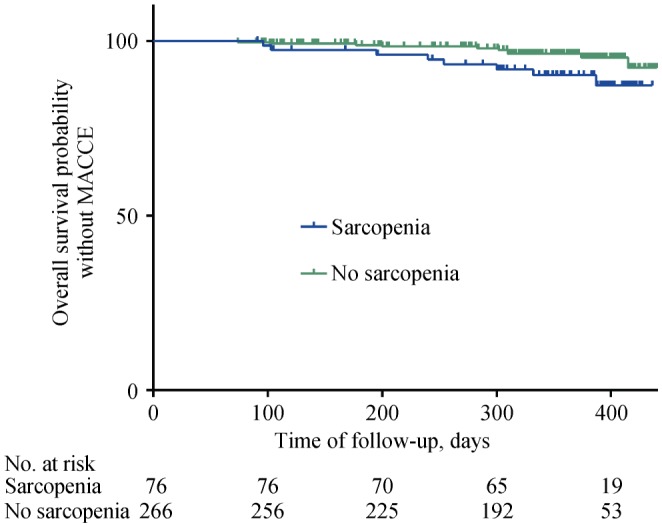
A total of 345 older patients with CHD were enrolled in the study, with a median age of 74 years. Among the patients, 78 (22.6%) were diagnosed with sarcopenia. During the follow-up time, there were significantly more unscheduled return visits in sarcopenic patients than in non-sarcopenic patients (34.2% . 21.8%, χ = 4.418, = 0.036), while there was no significant difference in the occurrence of MACCE (χ = 2.869, = 0.09) or all-cause mortality (χ = 1.673, = 0.196) between these patient groups. The Kaplan-Meier curve showed that the MACCE-free survival time of sarcopenic patients was significantly shorter than that in non-sarcopenic patients (χ = 4.102, = 0.043). After adjusting for sex, age, and the Charlson comorbidity index, sarcopenia was not an independent risk factor of unscheduled return visits (HR = 1.002, 95% CI: 0.556-1.807). However, the complication of anxiety and depression was an independent risk factor (HR = 1.876, 95% CI: 1.012-3.477, = 0.046) for unscheduled return visits in older patients with CHD.
There is a high prevalence of sarcopenia among hospitalized older adults with CHD. A shorter MACCE-free survival time and more unscheduled return visits are found in sarcopenic older patients with CHD. Clinicians should pay more attention to the functional status of older patients with CHD, as well as identification and management of geriatric syndromes.
肌肉减少症是一种进行性全身性骨骼肌疾病,与包括跌倒、骨折、身体残疾和死亡在内的不良后果发生风险增加相关。然而,关于老年冠心病(CHD)患者肌肉减少症的患病率及预后价值,鲜有系统性研究。本研究旨在调查住院老年CHD患者中肌肉减少症的患病率,并前瞻性评估肌肉减少症对这些患者短期预后的影响。
纳入2017年12月至2018年11月期间在北京协和医院诊断为CHD的≥65岁患者。根据2014年亚洲肌肉减少症工作组的共识诊断肌肉减少症。随访项目包括非计划复诊、主要心脑血管不良事件(MACCE)的发生情况及全因死亡率。采用Kaplan-Meier法估计肌肉减少症和非肌肉减少症老年CHD患者的无MACCE生存曲线。采用Cox回归分析来分析肌肉减少症与非计划复诊、MACCE及全因死亡率之间的关联。
本研究共纳入345例老年CHD患者,中位年龄为74岁。其中,78例(22.6%)被诊断为肌肉减少症。在随访期间,肌肉减少症患者的非计划复诊次数显著多于非肌肉减少症患者(34.2%对21.8%,χ² = 4.418,P = 0.036),而这些患者组之间MACCE的发生率(χ² = 2.869,P = 0.09)或全因死亡率(χ² = 1.673,P = 0.196)无显著差异。Kaplan-Meier曲线显示,肌肉减少症患者的无MACCE生存时间显著短于非肌肉减少症患者(χ² = 4.102,P = 0.043)。在调整性别、年龄和Charlson合并症指数后,肌肉减少症不是非计划复诊的独立危险因素(HR = 1.002,95%CI:0.556 - 1.807)。然而,焦虑和抑郁并发症是老年CHD患者非计划复诊的独立危险因素(HR = 1.876,95%CI:1.012 - 3.477,P = 0.046)。
住院老年CHD患者中肌肉减少症的患病率较高。肌肉减少症老年CHD患者的无MACCE生存时间较短且非计划复诊次数较多。临床医生应更加关注老年CHD患者的功能状态,以及老年综合征的识别和管理。