King Abdullah University of Science and Technology (KAUST), Biological and Environmental Science and Engineering Division, Advanced Membrane and Porous Materials Center, 23955-6900 Thuwal, Saudi Arabia.
King Abdullah University of Science and Technology (KAUST), Advanced Membranes and Porous Materials Center, Thuwal 23955-6900, Saudi Arabia.
Sci Adv. 2019 Nov 1;5(11):eaax6976. doi: 10.1126/sciadv.aax6976. eCollection 2019 Nov.
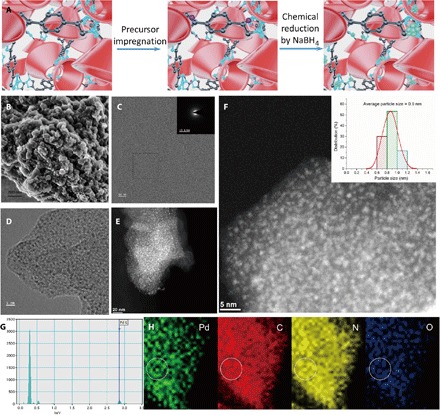
The synthesis of support materials with suitable coordination sites and confined structures for the controlled growth of ultrasmall metal nanoparticles is of great importance in heterogeneous catalysis. Here, by rational design of a cross-linked β-cyclodextrin polymer network (CPN), various metal nanoparticles (palladium, silver, platinum, gold, and rhodium) of subnanometer size (<1 nm) and narrow size distribution are formed via a mild and facile procedure. The presence of the metal coordination sites and the network structure are key to the successful synthesis and stabilization of the ultrasmall metal nanoparticles. The as-prepared CPN, loaded with palladium nanoparticles, is used as a heterogeneous catalyst and shows outstanding catalytic performance in the hydrogenation of nitro compounds and Suzuki-Miyaura coupling reaction under mild conditions. The CPN support works synergistically with the metal nanoparticles, achieving high catalytic activity and selectivity. In addition, the catalytic activity of the formed catalyst is controllable.
在多相催化中,具有合适配位位点和受限结构的支撑材料的合成对于超小金属纳米粒子的可控生长非常重要。在这里,通过交联 β-环糊精聚合物网络(CPN)的合理设计,通过温和简便的方法形成了各种亚纳米尺寸(<1nm)和窄尺寸分布的金属纳米粒子(钯、银、铂、金和铑)。金属配位位点和网络结构的存在是成功合成和稳定超小金属纳米粒子的关键。所制备的负载钯纳米粒子的 CPN 作为多相催化剂,在温和条件下用于硝基化合物的加氢和 Suzuki-Miyaura 偶联反应,表现出优异的催化性能。CPN 载体与金属纳米粒子协同作用,实现了高催化活性和选择性。此外,形成的催化剂的催化活性是可控的。