Black Dennis D, Mack Cara, Kerkar Nanda, Miloh Tamir, Sundaram Shikha S, Anand Ravinder, Gupta Ashutosh, Alonso Estella, Arnon Ronen, Bulut Pinar, Karpen Saul, Lin Chuan-Hao, Rosenthal Philip, Ryan Matthew, Squires Robert H, Valentino Pamela, Elsea Sarah H, Shneider Benjamin L
Pediatrics University of Tennessee Health Science Center Memphis TN.
Pediatrics University of Colorado School of Medicine Aurora CO.
Hepatol Commun. 2019 Aug 29;3(11):1482-1495. doi: 10.1002/hep4.1421. eCollection 2019 Nov.
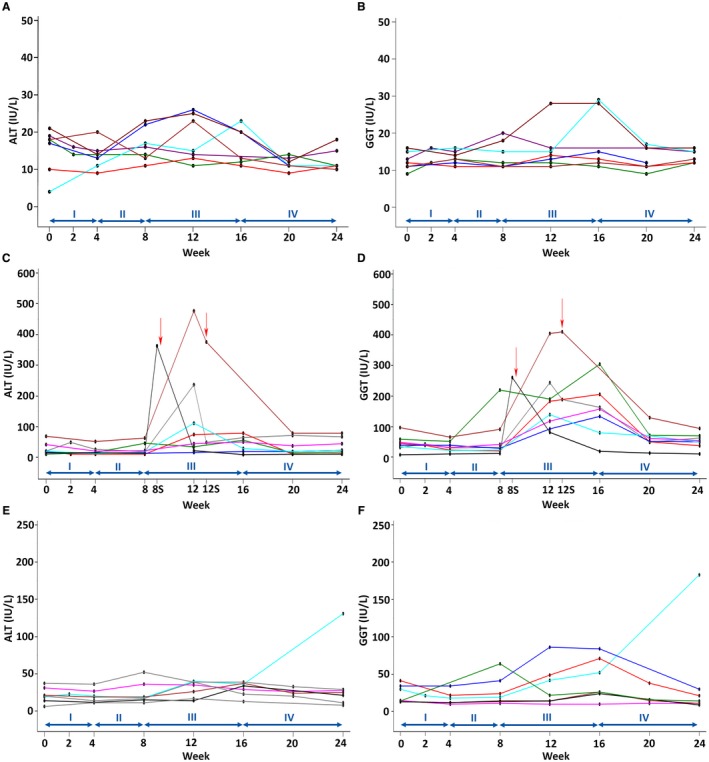
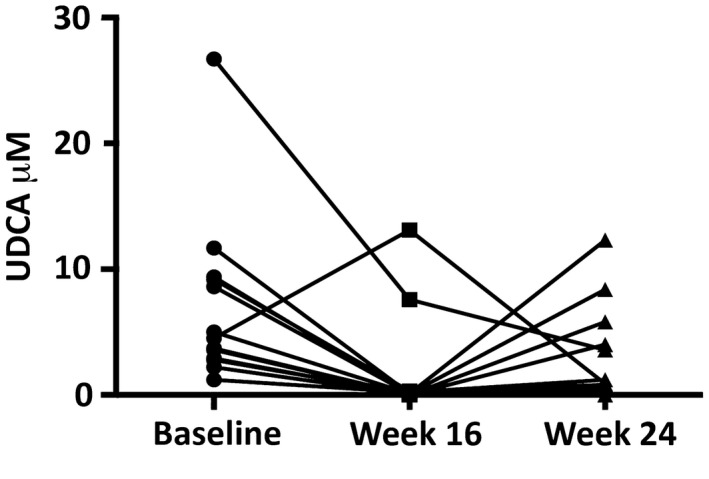
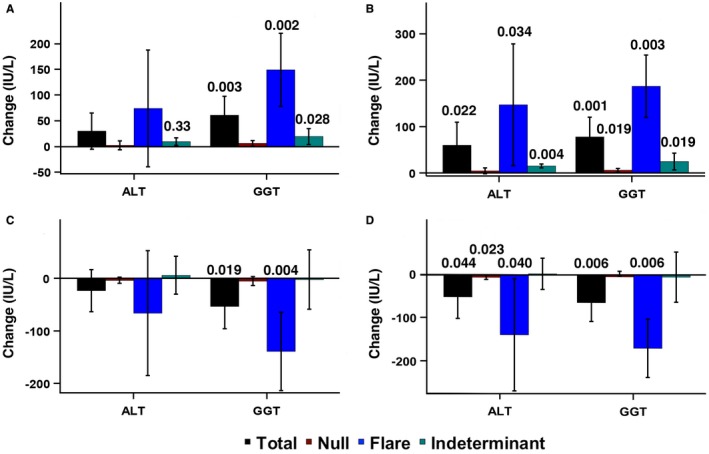
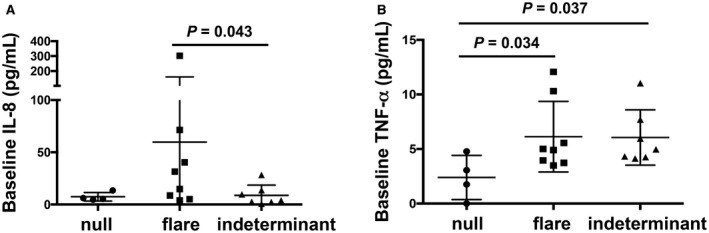
Ursodeoxycholic acid (UDCA) is commonly used to treat several liver disorders in adults and children, including primary sclerosing cholangitis (PSC) for which it is not U.S. Food and Drug Administration approved. UDCA treatment has an uncertain impact on disease outcomes and has been reported in high doses to be associated with worse outcome in adults with PSC. In this context, controlled withdrawal and reintroduction of UDCA in children with PSC were studied. Prior to study initiation, participants were required to have alanine aminotransferase (ALT) and gamma-glutamyl transpeptidase (GGT) <2 times the upper limit of normal on stable UDCA dosing. The study included four phases: I (stable dosing), II (50% UDCA reduction), III (UDCA discontinuation), IV (UDCA reintroduction), with a primary endpoint of change in ALT and GGT between phases I and III. We enrolled 27 participants (22 completed) between March 2011 and June 2016. Changes in mean ALT and GGT between phases I and III were ALT, +29.5 IU/L ( = 0.105) and GGT, +60.4 IU/L ( = 0.003). In 7 participants, ALT and GGT ≤29 IU/L did not rise above 29 IU/L (null response group). Eight participants had increases of ALT or GGT >100 IU/L (flare group). None developed elevated bilirubin. All flares responded to UDCA reinstitution. Serum GGT, interleukin-8, and tumor necrosis factor α levels were higher in the flare group at baseline. Liver biochemistries increased in children with PSC during controlled UDCA withdrawal; one third increased above 100 IU/L and one third remained normal during UDCA withdrawal. : The impact of prolonged UDCA use in childhood PSC and the significance of a biochemical flare are unclear. Further studies of the natural history and treatment of pediatric PSC and UDCA use are needed.
熊去氧胆酸(UDCA)常用于治疗成人和儿童的多种肝脏疾病,包括原发性硬化性胆管炎(PSC),尽管美国食品药品监督管理局未批准其用于该疾病。UDCA治疗对疾病转归的影响尚不明确,且有报道称高剂量使用UDCA与PSC成人患者的更差转归相关。在此背景下,研究了对PSC儿童患者进行UDCA的对照撤药和重新用药情况。在研究开始前,要求参与者在稳定的UDCA给药方案下,丙氨酸氨基转移酶(ALT)和γ-谷氨酰转肽酶(GGT)低于正常上限的2倍。该研究包括四个阶段:I期(稳定给药)、II期(UDCA剂量减少50%)、III期(停用UDCA)、IV期(重新引入UDCA),主要终点为I期和III期之间ALT和GGT的变化。我们在2011年3月至2016年6月期间招募了27名参与者(22名完成研究)。I期和III期之间平均ALT和GGT的变化分别为:ALT升高29.5 IU/L(P = 0.105),GGT升高60.4 IU/L(P = 0.003)。7名参与者的ALT和GGT≤29 IU/L未升高超过29 IU/L(无反应组)。8名参与者的ALT或GGT升高>100 IU/L(发作组)。无人出现胆红素升高。所有发作对重新引入UDCA均有反应。发作组基线时血清GGT、白细胞介素-8和肿瘤坏死因子α水平较高。在对照性UDCA撤药期间,PSC儿童患者的肝脏生化指标升高;三分之一升高超过100 IU/L,三分之一在UDCA撤药期间保持正常。:儿童PSC长期使用UDCA的影响以及生化发作的意义尚不清楚。需要对儿童PSC的自然病史、治疗及UDCA的使用进行进一步研究。