Department of Surgery and Department of Clinical and Experimental Medicine (IKE), Linköping University, 58183, Linköping, Sweden.
Department of Endocrine Surgery, Third Chair of Surgery, Jagiellonian University Medical College, 37 Prądnicka Street, 31-202, Kraków, Poland.
Langenbecks Arch Surg. 2019 Dec;404(8):929-944. doi: 10.1007/s00423-019-01828-4. Epub 2019 Nov 7.
BACKGROUND/PURPOSE: In Europe, the Division of Endocrine Surgery (DES) determines the number of operations (thyroid, neck dissection, parathyroids, adrenals, neuroendocrine tumors of the gastro-entero-pancreatic tract (GEP-NETs)) to be required for the European Board of Surgery Qualification in (neck) endocrine surgery. However, it is the national surgical boards that determine how surgical training is delivered in their respective countries. There is a lack of knowledge on the current situation concerning the training of surgical residents and fellows with regard to (neck) endocrine surgery in Europe.
A survey was sent out to all 28 current national delegates of the DES. One questionnaire was addressing the training of surgical residents while the other was addressing the training of fellows in endocrine surgery. Particular focus was put on the numbers of operations considered appropriate.
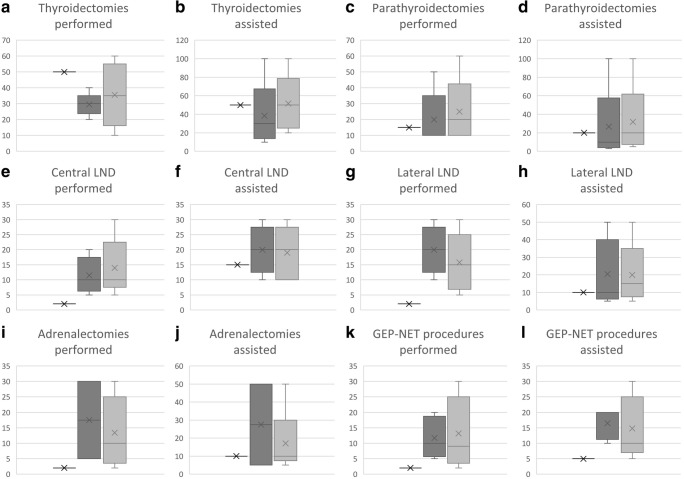
For most of the operations, the overall number as defined by national surgical boards matched quite well the views of the national delegates even though differences exist between countries. In addition, the current numbers required for the EBSQ exam are well within this range for thyroid and parathyroid procedures but below for neck dissections as well as operations on the adrenals and GEP-NETs.
Training in endocrine surgery should be performed in units that perform a minimum of 100 thyroid, 50 parathyroid, 15 adrenal, and/or 10 GEP-NET operations yearly. Fellows should be expected to have been the performing surgeon of a minimum of 50 thyroid operations, 10 (central or lateral) lymph node dissections, 15 parathyroid, 5 adrenal, and 5 GEP-NET operations.
背景/目的:在欧洲,内分泌外科分部(DES)决定了外科资格认证中(颈部)内分泌手术所需的操作数量(甲状腺、颈部清扫术、甲状旁腺、肾上腺、胃肠胰腺神经内分泌肿瘤(GEP-NETs))。然而,决定各自国家外科培训如何实施的是国家外科委员会。对于欧洲(颈部)内分泌外科的外科住院医师和研究员培训的现状,人们知之甚少。
向所有 28 名现任 DES 国家代表发送了一份调查。一份问卷针对外科住院医师培训,另一份针对内分泌外科研究员培训。特别关注的是认为合适的操作数量。
对于大多数手术,国家外科委员会定义的总体数量与国家代表的观点非常吻合,尽管各国之间存在差异。此外,EBSQ 考试目前所需的数量在甲状腺和甲状旁腺手术的范围内,但在颈部清扫术以及肾上腺和 GEP-NET 手术方面则低于这个范围。
内分泌外科培训应在每年至少进行 100 例甲状腺、50 例甲状旁腺、15 例肾上腺和/或 10 例 GEP-NET 手术的单位中进行。应期望研究员至少进行过 50 例甲状腺手术、10 例(中央或侧方)淋巴结清扫术、15 例甲状旁腺手术、5 例肾上腺手术和 5 例 GEP-NET 手术。