Laboratory of Neurogenetics, National Institute on Alcohol Abuse and Alcoholism, National Institutes of Health, Rockville, Maryland.
Department of Biological Sciences, Seton Hall University, South Orange, New Jersey.
JAMA Netw Open. 2019 Nov 1;2(11):e1914940. doi: 10.1001/jamanetworkopen.2019.14940.
The association between the D2 dopamine receptor gene (DRD2) Taq1A locus (rs1800497) and alcohol use disorder (AUD) is enduring but the subject of long-standing controversy; meta-analysis of studies across 3 decades shows an association between rs1800497 and AUD, but genome-wide analyses have detected no role for rs1800497 in any phenotype. No evidence has emerged that rs1800497, which is located in ANKK1, perturbs the expression or function of DRD2.
To resolve contradictions in previous studies by identifying hidden confounders and assaying for functional effects of rs1800497 and other loci in the DRD2 region.
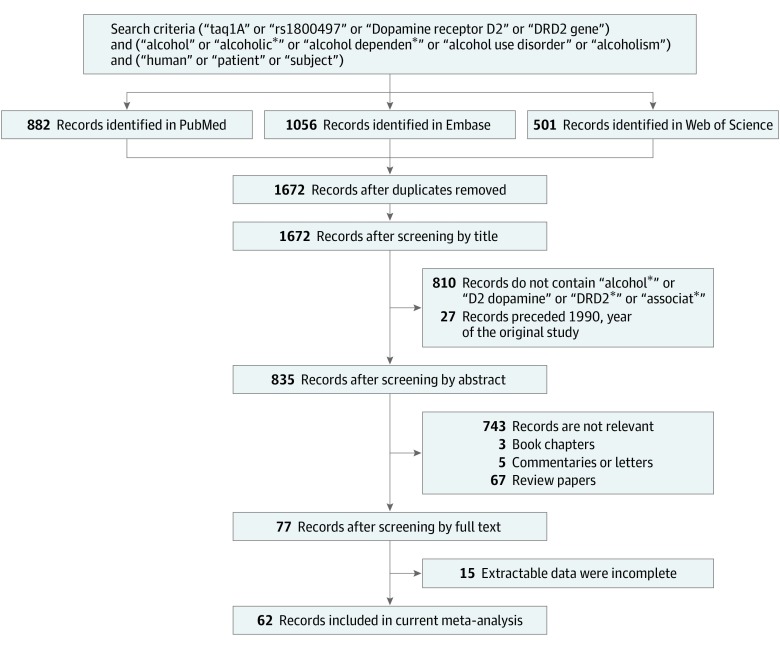
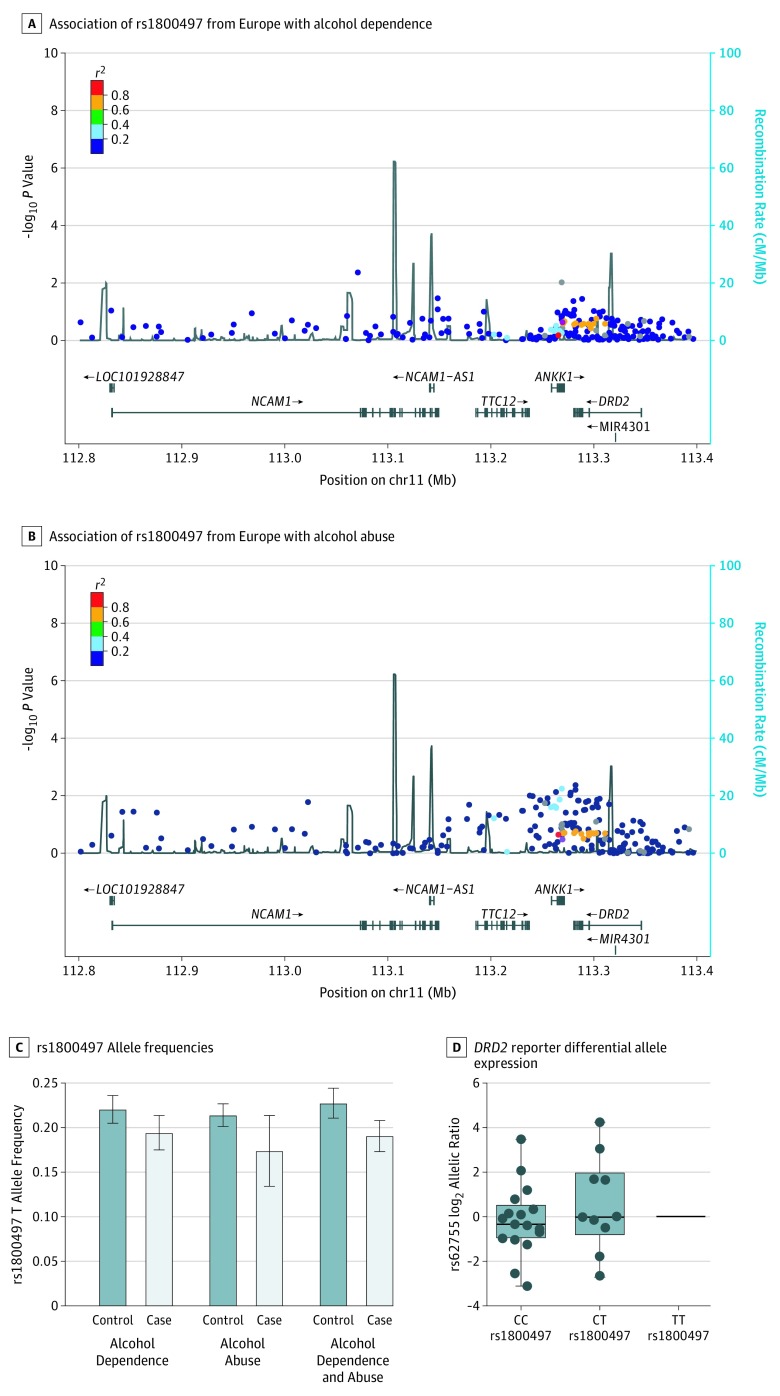
PubMed (882 studies), Embase (1056 studies), and Web of Science (501 studies) databases were searched through August 2018. Three clinical populations-Finnish, Native American, and African American participants-were genotyped for 208 to 277 informative single-nucleotide polymorphisms (SNPs) across the DRD2 region to test the associations of SNPs in this region with AUD.
Eligible studies had diagnosis of AUD made by accepted criteria, reliable genotyping methods, sufficient genotype data to calculate odds ratios and 95% CIs, and availability of control allele frequencies or genotype frequencies.
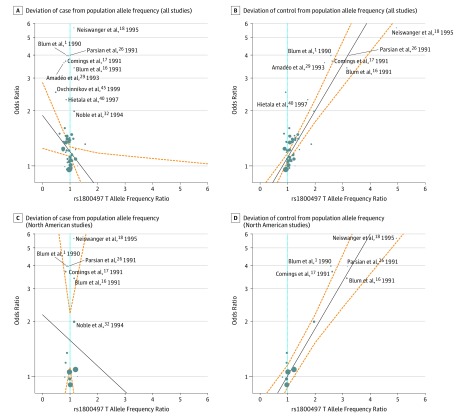
After meta-analysis of 62 studies, metaregression was performed to detect between-study heterogeneity and to explore the effects of moderators, including deviations of cases and controls from allele frequencies in large population databases (ExAC and 1000 Genomes). Linkage to AUD and the effect on gene expression of rs1800497 were evaluated in the context of other SNPs in the DRD2 region. Data analysis was performed from August 2018 to March 2019. This study follows the Preferred Reporting Items for Systematic Reviews and Meta-analyses reporting guideline.
The effects of rs1800497 and other SNPs in the DRD2 region on gene expression were measured in human postmortem brain samples via differential allelic expression and evaluated in other tissues via publicly available expression quantitative locus data.
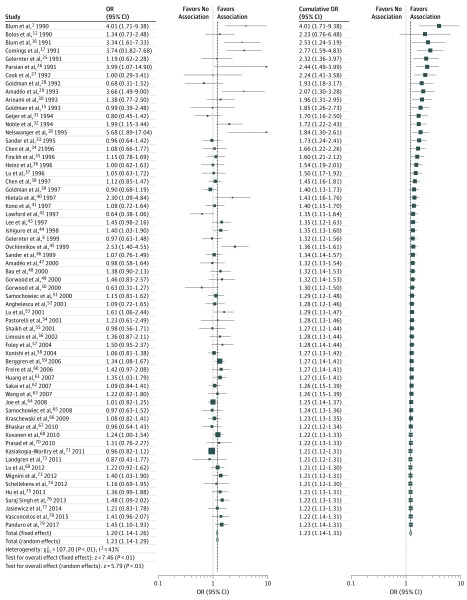
A total of 62 studies of DRD2 and AUD with 16 294 participants were meta-analyzed. The rs1800497 SNP was associated with AUD (odds ratio, 1.23; 95% CI, 1.14-1.31; P < .001). However, the association was attributable to spuriously low allele frequencies in controls in positive studies, which also accounted for some between-study heterogeneity (I2 = 43%; 95% CI, 23%-58%; Q61 = 107.20). Differential allelic expression of human postmortem brain and analysis of expression quantitative loci in public data revealed that a cis-acting locus or loci perturb the DRD2 transcript level; however, rs1800497 does not and is not in strong disequilibrium with such a locus. Across the DRD2 region, other SNPs are more strongly associated with AUD than rs1800497, although no DRD2 SNP was significantly associated in these 3 clinical samples.
In this meta-analysis, the significant association of DRD2 with AUD was reassessed. The DRD2 association was attributable to anomalously low control allele frequencies, not function, in positive studies. For genetic studies, statistical replication is not verification.
多巴胺 D2 受体基因(DRD2)Taq1A 基因座(rs1800497)与酒精使用障碍(AUD)之间的关联是持久的,但也是长期争议的主题;对 30 年来的研究进行荟萃分析显示,rs1800497 与 AUD 之间存在关联,但全基因组分析并未发现 rs1800497 在任何表型中发挥作用。没有证据表明位于 ANKK1 中的 rs1800497 会干扰 DRD2 的表达或功能。
通过确定隐藏的混杂因素并检测 rs1800497 及 DRD2 区域内其他基因座的功能效应,解决先前研究中的矛盾。
通过 2018 年 8 月检索 PubMed(882 项研究)、Embase(1056 项研究)和 Web of Science(501 项研究)数据库,对来自芬兰、美洲原住民和非裔美国人的三个临床人群进行 208 至 277 个信息单核苷酸多态性(SNP)的基因分型,以检测该区域内的 SNP 与 AUD 的关联。
符合条件的研究有 AUD 通过公认的标准诊断、可靠的基因分型方法、有足够的基因型数据来计算优势比和 95%CI,以及控制等位基因频率或基因型频率的可用性。
在对 62 项研究进行荟萃分析后,进行了荟萃回归分析,以检测研究间的异质性,并探索了包括病例和对照偏离大人群数据库(ExAC 和 1000 基因组)中等位基因频率的偏差等调节因素的影响。在 DRD2 区域内其他 SNP 的背景下评估了 rs1800497 与 AUD 的关联及其对基因表达的影响。数据分析于 2018 年 8 月至 2019 年 3 月进行。本研究遵循系统评价和荟萃分析报告的首选报告项目准则。
通过差异等位基因表达测量人类死后大脑样本中 rs1800497 和 DRD2 区域内其他 SNP 对基因表达的影响,并通过公共可用的表达定量基因座数据在其他组织中进行评估。
荟萃分析了 62 项关于 DRD2 和 AUD 的研究,共有 16294 名参与者。rs1800497 SNP 与 AUD 相关(优势比,1.23;95%CI,1.14-1.31;P<0.001)。然而,这种关联归因于阳性研究中对照的等位基因频率异常低,这也解释了一些研究间的异质性(I2=43%;95%CI,23%-58%;Q61=107.20)。对人类死后大脑的差异等位基因表达和公共数据中的表达定量基因座分析显示,顺式作用基因座或基因座扰乱了 DRD2 转录水平;然而,rs1800497 不会,也与这样的基因座没有强不平衡。在整个 DRD2 区域内,其他 SNP 与 AUD 的关联比 rs1800497 更强,尽管在这 3 个临床样本中没有任何 DRD2 SNP 显著相关。
在这项荟萃分析中,重新评估了 DRD2 与 AUD 的显著关联。DRD2 相关性归因于阳性研究中对照的等位基因频率异常低,而不是功能。对于遗传研究,统计复制并不是验证。