RTI International, Center for Global Health, Durham, NC, United States of America.
FHI 360, Global Health Population and Nutrition, Durham, NC, United States of America.
PLoS One. 2019 Nov 8;14(11):e0224898. doi: 10.1371/journal.pone.0224898. eCollection 2019.
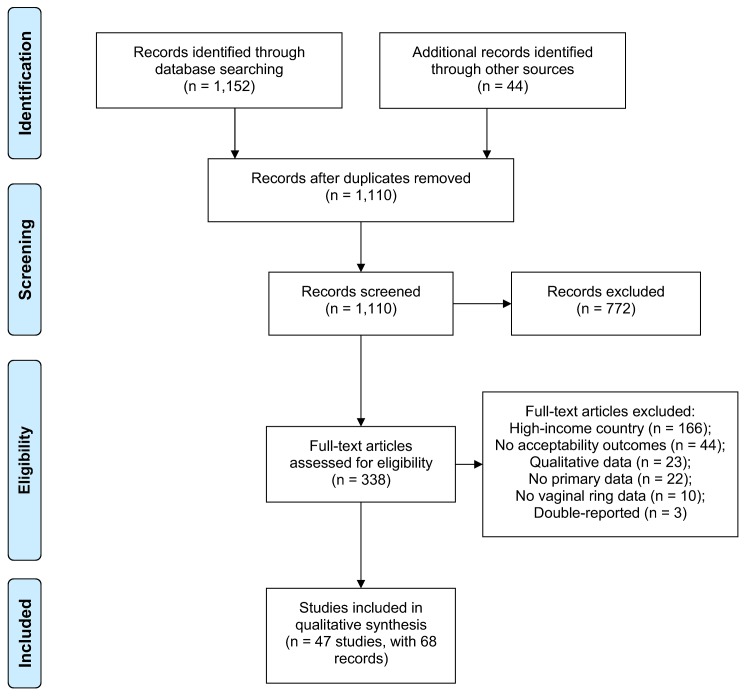
The vaginal ring (VR) is a female-initiated drug-delivery platform used for different indications, including HIV pre-exposure prophylaxis (PrEP). We conducted a systematic review of VR acceptability, values and preferences among women in low- and middle-income countries (LMIC) to inform further investment and/or guidance on VR use for HIV prevention. Following PRISMA guidelines, we used structured methods to search, screen, and extract data from randomized controlled trials (RCTs) and observational studies reporting quantitative outcomes of acceptability of the VR for any indication published 1/1970-2/2019 (PROSPERO: CRD42019122220). Of 1,110 records identified, 68 met inclusion criteria. Studies included women 15-50+ years from 25 LMIC for indications including HIV prevention, contraception, abnormal bleeding, and menopause. Overall VR acceptability was high (71-98% across RCTs; 62-100% across observational studies), with 80-100% continuation rates in RCTs and favorable ease of insertion (greater than 85%) and removal 89-99%). Users reported concerns about the VR getting lost in the body (8-43%), although actual expulsions and adverse events were generally infrequent. Most women disclosed use to partners, with some worrying about partner anger/violence. The VR was not felt during intercourse by 70-92% of users and 48-97% of partners. Acceptability improved over time both within studies (as women gained VR experience and worries diminished), and over chronological time (as the device was popularized). Women expressed preferences for accessible, long-acting, partner-approved methods that prevent both HIV and pregnancy, can be used without partner knowledge, and have no impact on sex and few side effects. This review was limited by a lack of standardization of acceptability measures and study heterogeneity. This systematic review suggests that most LMIC women users have a positive view of the VR that increases with familiarity of use; and, that many would consider the VR an acceptable future delivery device for HIV prevention or other indications.
阴道环(VR)是一种女性启动的药物输送平台,用于多种适应症,包括 HIV 暴露前预防(PrEP)。我们对中低收入国家(LMIC)女性对 VR 的可接受性、价值观和偏好进行了系统评价,为进一步投资和/或指导 VR 用于 HIV 预防提供了信息。根据 PRISMA 指南,我们使用结构化方法,从 1970 年 1 月 1 日至 2019 年 2 月 2 日发表的报告任何适应症 VR 可接受性的随机对照试验(RCT)和观察性研究中搜索、筛选和提取数据(PROSPERO:CRD42019122220)。在确定的 1110 条记录中,有 68 条符合纳入标准。这些研究包括来自 25 个 LMIC 的 15-50 岁以上的女性,适应症包括 HIV 预防、避孕、异常出血和更年期。总体而言,VR 的可接受性很高(RCT 中为 71-98%;观察性研究中为 62-100%),RCT 中的继续使用率为 80-100%,易于插入(大于 85%)和移除 89-99%)。使用者报告了对 VR 在体内丢失的担忧(8-43%),尽管实际的排出和不良事件通常很少见。大多数女性向伴侣透露了使用情况,有些女性担心伴侣会生气/暴力。70-92%的使用者和 48-97%的伴侣在性交过程中感觉不到 VR。在研究中,随着女性获得 VR 经验和担忧减少,以及随着时间的推移(随着设备的普及),可接受性会提高。女性表示更喜欢可获得、长效、伴侣认可、既能预防 HIV 又能预防怀孕、无需伴侣知晓、对性生活无影响且副作用少的方法。本综述受到缺乏可接受性措施标准化和研究异质性的限制。这项系统评价表明,大多数 LMIC 女性使用者对 VR 的看法是积极的,随着使用的熟悉程度增加而增加;并且,许多人会考虑将 VR 作为未来预防 HIV 或其他适应症的可接受的输送装置。