
用于在变化环境下实现频率分析的阶跃径流序列的交叉重建方法。
A Cross-Reconstruction Method for Step-Changed Runoff Series to Implement Frequency Analysis under Changing Environment.
机构信息
School of Environmental Science and Engineering, Chang'an University, Xi'an 710054, China.
Key Laboratory of Subsurface Hydrology and Ecological Effect in Arid Region, Ministry of Education, Chang'an University, Xi'an 710054, China.
出版信息
Int J Environ Res Public Health. 2019 Nov 7;16(22):4345. doi: 10.3390/ijerph16224345.
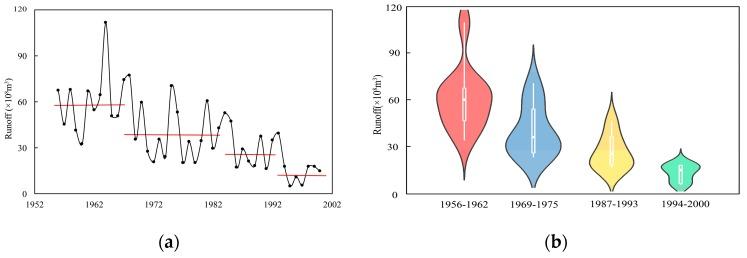
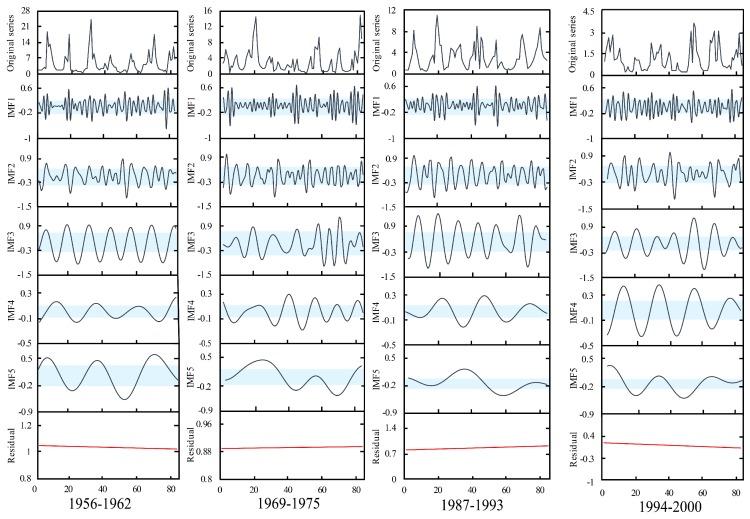
The stationarity of observed hydrological series has been broken or destroyed in many areas worldwide due to changing environments, causing hydrologic designs under stationarity assumption to be questioned and placing designed projects under threat. This paper proposed a data expansion approach-namely, the cross-reconstruction (CR) method-for frequency analysis for a step-changed runoff series combined with the empirical mode decomposition (EMD) method. The purpose is to expand the small data on each step to meet the requirements of data capacity for frequency analysis and to provide more reliable statistics within a stepped runoff series. Taking runoff records at three gauges in western China as examples, the results showed that the cross-reconstruction method has the advantage of data expansion of the small sample runoff data, and the expanded runoff data at steps can meet the data capacity requirements for frequency analysis. In addition, the comparison of the expanded and measured data at steps indicated that the expanded data can demonstrate the statistics closer to the potential data population, rather than just reflecting the measured data. Therefore, it is considered that the CR method ought to be available in frequency analysis for step-changed records, can be used as a tool to construct the hydrological probability distribution under different levels of changing environments (at different steps) through data expansion, and can further assist policy-making in water resources management in the future.
由于环境变化,世界上许多地区的观测水文序列的稳定性已经被打破或破坏,这使得基于平稳性假设的水文设计受到质疑,并使设计项目面临威胁。本文提出了一种数据扩展方法,即交叉重构(CR)方法,用于结合经验模态分解(EMD)方法对阶跃径流量序列进行频率分析。目的是扩展每个阶跃的小数据量,以满足频率分析的数据容量要求,并在阶跃径流量序列中提供更可靠的统计数据。以中国西部三个测站的径流量记录为例,结果表明,交叉重构方法具有扩展小样本径流量数据的优势,扩展后的阶跃径流量数据可以满足频率分析的数据容量要求。此外,对阶跃处扩展和实测数据的比较表明,扩展数据可以更好地反映潜在数据总体的统计特征,而不仅仅是反映实测数据。因此,认为 CR 方法应该可用于阶跃记录的频率分析,可以作为一种工具,通过数据扩展构建不同变化环境(在不同阶跃)下的水文概率分布,并为未来的水资源管理政策制定提供辅助。





 Zotero 插件